What it means
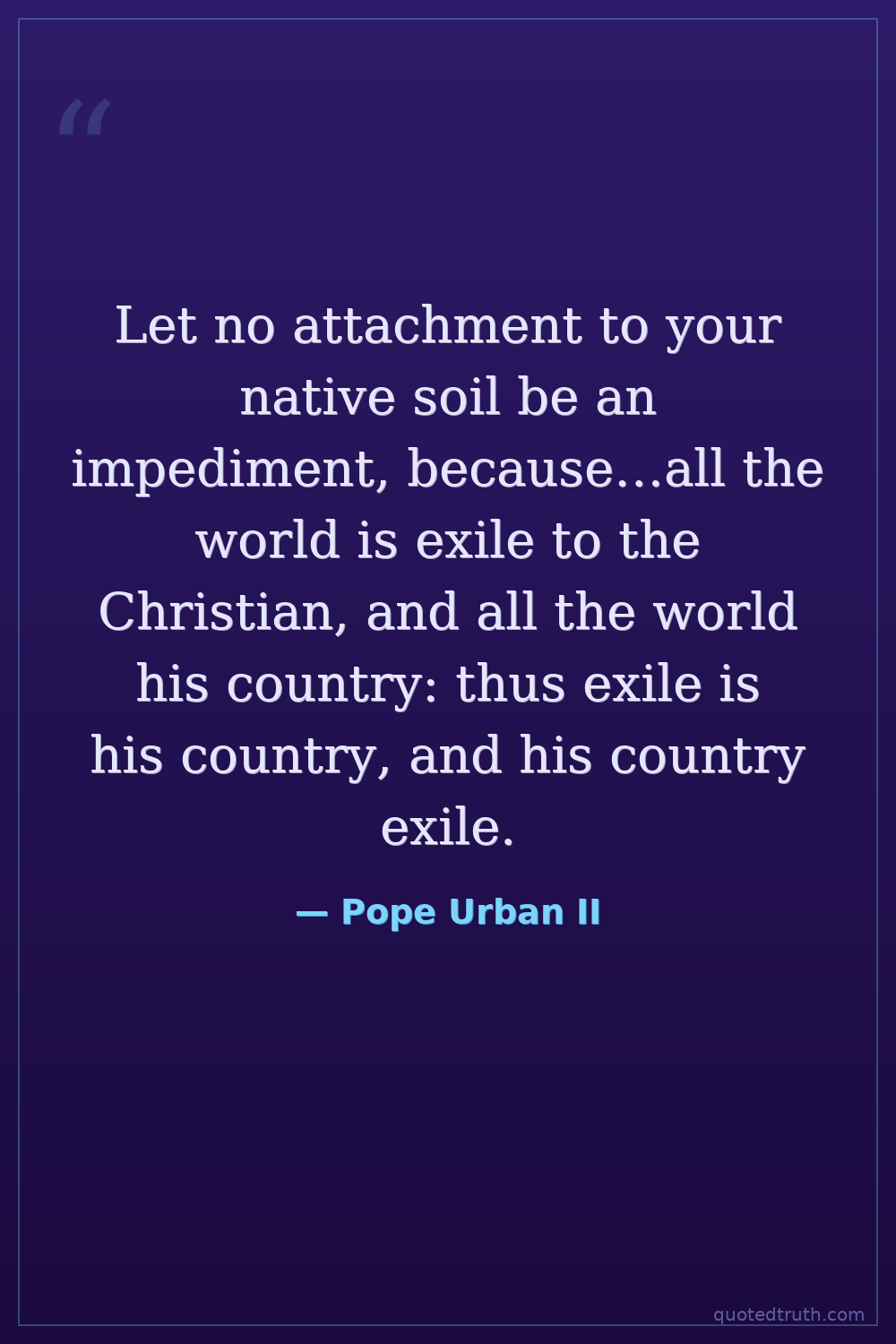
The quote tells Christians not to let love of homeland block a higher calling. Since the faithful belong ultimately to heaven, no earthly place is truly home — every land is equally foreign and equally familiar. The concepts of home and exile collapse into each other. This frees believers from local loyalty, making movement across the earth spiritually natural rather than a painful sacrifice or desertion of duty.
Relevance to Pope Urban II
Urban II spent years in literal exile — expelled from Rome by the antipope Clement III during the Investiture Controversy, he wandered Italy and France. A French Cluniac monk elevated to pope in a foreign city, displacement shaped his entire career. His Clermont speech deployed Augustinian pilgrimage theology with personal conviction: redefining homeland as spiritually irrelevant was both strategic genius and lived truth for a man who had lost his own.
The era
In 1095, European identity was inseparable from land — serfs were legally bound to estates, knights derived authority from hereditary fiefdoms, and leaving one's village was rare and frightening. The Seljuk Turks had seized Jerusalem and crushed Byzantine armies at Manzikert in 1071, cutting off Christian pilgrimage routes. Urban needed thousands to voluntarily uproot and march thousands of miles. Reframing exile as the normal Christian condition made that unprecedented mass migration spiritually coherent.
AI-generated insights based on extensive research and information for context. Factual errors? Email [email protected].