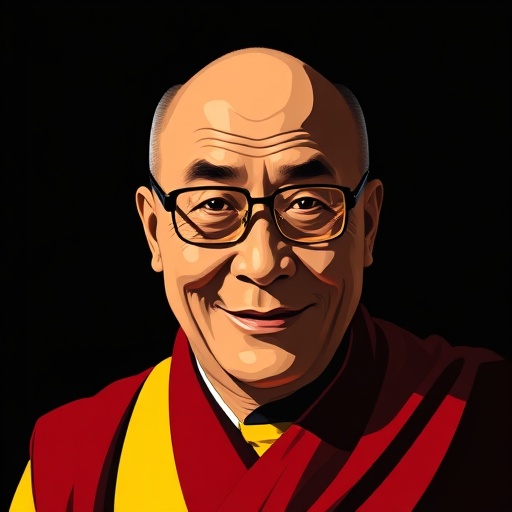
Dalai Lama (14th) — "Sometimes I think I am a Communist."
Sometimes I think I am a Communist.
Sometimes I think I am a Communist.
Click any product to generate a realistic preview. Up to 3 at a time.
* Initial load can take up to 90 seconds — revising the preview in another color is nearly instant.
"I am a monk, but I am also a scientist. I believe that science and spirituality can go hand in hand."
"I have no special talent. I am only passionately curious."
"The more time you spend thinking about yourself, the more suffering you will experience."
"I think the most important thing is to be happy. If you are happy, you can make others happy."
"If you have fear, you don't have peace."
Found in 1 providers: grok
1 source checked
The speaker is saying that when he reflects on economic fairness and concern for the poor, he finds himself aligned with certain communist ideals — specifically the redistribution of wealth and prioritizing the welfare of working people over profit. He is not endorsing political communism or its atheism, but acknowledging that its core economic concern for the disadvantaged resonates with his own values around human equality and compassion.
Tenzin Gyatso has explicitly called himself 'half-Buddhist, half-Marxist,' drawing a sharp line between Marxist economic justice and communist political repression. Having been exiled from Tibet in 1959 by the Chinese Communist Party — a regime that destroyed monasteries and imprisoned monks — his sympathy with Marxist economics despite living under its cruelest application reveals the depth of his commitment to separating ideology from compassion. Buddhist principles demand concern for suffering regardless of its political framing.
The Dalai Lama has made this remark repeatedly since the 1990s through the 2010s, a period of staggering global wealth concentration following the Cold War's end. As unregulated capitalism produced billionaires alongside mass poverty, and the 2008 financial crisis exposed systemic inequality, his statement landed as a deliberate provocation — challenging Western audiences who saw capitalism and spiritual values as natural allies while communism and spirituality were opposites.
AI-generated insights based on extensive research and information for context. Factual errors? Email [email protected].
Your cart is empty