Dalai Lama (14th) — "The more time you spend thinking about yourself, the more suffering you will exp…"
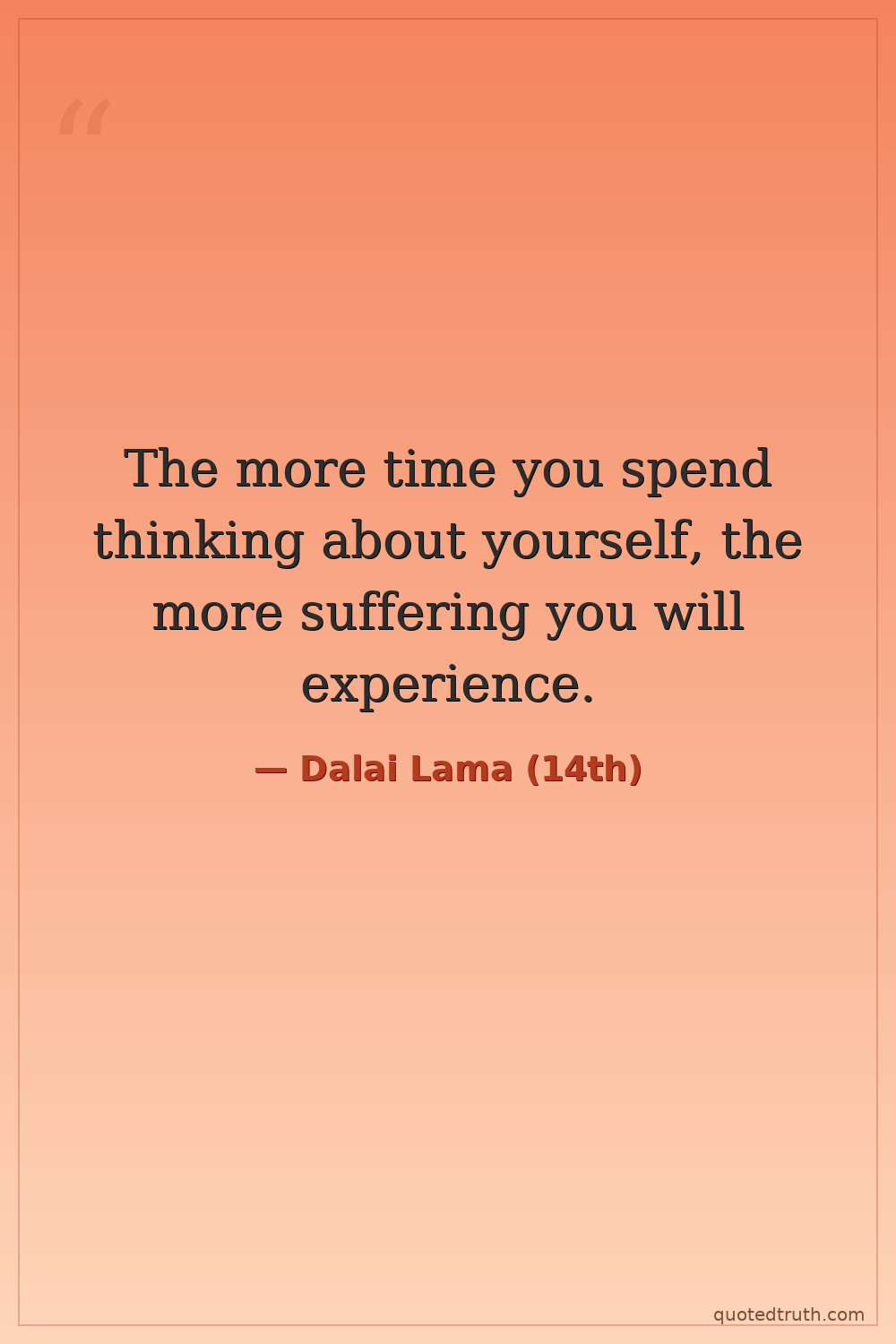
The more time you spend thinking about yourself, the more suffering you will experience.
The more time you spend thinking about yourself, the more suffering you will experience.
Click any product to generate a realistic preview. Up to 3 at a time.
* Initial load can take up to 90 seconds — revising the preview in another color is nearly instant.
"When you practice gratefulness, there is a sense of respect toward others."
"I joke sometimes that I am the longest-serving refugee."
"I think the most important thing is to be happy. If you are happy, you can make others happy."
"We need to understand that inner peace is the key to world peace."
"Choose to be optimistic, it feels better."
Found in 1 providers: grok
1 source checked
Constantly fixating on your own desires, problems, or status amplifies mental suffering. When your attention loops inward — on what you lack, how you're perceived, or what might go wrong for you — anxiety and dissatisfaction grow. Redirecting focus outward, toward others and their wellbeing, naturally quiets that noise. The mind that obsesses over itself creates its own prison; the one engaged with the world finds relief.
Tenzin Gyatso has lived this principle under extreme circumstances — exiled from Tibet since 1959 when China occupied his homeland, yet he redirected energy toward compassion rather than personal grievance. His Buddhist philosophy centers on anatman (no fixed self) and karuna (compassion for others) as the antidote to ego-driven suffering. His Nobel Peace Prize in 1989 recognized decades of outward-focused advocacy — proof that selflessness, not self-absorption, sustains both peace and purpose.
The 14th Dalai Lama's teachings emerged as Western culture shifted sharply toward individualism — the 'me generation' of the 1970s-80s, then social media's amplification of self-image obsession in the 2000s-2010s. Depression and anxiety rates rose in lockstep with selfie culture and personal branding. Simultaneously, neuroscience began confirming what Buddhism long held: self-referential rumination is a core driver of depression. His warning arrived precisely when individualistic cultures needed it most.
AI-generated insights based on extensive research and information for context. Factual errors? Email [email protected].
Your cart is empty