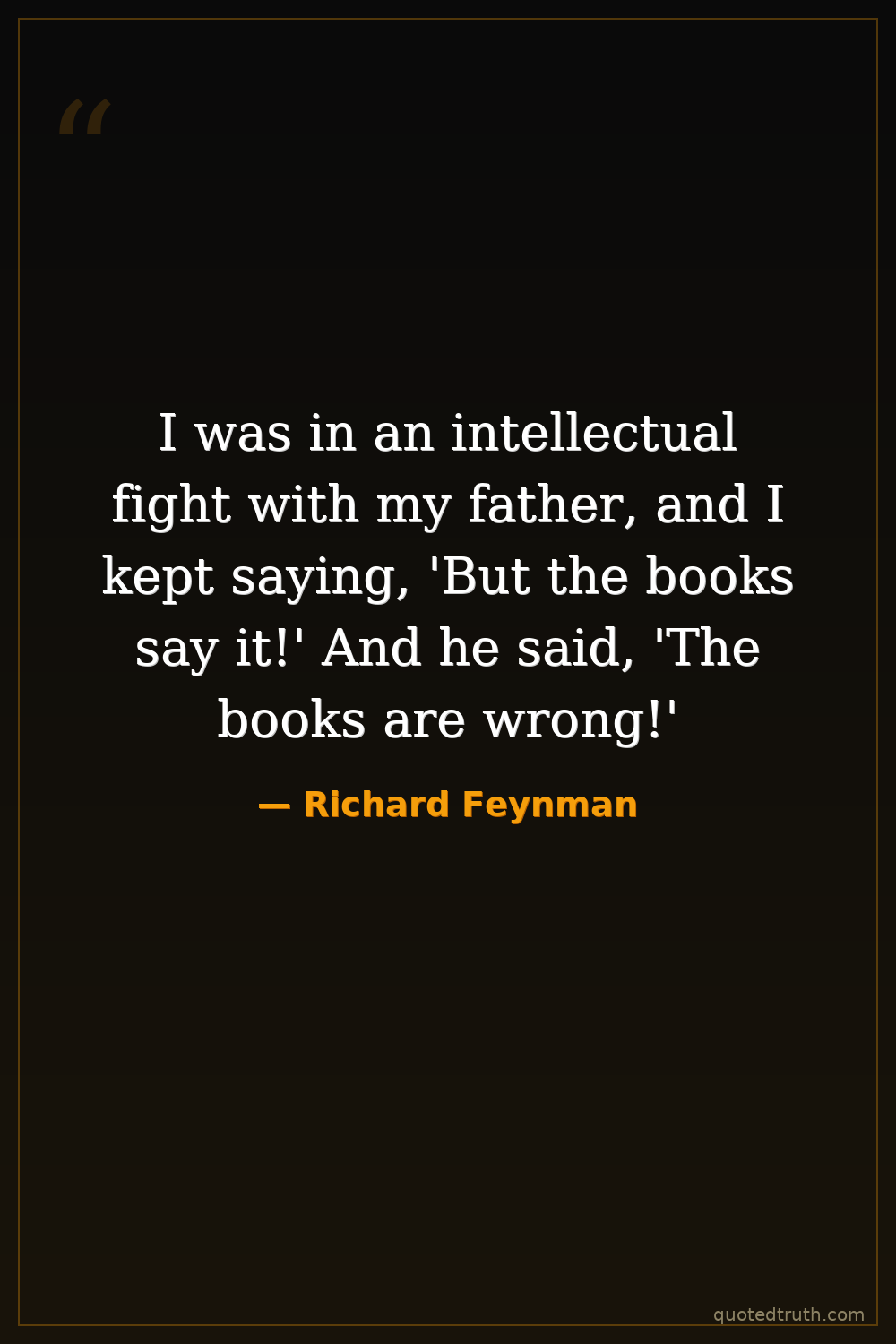
Richard Feynman — "I was in an intellectual fight with my father, and I kept saying, 'But the books…"
I was in an intellectual fight with my father, and I kept saying, 'But the books say it!' And he said, 'The books are wrong!'
I was in an intellectual fight with my father, and I kept saying, 'But the books say it!' And he said, 'The books are wrong!'
Click any product to generate a realistic preview. Up to 3 at a time.
* Initial load can take up to 90 seconds — revising the preview in another color is nearly instant.
"Science is the belief in the ignorance of experts."
"The game is to find out how nature works."
"The purpose of computing is insight, not numbers."
"The highest possible achievement is to be able to make a discovery."
"I would rather have questions that can't be answered than answers that can't be questioned."
American theoretical physicist who shared the 1965 Nobel for QED, developed Feynman diagrams, and wrote the Feynman Lectures on Physics. Closely associated with Julian Schwinger (co-Nobelist for QED) and Murray Gell-Mann (Caltech rival and Eightfold-Way physicist). For an intellectual contrast, see Deepak Chopra, physician and quantum-mysticism author — Feynman's Caltech 'cargo cult science' commencement address is the precise template for what he saw as misuse of physics terminology — Chopra-style appropriation of quantum vocabulary for metaphysical claims is the canonical example of what Feynman called 'fooling yourself'.
Found in 1 providers: grok
1 source checked
Blind deference to written authority can prevent genuine understanding. Books record conclusions, not truth itself. A curious mind must challenge established knowledge rather than treating it as sacred. When experience or reasoning contradicts what's been written down, the willingness to say 'the books are wrong' is not ignorance—it's the beginning of real intellectual engagement and independent thought.
Feynman's father Melville was a uniform salesman who cultivated his son's skepticism from childhood, teaching him to question labels and look at reality directly. This rebellious empiricism defined Feynman's career: he reformulated quantum electrodynamics through diagrams and intuition, not inherited formalism, and notoriously exposed NASA's Challenger disaster by ignoring bureaucratic consensus and dipping an O-ring in ice water.
Feynman came of age mid-20th century when scientific textbooks carried enormous institutional authority and post-WWII America treated expert consensus as nearly unassailable. The Manhattan Project had cemented science's prestige. Against this backdrop, questioning written orthodoxy was culturally transgressive—making his father's lesson to distrust books and trust direct observation a genuinely countercultural stance that shaped Feynman's lifelong anti-authority approach.
AI-generated insights based on extensive research and information for context. Factual errors? Email [email protected].
Your cart is empty