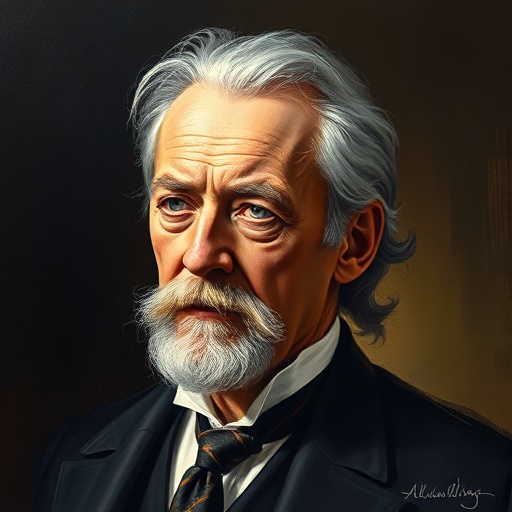
Alexander Fleming — "I did not invent penicillin. Nature did. I just found it."
I did not invent penicillin. Nature did. I just found it.
I did not invent penicillin. Nature did. I just found it.
Click any product to generate a realistic preview. Up to 3 at a time.
* Initial load can take up to 90 seconds — revising the preview in another color is nearly instant.
"I am not a hero. I just happened to be in the right place at the right time."
"It is the lone worker who makes the first advance in a subject; the details may be worked out by a team, but the prime idea is due to enterprise, thought, and perception of an individual."
"My work was not a flash of genius, but a gradual unfolding of facts."
"I am just a simple bacteriologist who got lucky."
"Many difficulties were encountered in the early attempts to isolate and purify penicillin."
Found in 1 providers: grok
1 source checked
Fleming credits nature, not himself, for penicillin. The mold Penicillium notatum already produced the antibacterial compound long before any human noticed it. His role was simply observation: spotting that bacteria around a contaminated petri dish had died. He frames discovery as recognition rather than creation, pushing back against the idea that scientists invent breakthroughs. The real work, he suggests, was done by biology, and humans just have to pay attention.
Fleming literally stumbled onto penicillin in 1928 when a Staphylococcus plate was contaminated by airborne mold in his cluttered St. Mary's lab. A Scottish bacteriologist trained as a military doctor in WWI, he had watched antiseptics fail wounded soldiers and was hunting for something better. His humility here is genuine: he could not mass-produce the drug himself, and credited Florey and Chain, who shared his 1945 Nobel Prize, for turning the observation into medicine.
Fleming worked from the 1920s through 1940s, an era when bacterial infection was still a routine killer. Pneumonia, sepsis, childbirth fever, and battlefield wounds had no reliable cure. World War II created urgent demand, pushing American firms to mass-produce penicillin by D-Day 1944, saving thousands of Allied lives. Science was shifting from lone-genius mythology toward big collaborative labs, and Fleming's modest framing fit a public newly aware that medical miracles came from teamwork, industry, and luck as much as individual brilliance.
AI-generated insights based on extensive research and information for context. Factual errors? Email [email protected].
Your cart is empty