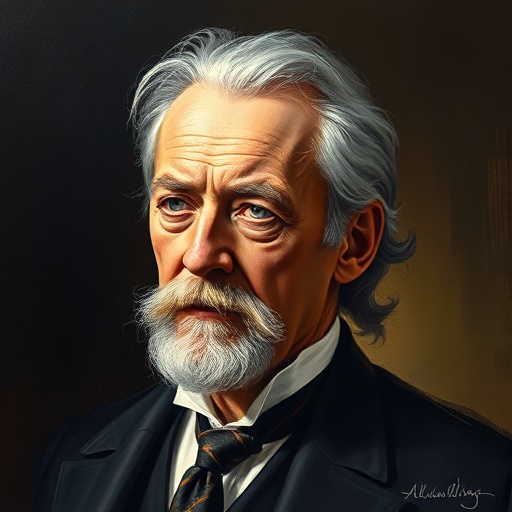
Alexander Fleming — "I never thought of myself as a great man, just a man who made a great discovery."
I never thought of myself as a great man, just a man who made a great discovery.
I never thought of myself as a great man, just a man who made a great discovery.
Click any product to generate a realistic preview. Up to 3 at a time.
* Initial load can take up to 90 seconds — revising the preview in another color is nearly instant.
"The future of chemotherapy lies in the intelligent use of these new antibacterial agents."
"The thought that I might have discovered something which would be of value in treating disease was, of course, uppermost in my mind."
"The greatest reward for a scientist is the advancement of knowledge."
"I had no idea that I had stumbled on to a subject that would prove to be of such immense importance."
"The world is full of interesting things. You just have to look for them."
Found in 1 providers: grok
1 source checked
A humble distinction between personal worth and the significance of one's work. Fleming separates his identity from his achievement, suggesting that discovering something extraordinary doesn't make the discoverer extraordinary — it makes the discovery extraordinary. He credits observation and circumstance over inherent genius. The point: greatness can flow through an ordinary person without that person needing to claim it as evidence of their own superior nature or special destiny.
Fleming's penicillin discovery in 1928 was largely accidental — a contaminated petri dish he nearly discarded revealed mold killing surrounding bacteria. He repeatedly credited luck over brilliance throughout his life. Despite winning the 1945 Nobel Prize, colleagues described him as quiet and self-deprecating rather than ambitious. This quote reflects his genuine character: a careful, observant scientist who understood that noticing the right thing at the right moment mattered far more than any claim to personal greatness.
Fleming worked during an era when the 'great man' theory dominated — history was understood as driven by towering heroic individuals. Yet his discovery emerged quietly in a London laboratory. As WWII raged, mass-produced penicillin saved hundreds of thousands of soldiers from infected wounds, making it one of history's most consequential medical breakthroughs. Against a backdrop of larger-than-life wartime figures like Churchill and Roosevelt, Fleming's modest framing directly challenged the cult of heroic individual genius surrounding scientific achievement.
AI-generated insights based on extensive research and information for context. Factual errors? Email [email protected].
Your cart is empty