Robert Koch — "The study of bacteria has opened up a new world of knowledge, and it is a world …"
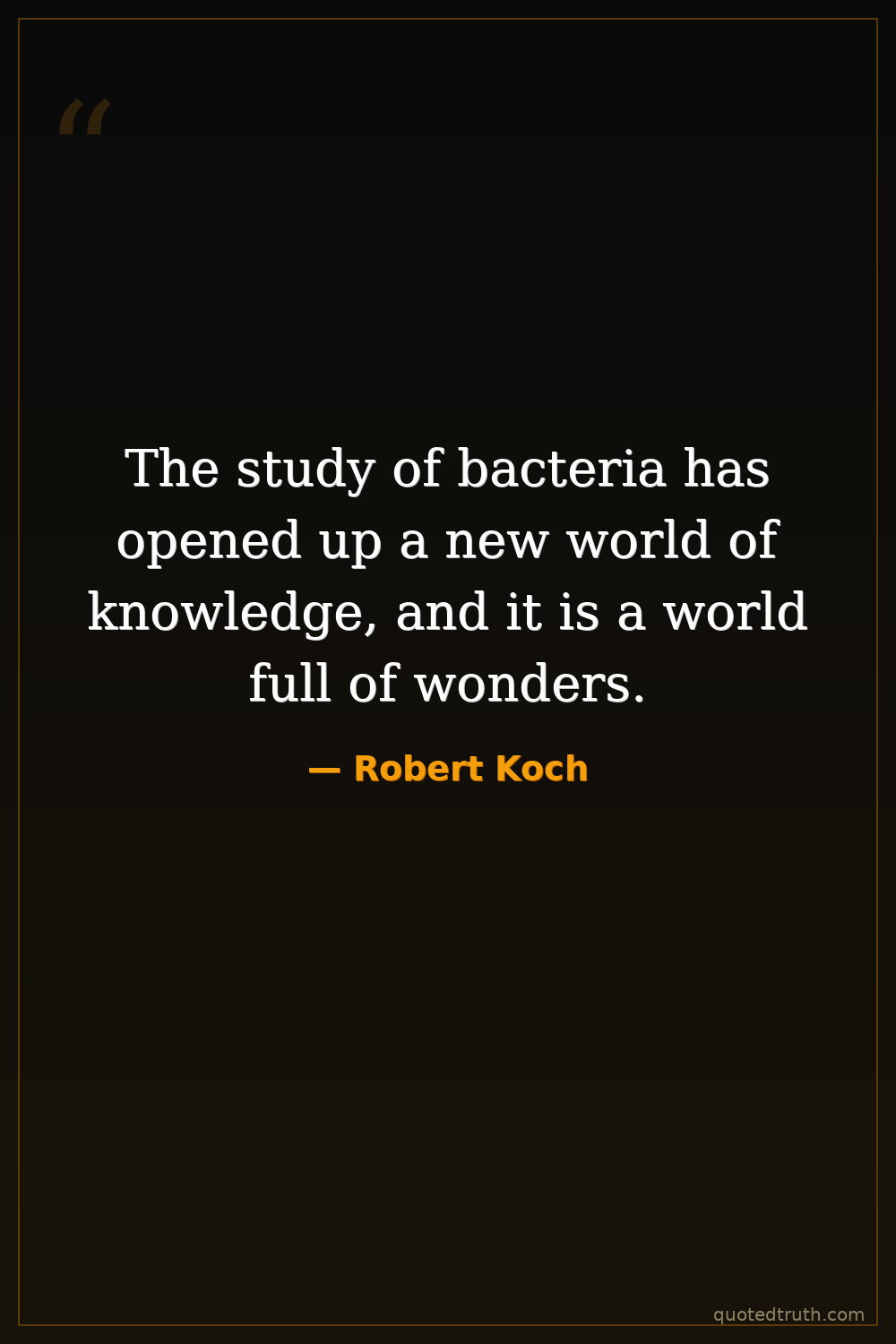
The study of bacteria has opened up a new world of knowledge, and it is a world full of wonders.
The study of bacteria has opened up a new world of knowledge, and it is a world full of wonders.
Click any product to generate a realistic preview. Up to 3 at a time.
* Initial load can take up to 90 seconds — revising the preview in another color is nearly instant.
"The scientific community must work together to address the global challenges of infectious diseases."
"The experimental method is the foundation of all scientific progress."
"It is a great responsibility to be a physician, for upon us depends the health of the community."
"I have always believed in the power of observation and experimentation."
"The ultimate test of a scientific theory is its practical application."
Found in 1 providers: grok
1 source checked
Bacteria aren't just pathogens to be defeated — studying them reveals an entirely hidden universe of biological complexity and behavior. Koch is expressing that microbiology is not merely a medical utility but a frontier of genuine wonder, comparable to discovering a new continent. The invisible world beneath a microscope operates by its own laws and rewards scientific curiosity far beyond any single disease or cure.
Koch's entire career embodied this wonder. He identified the anthrax bacillus in 1876, isolated Mycobacterium tuberculosis in 1882 — then the leading cause of death in Europe — and formulated Koch's Postulates, a framework proving specific bacteria cause specific diseases. His Nobel Prize came in 1905. Koch treated the laboratory not as a clinical necessity but as a site of discovery, approaching each microbe as a new species in a genuinely unexplored world.
Koch worked during the 1870s–1900s, when germ theory was overturning miasma doctrine — the belief that disease arose from bad air. Tuberculosis killed roughly one in seven Europeans. Pasteur and Koch together proved invisible organisms caused specific illnesses, transforming medicine from guesswork into science. The microscope had only recently become powerful enough to reveal bacterial detail, so Koch's generation was literally the first to see this hidden world — their discoveries felt as revolutionary as Galileo's telescope.
AI-generated insights based on extensive research and information for context. Factual errors? Email [email protected].
Your cart is empty