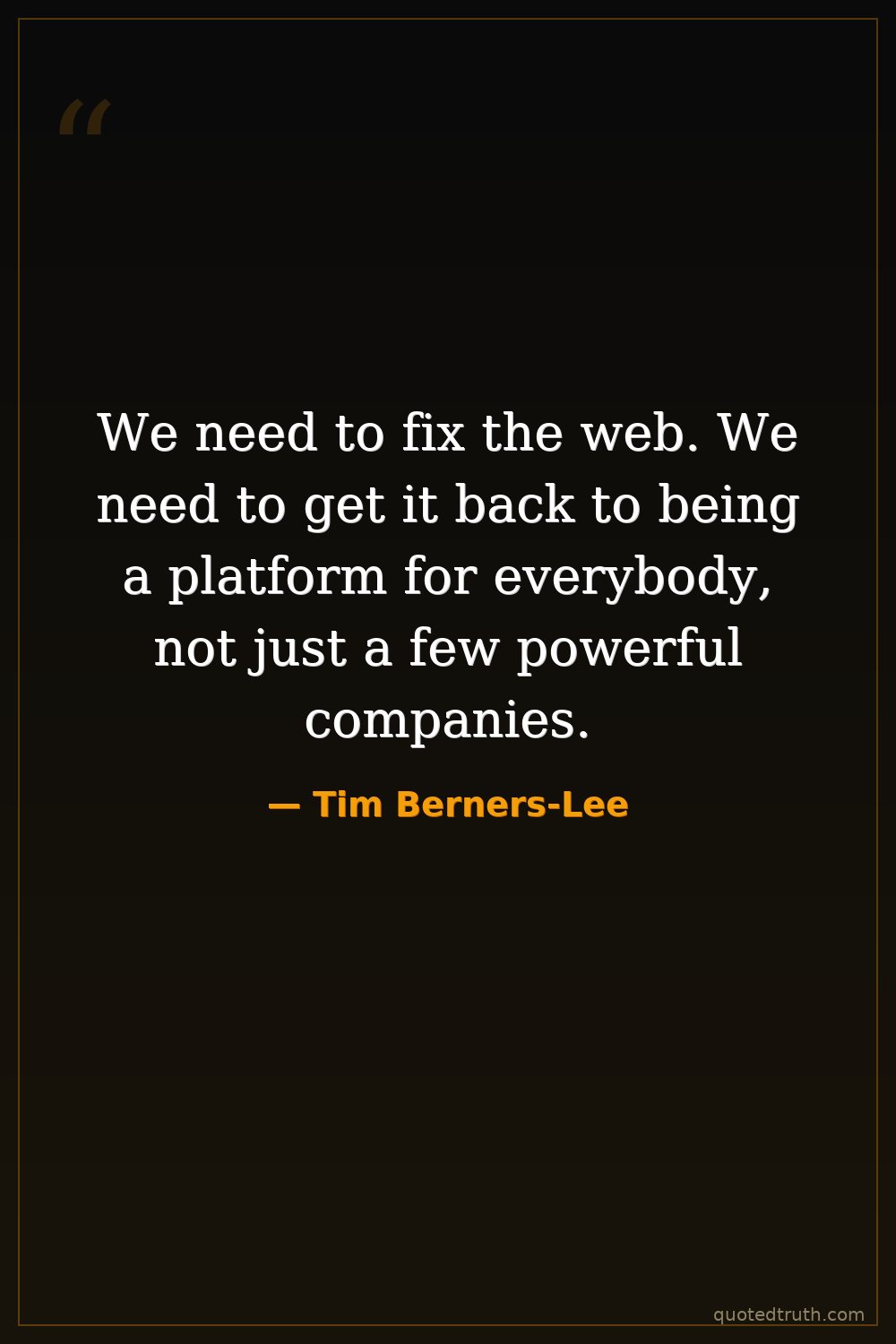
Tim Berners-Lee — "We need to fix the web. We need to get it back to being a platform for everybody…"
We need to fix the web. We need to get it back to being a platform for everybody, not just a few powerful companies.
We need to fix the web. We need to get it back to being a platform for everybody, not just a few powerful companies.
Click any product to generate a realistic preview. Up to 3 at a time.
* Initial load can take up to 90 seconds — revising the preview in another color is nearly instant.
"The web is a shared space."
"I'm not a fan of the term 'Web 2.0.' It implies that the web is a finished product, which it's not."
"I’m not happy with the way some companies use the web to exploit people."
"The web is under attack from governments and corporations. We need to fight back."
"I'm not a fan of the term 'information superhighway.' It implies a one-way flow of information, which is not what the web is about."
British computer scientist who invented the World Wide Web at CERN in 1989 and founded the W3C, championing open web standards. Closely associated with Vint Cerf (TCP/IP co-creator and 'father of the internet') and Marc Andreessen (Mosaic browser creator and Netscape co-founder). For an intellectual contrast, see Mark Zuckerberg, Facebook (Meta) founder — Zuckerberg's walled-garden Facebook is the canonical contemporary opposite of Berners-Lee's open-web vision; Berners-Lee's Solid project and 'recapture the web' essays are explicitly written as a rebuttal to the platform-monopoly model Facebook pioneered.
Found in 1 providers: grok
1 source checked
The web has drifted from its founding purpose. A handful of corporations now control most of what people see, share, and do online, leaving ordinary users with little agency. To restore the web's original promise, power must be redistributed so anyone can participate, create, and communicate without depending on a small set of gatekeepers who extract value while setting the rules.
Berners-Lee invented the web in 1989 and deliberately gave it away royalty-free so it would belong to everyone. Watching surveillance capitalism and platform monopolies emerge from his creation drove him to launch the Solid project, a technical specification designed to let individuals own their own data and break the grip of centralized platforms on personal identity and social interaction.
By the mid-2010s, Facebook, Google, and Amazon had captured the majority of web traffic, advertising revenue, and user data. Cambridge Analytica, GDPR debates, and algorithmic radicalization scandals made concentration of web power a mainstream political concern. Berners-Lee made this call explicitly around 2018, a moment when trust in big tech had collapsed and decentralization movements like the fediverse were gaining serious momentum.
AI-generated insights based on extensive research and information for context. Factual errors? Email [email protected].
Your cart is empty