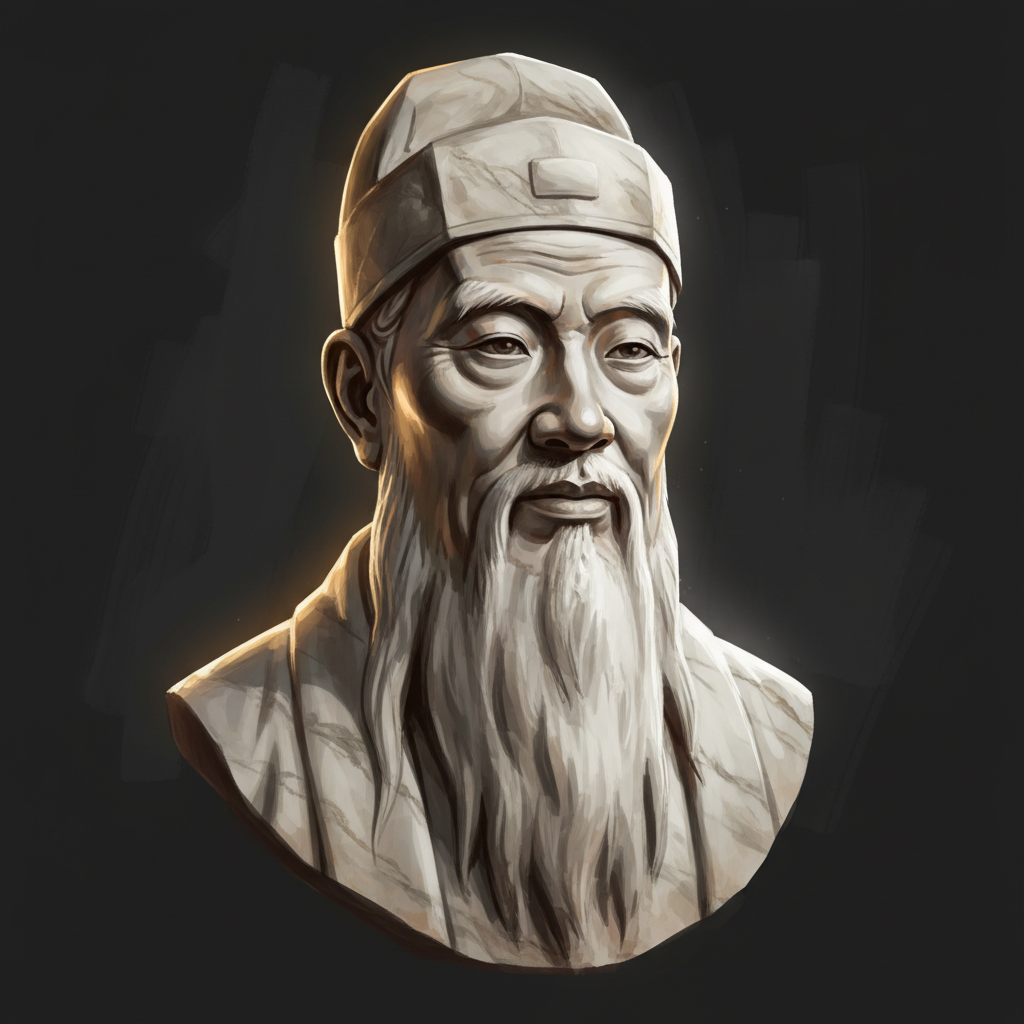
Confucius — "Study the past if you would define the future."
Study the past if you would define the future.
Study the past if you would define the future.
Click any product to generate a realistic preview. Up to 3 at a time.
* Initial load can take up to 90 seconds — revising the preview in another color is nearly instant.
"Is humanity far away? Whenever I want the virtue of humanity, it comes at once."
"The gentleman seeks to be slow in speech and earnest in action."
"Before you embark on a journey of revenge, dig two graves."
"By three methods we may learn wisdom: First, by reflection, which is noblest; Second, by imitation, which is easiest; and third by experience, which is the bitterest."
"A man without constancy cannot be a diviner or a physician."
Chinese philosopher and teacher whose teachings (compiled by his students in the Analects) became the foundational ethical framework of East Asian civilization for 2,500 years. Closely associated with Mencius (his most-influential follower a century later). For an intellectual contrast, see Laozi, near-contemporary Chinese sage and Tao Te Ching author — Confucius systematized social order through ritual and family hierarchy; Laozi's Taoist effortless-action philosophy argued such systems were the disease, not the cure. The two founding poles of Chinese moral philosophy — every East Asian moral tradition since has positioned itself between them.
The standard scholarly entry points to Confucius's work: Philip J. Ivanhoe (Georgetown, Chinese philosophy) — Confucian Moral Self Cultivation (2000); Edward Slingerland (UBC, Asian Studies) — Effortless Action: Wu-wei as Conceptual Metaphor (2003); Tu Weiming (Harvard, Confucian scholar) — Confucian Thought: Selfhood as Creative Transformation (1985). These are the works graduate seminars cite when teaching Confucius.
Found in 1 providers: gemini
1 source checked
Understanding history is essential for shaping what comes next. By examining what has already happened—successes, failures, patterns of human behavior—you gain the knowledge needed to make better decisions going forward. Without studying the past, you are guessing about the future. The line argues that foresight is not invention but inheritance: the future you want is built on lessons already paid for by people who came before you.
Confucius spent his life as a teacher and editor of ancient texts, compiling the Five Classics and revering the early Zhou dynasty as a moral high point. He believed personal and political virtue came from studying ancestral rituals, poetry, and history. His entire project was conservative in the literal sense—conserving wisdom. This saying captures his core conviction that a scholar-statesman shapes the future not through novel ideas but through deep mastery of what previous sages had already worked out.
Confucius lived during the Spring and Autumn period (roughly 551–479 BCE), when the Zhou dynasty was crumbling and rival states fought constantly. Traditional rituals and social bonds were dissolving, and warlords ignored the old codes. Against this chaos, Confucius pointed backward to the early Zhou kings as a template for restoring order. Studying the past was not nostalgia—it was a practical political program in an era when forgetting tradition meant collapse into endless warfare and moral decay.
AI-generated insights based on extensive research and information for context. Factual errors? Email [email protected].
Your cart is empty