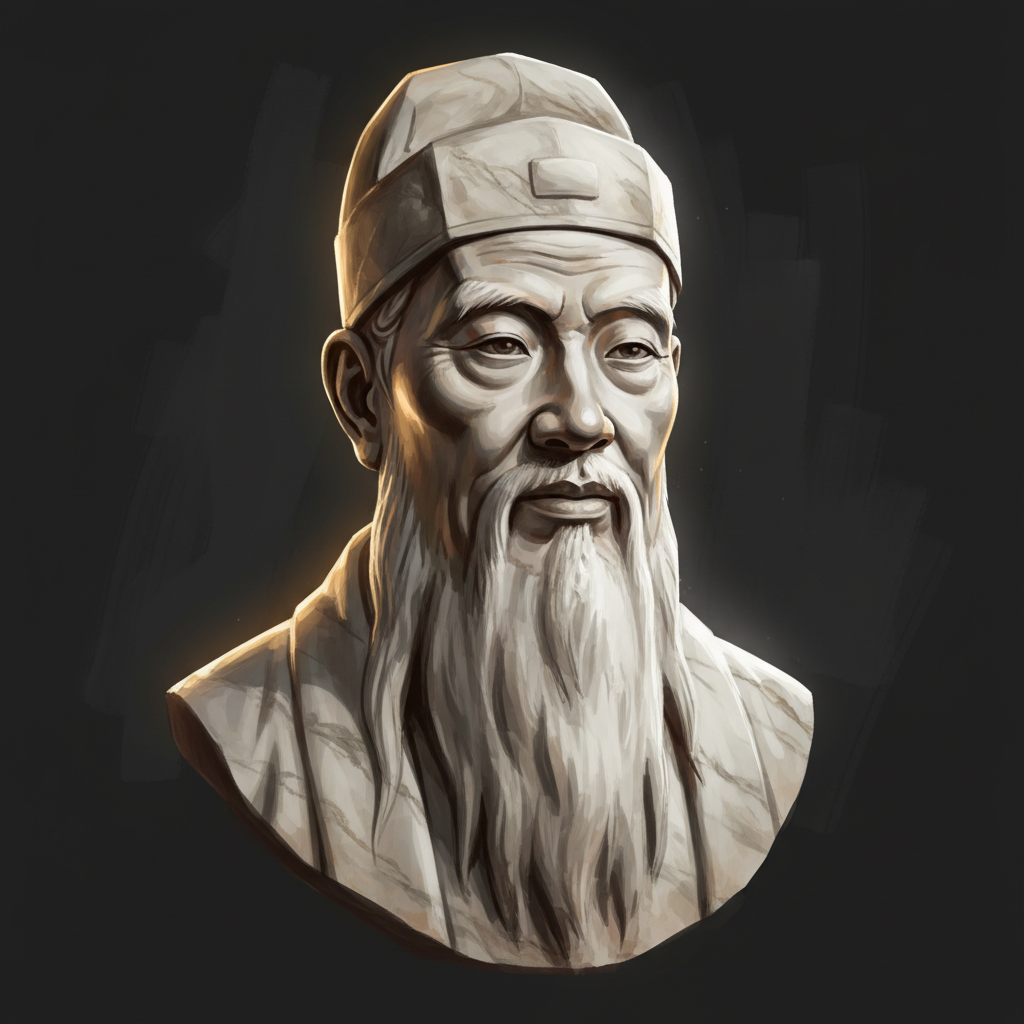
Confucius — "You cannot open a book without learning something."
You cannot open a book without learning something.
You cannot open a book without learning something.
Click any product to generate a realistic preview. Up to 3 at a time.
* Initial load can take up to 90 seconds — revising the preview in another color is nearly instant.
"The gentleman understands integrity; the petty person knows about profit."
"One who does not understand the Mandate of Heaven cannot be a gentleman."
"I have never seen anyone who loved virtue as much as they loved sex."
"The gentleman reveres three things. He reveres the mandate of Heaven; he reveres great people; and he reveres the words of sages."
"Attack the evil that is within yourself, rather than attacking the evil that is in others."
Chinese philosopher and teacher whose teachings (compiled by his students in the Analects) became the foundational ethical framework of East Asian civilization for 2,500 years. Closely associated with Mencius (his most-influential follower a century later). For an intellectual contrast, see Laozi, near-contemporary Chinese sage and Tao Te Ching author — Confucius systematized social order through ritual and family hierarchy; Laozi's Taoist effortless-action philosophy argued such systems were the disease, not the cure. The two founding poles of Chinese moral philosophy — every East Asian moral tradition since has positioned itself between them.
The standard scholarly entry points to Confucius's work: Philip J. Ivanhoe (Georgetown, Chinese philosophy) — Confucian Moral Self Cultivation (2000); Edward Slingerland (UBC, Asian Studies) — Effortless Action: Wu-wei as Conceptual Metaphor (2003); Tu Weiming (Harvard, Confucian scholar) — Confucian Thought: Selfhood as Creative Transformation (1985). These are the works graduate seminars cite when teaching Confucius.
Found in 1 providers: gemini
1 source checked
Every book offers at least one new insight, fact, or perspective, no matter how small. Simply engaging with written text expands your understanding, whether you agree with the content, disagree with it, or merely encounter a single memorable phrase. Reading is never wasted effort because the act itself produces some form of mental growth, exposure to ideas, or sharpening of thought that you carry forward into the rest of your life.
Confucius devoted his life to study, teaching, and the transmission of classical texts like the Book of Odes and Book of Documents. He famously said he was not born with knowledge but loved antiquity and sought it earnestly. As a teacher who accepted students regardless of class, he believed education was the foundation of moral character and social harmony, making reverence for learning from books central to his philosophy.
During the Spring and Autumn period (roughly 551–479 BCE), China was fragmenting into warring states and traditional Zhou rituals were decaying. Written texts existed on bamboo slips and silk, accessible mostly to aristocrats and scribes. Confucius championed broader literacy and study of ancient records as a way to restore moral order, making his endorsement of books radical in an age when knowledge was guarded and most people were illiterate peasants.
AI-generated insights based on extensive research and information for context. Factual errors? Email [email protected].
Your cart is empty