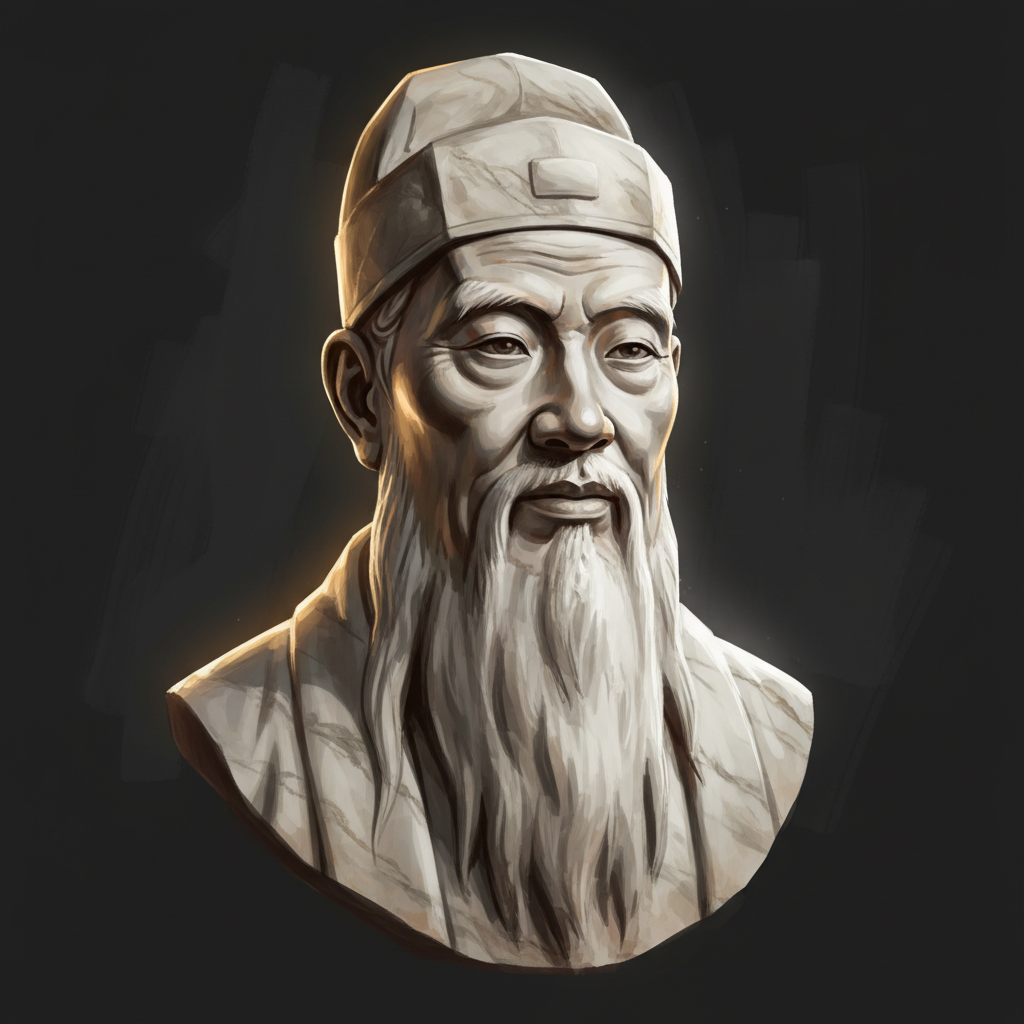
Confucius — "I have never seen anyone who loved virtue as much as they loved sex."
I have never seen anyone who loved virtue as much as they loved sex.
I have never seen anyone who loved virtue as much as they loved sex.
Click any product to generate a realistic preview. Up to 3 at a time.
* Initial load can take up to 90 seconds — revising the preview in another color is nearly instant.
"The Master said, 'I walk in the company of two other men, and I can always learn from them. I select their good qualities and follow them, and I correct their bad qualities and avoid them.'"
"The superior man understands what is right; the inferior man understands what will sell."
"The gentleman is not concerned that he is not acknowledged, but rather that he should do something worthy of being acknowledged."
"If a man does not say 'What shall I do? What shall I do?', I can do nothing with him."
"Is it not a pleasure, having learned something, to try it out at due intervals?"
Chinese philosopher and teacher whose teachings (compiled by his students in the Analects) became the foundational ethical framework of East Asian civilization for 2,500 years. Closely associated with Mencius (his most-influential follower a century later). For an intellectual contrast, see Laozi, near-contemporary Chinese sage and Tao Te Ching author — Confucius systematized social order through ritual and family hierarchy; Laozi's Taoist effortless-action philosophy argued such systems were the disease, not the cure. The two founding poles of Chinese moral philosophy — every East Asian moral tradition since has positioned itself between them.
The standard scholarly entry points to Confucius's work: Philip J. Ivanhoe (Georgetown, Chinese philosophy) — Confucian Moral Self Cultivation (2000); Edward Slingerland (UBC, Asian Studies) — Effortless Action: Wu-wei as Conceptual Metaphor (2003); Tu Weiming (Harvard, Confucian scholar) — Confucian Thought: Selfhood as Creative Transformation (1985). These are the works graduate seminars cite when teaching Confucius.
Found in 1 providers: deepseek
1 source checked
People chase physical pleasure with intense energy and devotion, but rarely pursue moral goodness with the same passion. The speaker observes that humans naturally prioritize desire and attraction over character development. If only we worked on becoming better people with the same hunger we bring to romance and lust, society would transform. It's a lament about misplaced priorities in human nature.
Confucius built his entire teaching around self-cultivation and ren (humaneness), spending decades traveling between warring states trying to convince rulers to prioritize ethics over pleasure and power. As a moral philosopher who valued ritual propriety and disciplined character, he constantly observed disciples and officials choosing comfort over virtue. This frustrated observation reflects his lifelong struggle to make moral seriousness feel as compelling as base desires.
During the Spring and Autumn period (around 500 BCE), Chinese society was fracturing as feudal lords waged constant war, indulged in luxury, and abandoned the Zhou ritual order. Court life centered on concubines, feasts, and political scheming rather than ethical governance. Confucius watched rulers choose pleasure and expedience over the ancient virtues he championed, making his complaint a pointed critique of aristocratic decadence during an age of moral collapse.
AI-generated insights based on extensive research and information for context. Factual errors? Email [email protected].
Your cart is empty