Confucius — "The superior man has a dignified ease without pride. The mean man has pride with…"
The superior man has a dignified ease without pride. The mean man has pride without a dignified ease.
The superior man has a dignified ease without pride. The mean man has pride without a dignified ease.
Click any product to generate a realistic preview. Up to 3 at a time.
* Initial load can take up to 90 seconds — revising the preview in another color is nearly instant.
"What you do not want done to yourself, do not do to others."
"A youth is to be regarded with respect. How do we know that his future will not be equal to our present?"
"Do not be desirous of having things done quickly; do not look at small advantages. Desire to have things done quickly prevents their being done thoroughly. Looking at small advantages prevents great a…"
"He who learns but does not think, is lost! He who thinks but does not learn is in great danger."
"He who knows all the answers has not been asked all the questions."
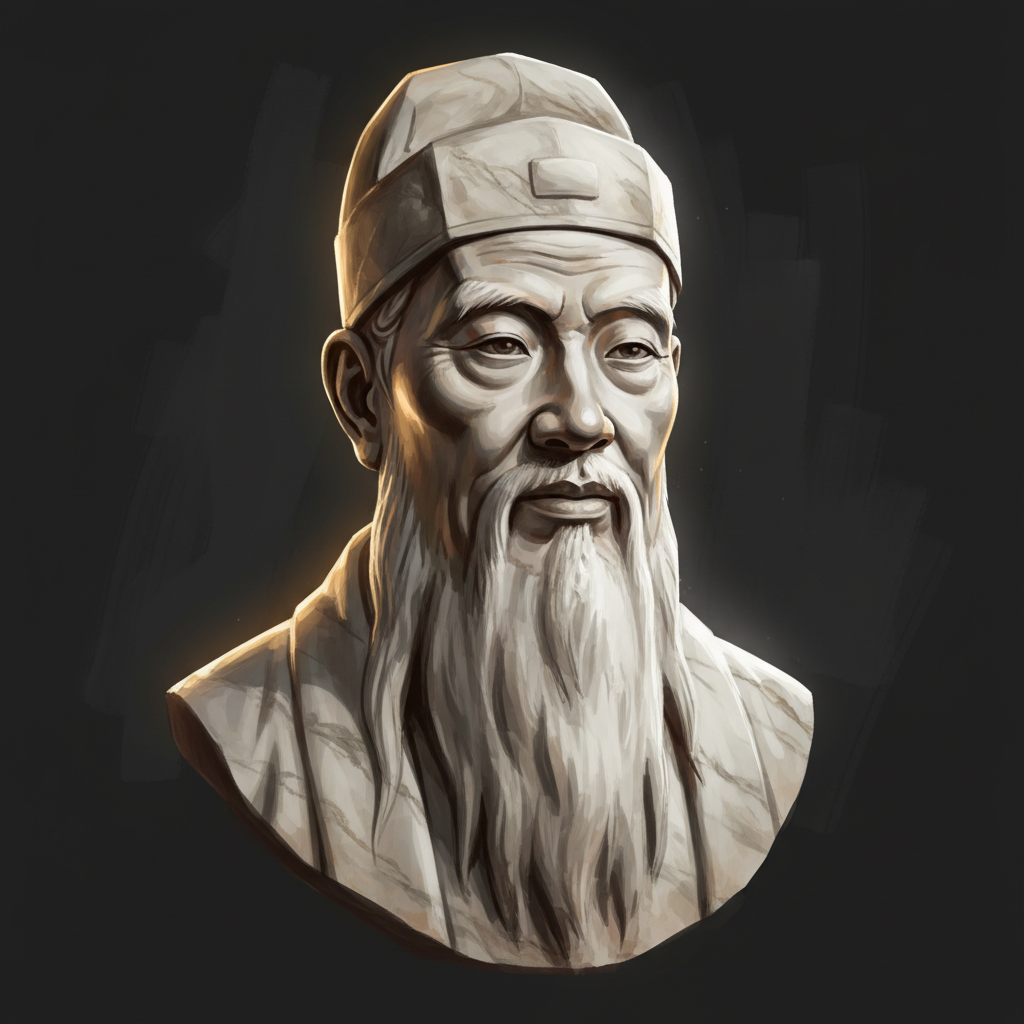
Chinese philosopher and teacher whose teachings (compiled by his students in the Analects) became the foundational ethical framework of East Asian civilization for 2,500 years. Closely associated with Mencius (his most-influential follower a century later). For an intellectual contrast, see Laozi, near-contemporary Chinese sage and Tao Te Ching author — Confucius systematized social order through ritual and family hierarchy; Laozi's Taoist effortless-action philosophy argued such systems were the disease, not the cure. The two founding poles of Chinese moral philosophy — every East Asian moral tradition since has positioned itself between them.
The standard scholarly entry points to Confucius's work: Philip J. Ivanhoe (Georgetown, Chinese philosophy) — Confucian Moral Self Cultivation (2000); Edward Slingerland (UBC, Asian Studies) — Effortless Action: Wu-wei as Conceptual Metaphor (2003); Tu Weiming (Harvard, Confucian scholar) — Confucian Thought: Selfhood as Creative Transformation (1985). These are the works graduate seminars cite when teaching Confucius.
Found in 1 providers: gemini
1 source checked
True excellence carries itself with calm confidence that needs no announcement. A person of genuine character moves through the world with quiet self-assurance, comfortable in their own skin without demanding recognition. The small-minded person does the opposite: they puff themselves up with arrogance but lack any inner steadiness, using loud self-importance to mask insecurity. Real dignity is relaxed; fake dignity is defensive and grasping for status.
Confucius built his entire teaching around the junzi, the 'superior man' or cultivated gentleman, contrasting him with the xiaoren, the petty person. Having served as a minor official and spent years traveling between warring states seeking rulers who would adopt his ethics, Confucius watched aristocrats posture for power while lacking virtue. His own humble origins and refusal to flatter patrons embodied this dignified ease, making the distinction personally lived rather than abstract.
Confucius lived during the Spring and Autumn period (roughly 551–479 BCE), when the Zhou dynasty's authority was collapsing and rival states jockeyed for dominance through intrigue, warfare, and showy displays of rank. Nobles inherited titles but often lacked the ritual refinement those titles once implied. Amid this social disorder, Confucius argued that true nobility came from moral cultivation, not bloodline or bluster—a radical reframing of what made someone genuinely worthy of respect.
AI-generated insights based on extensive research and information for context. Factual errors? Email [email protected].
Your cart is empty