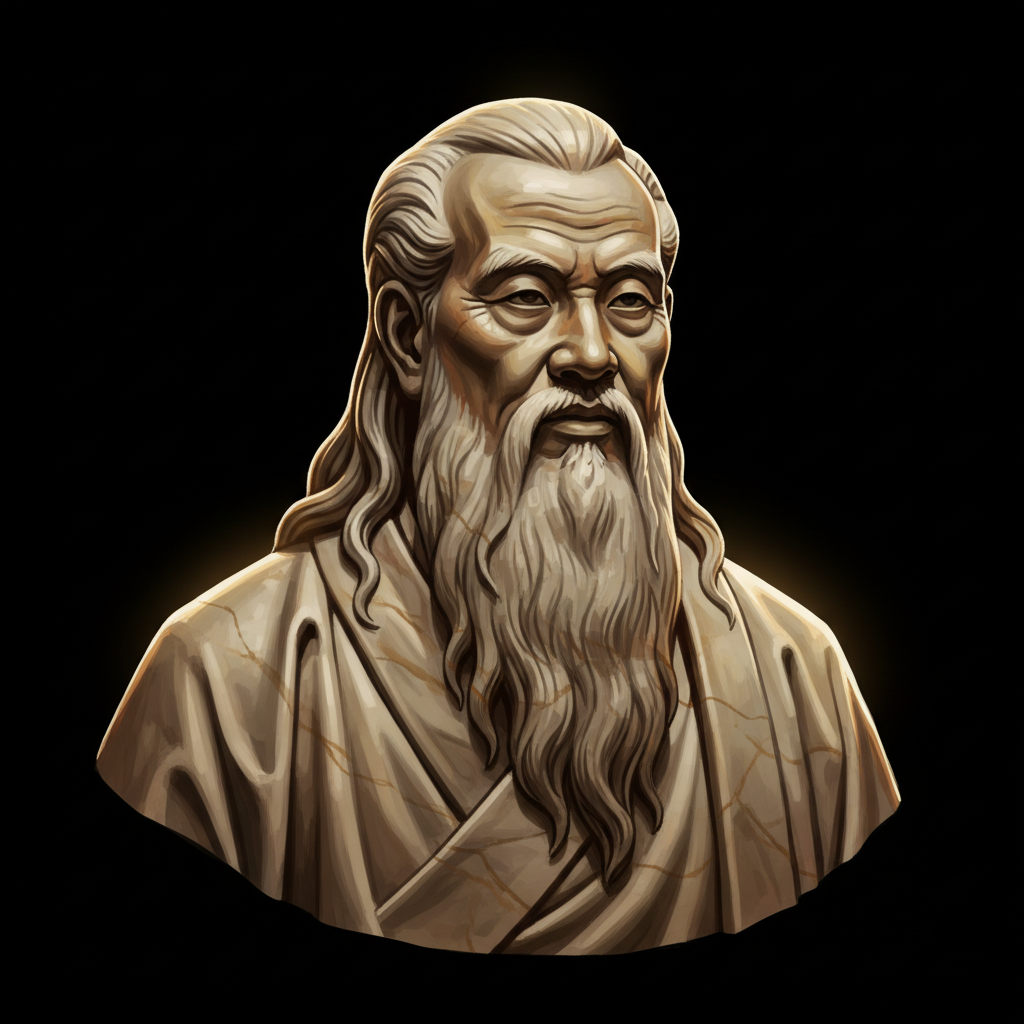
Laozi — "He (the sage) wants all things to follow their own nature, but dares not act."
He (the sage) wants all things to follow their own nature, but dares not act.
He (the sage) wants all things to follow their own nature, but dares not act.
Click any product to generate a realistic preview. Up to 3 at a time.
* Initial load can take up to 90 seconds — revising the preview in another color is nearly instant.
"Water is fluid, soft, and yielding. But water will wear away rock, which is rigid and cannot yield. As a rule, whatever is fluid, soft, and yielding will overcome whatever is rigid and hard. This is a…"
"The soft and the weak overcome the hard and the strong."
"The five colors blind the eye. The five notes deafen the ear. The five tastes dull the palate."
"The greatest skill is to seem unskilled; The greatest abundance is to seem empty."
"Fill your bowl to the brim and it will spill. Keep sharpening your knife and it will blunt."
Reputed founder of Taoism and author of the Tao Te Ching, whose wu wei (effortless action) shaped East Asian philosophy. Closely associated with Zhuangzi (later Taoist who extended Laozi's framework). For an intellectual contrast, see Confucius, near-contemporary Chinese sage of social ritual and duty — Confucius systematized social order through ritual and hierarchy; Laozi argued that all such systems were the disease, not the cure — the two founding poles of Chinese moral philosophy.
Found in 1 providers: gemini
1 source checked
The wise person lets everything unfold according to its own nature rather than forcing outcomes. They hold back from meddling, pushing, or imposing their will on people and situations. Interference, even well-intentioned, disrupts the natural flow and usually makes things worse. True wisdom means trusting that things grow, settle, and resolve on their own when left alone. Restraint is not passivity but a disciplined refusal to interrupt what is already working.
Laozi built Taoism around wu wei, effortless non-action, and this line captures that core teaching exactly. Legend holds he served as a keeper of royal archives, observing rulers who micromanaged their realms into chaos before he rode west and composed the Tao Te Ching. His entire philosophy rejects forced control in favor of aligning with the Tao, the natural way things move when humans stop interfering.
Laozi lived during the late Zhou dynasty, an era of collapsing feudal order that spiraled into the Warring States period. Rival lords waged constant war, legalist advisors pushed harsh laws, and Confucians prescribed elaborate rituals to restore harmony. Against this backdrop of aggressive intervention, Laozi's call for restraint and non-interference was radical. His teaching offered an alternative to both brutal statecraft and rigid moralism, shaping Chinese thought for millennia.
AI-generated insights based on extensive research and information for context. Factual errors? Email [email protected].
Your cart is empty