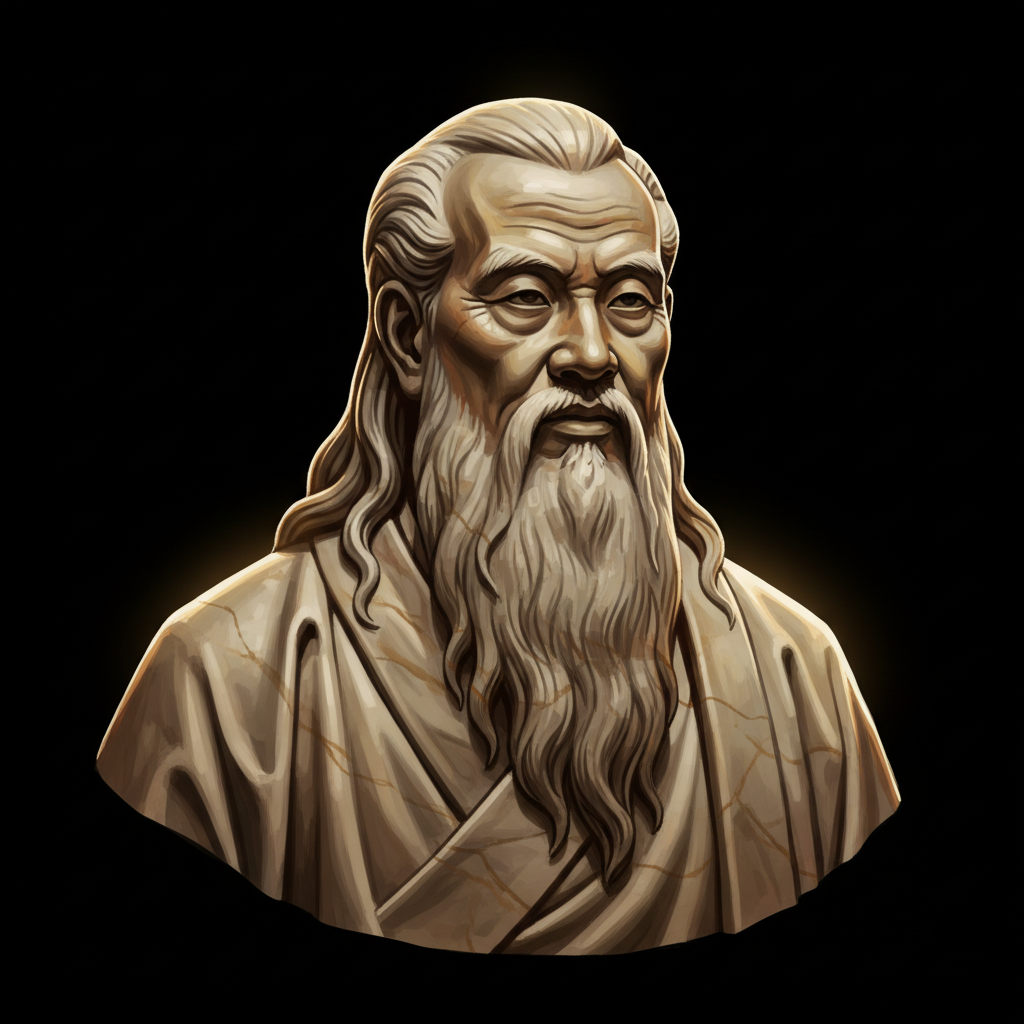
Laozi — "Under heaven all can see beauty as beauty only because there is ugliness. All ca…"
Under heaven all can see beauty as beauty only because there is ugliness. All can know good as good only because there is evil.
Under heaven all can see beauty as beauty only because there is ugliness. All can know good as good only because there is evil.
Click any product to generate a realistic preview. Up to 3 at a time.
* Initial load can take up to 90 seconds — revising the preview in another color is nearly instant.
"Empty your mind of all thoughts. Let your heart be at peace. Watch the turmoil of the world, but let your serenity remain. Return to the root. This is tranquility. This is returning to your destiny."
"When the world has the Tao, the swift horses are used for hauling manure. When the world is without the Tao, war horses are bred in the suburbs."
"If you realize that all things change, there is nothing you will try to hold on to. If you are not afraid of dying, there is nothing you cannot achieve."
"The sage puts his person last and finds his person first. He treats his person as external and his person is preserved."
"When the best student hears the Tao, he practices it diligently. When the average student hears the Tao, he is half-hearted. When the worst student hears the Tao, he laughs out loud. If he did not lau…"
Reputed founder of Taoism and author of the Tao Te Ching, whose wu wei (effortless action) shaped East Asian philosophy. Closely associated with Zhuangzi (later Taoist who extended Laozi's framework). For an intellectual contrast, see Confucius, near-contemporary Chinese sage of social ritual and duty — Confucius systematized social order through ritual and hierarchy; Laozi argued that all such systems were the disease, not the cure — the two founding poles of Chinese moral philosophy.
Found in 1 providers: gemini
1 source checked
Opposites define each other. You only recognize beauty because ugliness exists for contrast, and goodness only stands out against evil. Every quality we label depends on its opposite to have meaning. Without darkness, light is just neutral; without failure, success is just the default. The categories we use to judge the world are relational, not absolute, and emerge from the act of comparison itself.
Laozi is credited with founding Taoism and writing the Tao Te Ching, a text built on paradox and the unity of opposites. As a quiet archivist in the Zhou royal library, he observed how rigid moral categories cause conflict. This teaching reflects his core doctrine of yin-yang complementarity and wu wei, urging rulers and seekers to stop forcing distinctions and instead see how labels generate the very divisions they claim to describe.
Laozi lived during the late Zhou dynasty (6th century BCE), an age of collapsing feudal order soon to spiral into the Warring States period. Confucian reformers were codifying strict virtues, rituals, and social hierarchies to restore stability. Laozi pushed back, arguing that imposing sharp moral categories actually manufactured the disorder they aimed to cure. His teaching challenged the moralizing projects of rival philosophers competing for influence in the courts of warring Chinese states.
AI-generated insights based on extensive research and information for context. Factual errors? Email [email protected].
Your cart is empty