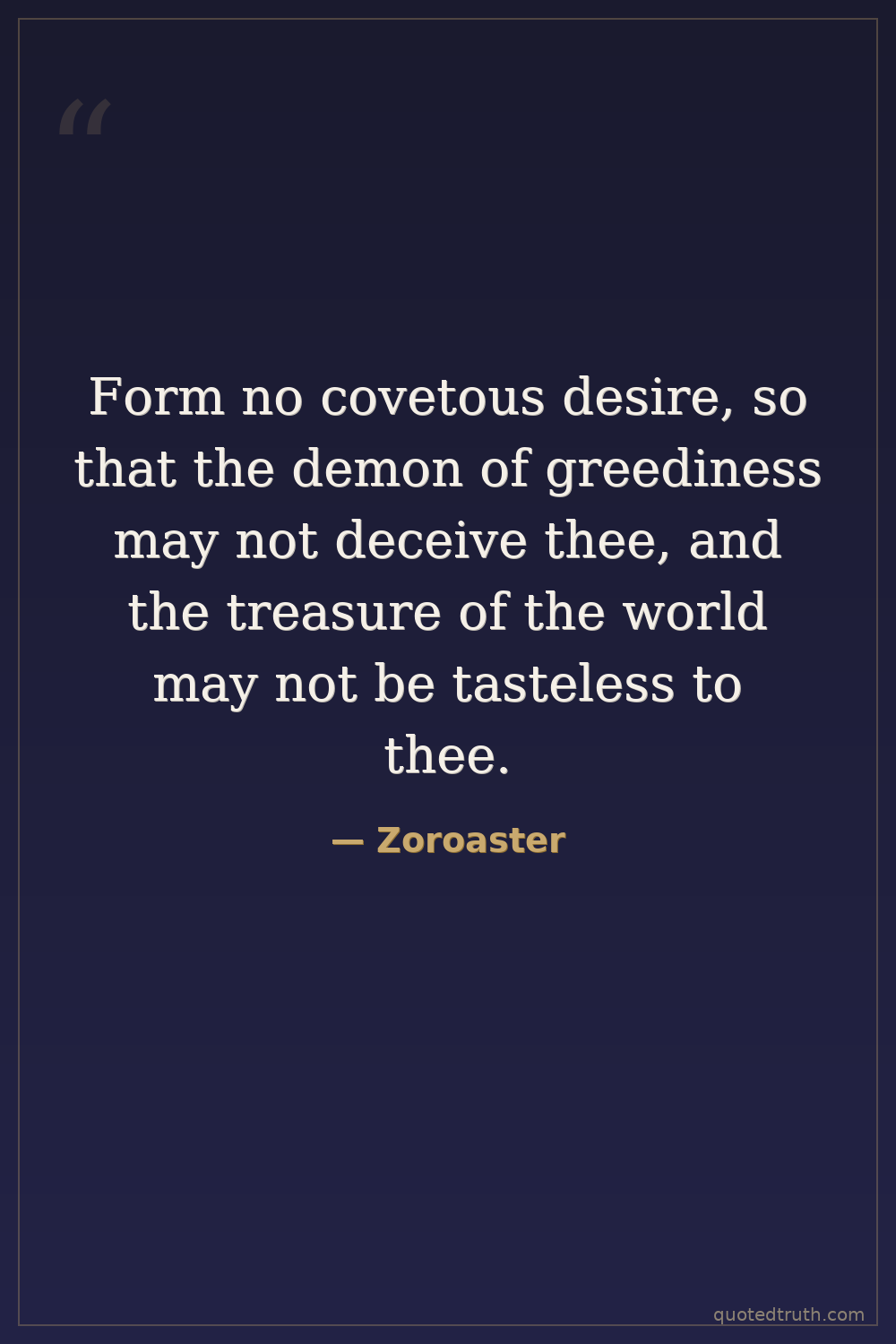
Zoroaster — "Form no covetous desire, so that the demon of greediness may not deceive thee, a…"
Form no covetous desire, so that the demon of greediness may not deceive thee, and the treasure of the world may not be tasteless to thee.
Form no covetous desire, so that the demon of greediness may not deceive thee, and the treasure of the world may not be tasteless to thee.
Click any product to generate a realistic preview. Up to 3 at a time.
* Initial load can take up to 90 seconds — revising the preview in another color is nearly instant.
"The reward for righteousness is not merely in the afterlife, but in the present moment through inner peace and joy."
"Who created light and darkness? Who created sleep and waking?"
"Hear with your ears the best things; behold with a clear vision the two choices, deciding each man for himself, before the great consummation."
"The path of the righteous is not always easy, but it is always right. And sometimes, it involves a lot of sheep. You wouldn't believe the amount of sheep."
"A gentle hand can lead even an elephant by a hair."
Iranian prophet who founded Zoroastrianism, the first major religion of cosmic dualism between good (Ahura Mazda) and evil (Angra Mainyu). Closely associated with The Buddha (near-contemporary Eastern moral-cosmological revolutionary). For an intellectual contrast, see Friedrich Nietzsche, German philosopher of 'beyond good and evil' — Nietzsche appropriated Zarathustra's name for Thus Spoke Zarathustra (1883) precisely to invert the original's moral cosmology — the historical Zoroaster founded the good-versus-evil framework Nietzsche's character announces the end of.
Found in 1 providers: gemini
1 source checked
Don't let grasping desires take hold of you. When you constantly crave more wealth, possessions, or status, that hunger itself becomes a trap that distorts your judgment and steals your satisfaction. Paradoxically, the more greedily you chase the world's riches, the less you actually enjoy them, because nothing ever feels like enough. Contentment comes from restraining desire, not feeding it, so ordinary blessings regain their flavor.
Zoroaster founded a faith built on the moral battle between Asha (truth, order) and Druj (the lie, chaos), with greediness personified as the demon Az who devours and never satisfies. As a prophet-reformer challenging a priestly caste focused on ritual wealth and cattle-raiding, he taught that inner purity and good thought mattered more than material gain, making this warning central to his ethical system rather than incidental advice.
In the late second or early first millennium BCE on the Iranian plateau, tribal society revolved around herds, plunder raids, and warrior chieftains who measured honor by seized cattle and gold. Older polytheistic priests sanctified these raids through sacrifice. Zoroaster emerged during this turbulent transition from pastoral raiding to settled agriculture, preaching a radical ethical monotheism that reframed virtue as honest labor and inner discipline rather than conquest, making anti-greed teaching revolutionary.
AI-generated insights based on extensive research and information for context. Factual errors? Email [email protected].
Your cart is empty