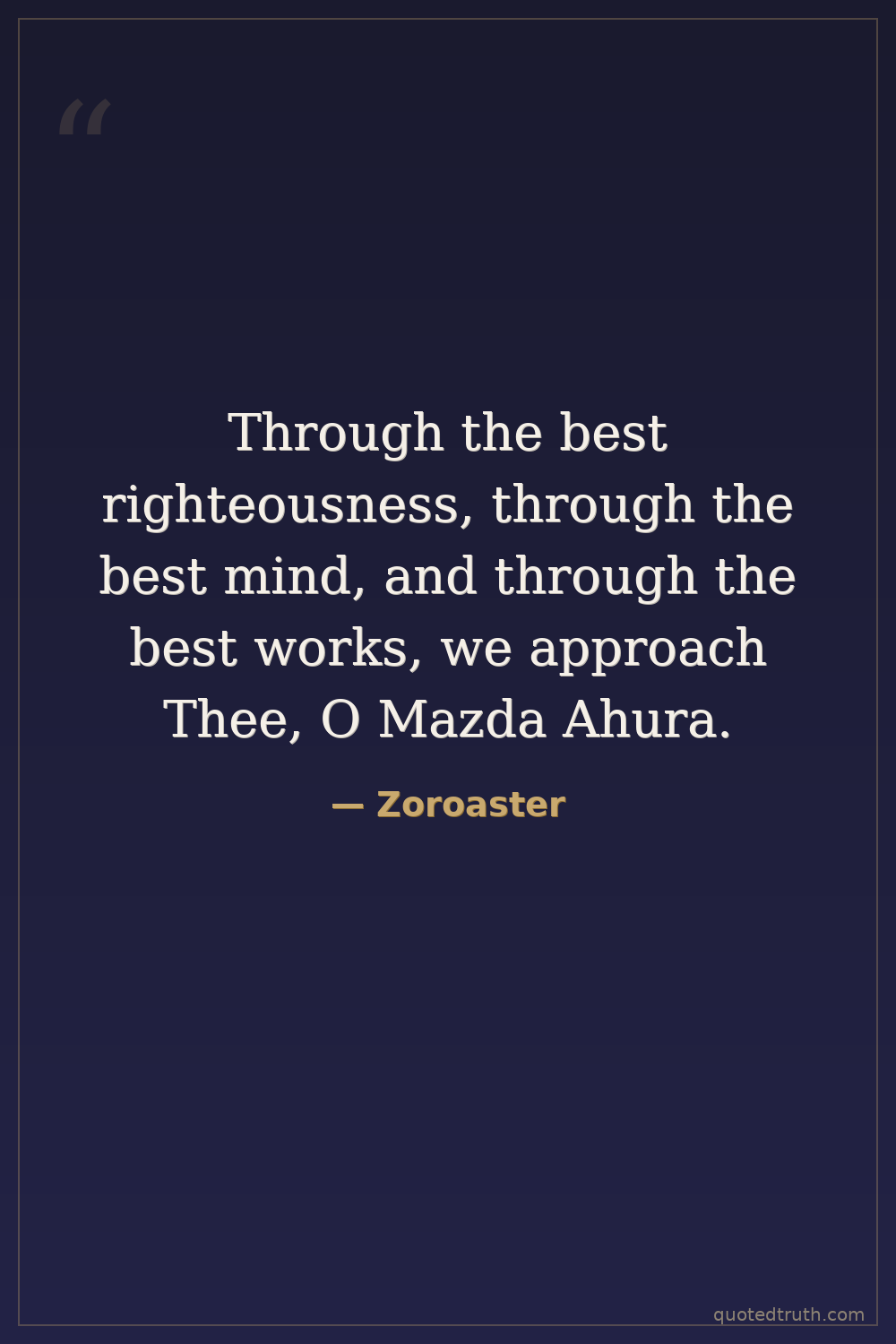
Zoroaster — "Through the best righteousness, through the best mind, and through the best work…"
Through the best righteousness, through the best mind, and through the best works, we approach Thee, O Mazda Ahura.
Through the best righteousness, through the best mind, and through the best works, we approach Thee, O Mazda Ahura.
Click any product to generate a realistic preview. Up to 3 at a time.
* Initial load can take up to 90 seconds — revising the preview in another color is nearly instant.
"Evil to the evil, good reward to the good."
"In the radiance of righteousness, we shall learn self-knowledge and righteous thinking."
"Clear is this all to the man of wisdom as to the man who carefully thinks; he who upholds Truth with all the might of his power, he who upholds Truth the utmost in his word and deed, he, indeed, is th…"
"Aša Vahišta (Best Righteousness) is the best of all things, and happiness is to him who is righteous for the sake of Righteousness."
"Whoso causes affliction to the righteous, him shall the evil spirit hold captive."
Iranian prophet who founded Zoroastrianism, the first major religion of cosmic dualism between good (Ahura Mazda) and evil (Angra Mainyu). Closely associated with The Buddha (near-contemporary Eastern moral-cosmological revolutionary). For an intellectual contrast, see Friedrich Nietzsche, German philosopher of 'beyond good and evil' — Nietzsche appropriated Zarathustra's name for Thus Spoke Zarathustra (1883) precisely to invert the original's moral cosmology — the historical Zoroaster founded the good-versus-evil framework Nietzsche's character announces the end of.
Found in 1 providers: gemini
1 source checked
Reaching the highest truth or divine presence requires aligning three parts of yourself at their best: your moral choices, your thinking, and your actions. You cannot approach the sacred through words or ritual alone. Good intentions without good deeds fall short, and good deeds without clear thinking go astray. Only when right conduct, right thought, and right work move together do you draw closer to what is ultimate and good.
This triad, often rendered as good thoughts, good words, good deeds, is the defining ethical formula Zoroaster taught and the core of every Gatha he composed. As a reforming priest who rejected the bloody sacrifices and polytheism of his tribe, he replaced ritual access to the gods with personal moral effort. Addressing Ahura Mazda, the single wise Lord he proclaimed, shows his radical monotheism and his conviction that righteousness, not sacrifice, is the true path.
Zoroaster lived in Bronze Age eastern Iran, roughly 1500 to 1000 BCE, among pastoral Indo-Iranian tribes who worshipped many deities through animal sacrifice, intoxicating haoma rites, and warrior cults led by hereditary priests. Cattle raiding and tribal violence were constant. By insisting that a person approaches the divine through ethical character rather than priestly ceremony, Zoroaster broke sharply with that sacrificial culture and laid groundwork that later shaped Persian imperial religion and, indirectly, Judaism, Christianity, and Islam.
AI-generated insights based on extensive research and information for context. Factual errors? Email [email protected].
Your cart is empty