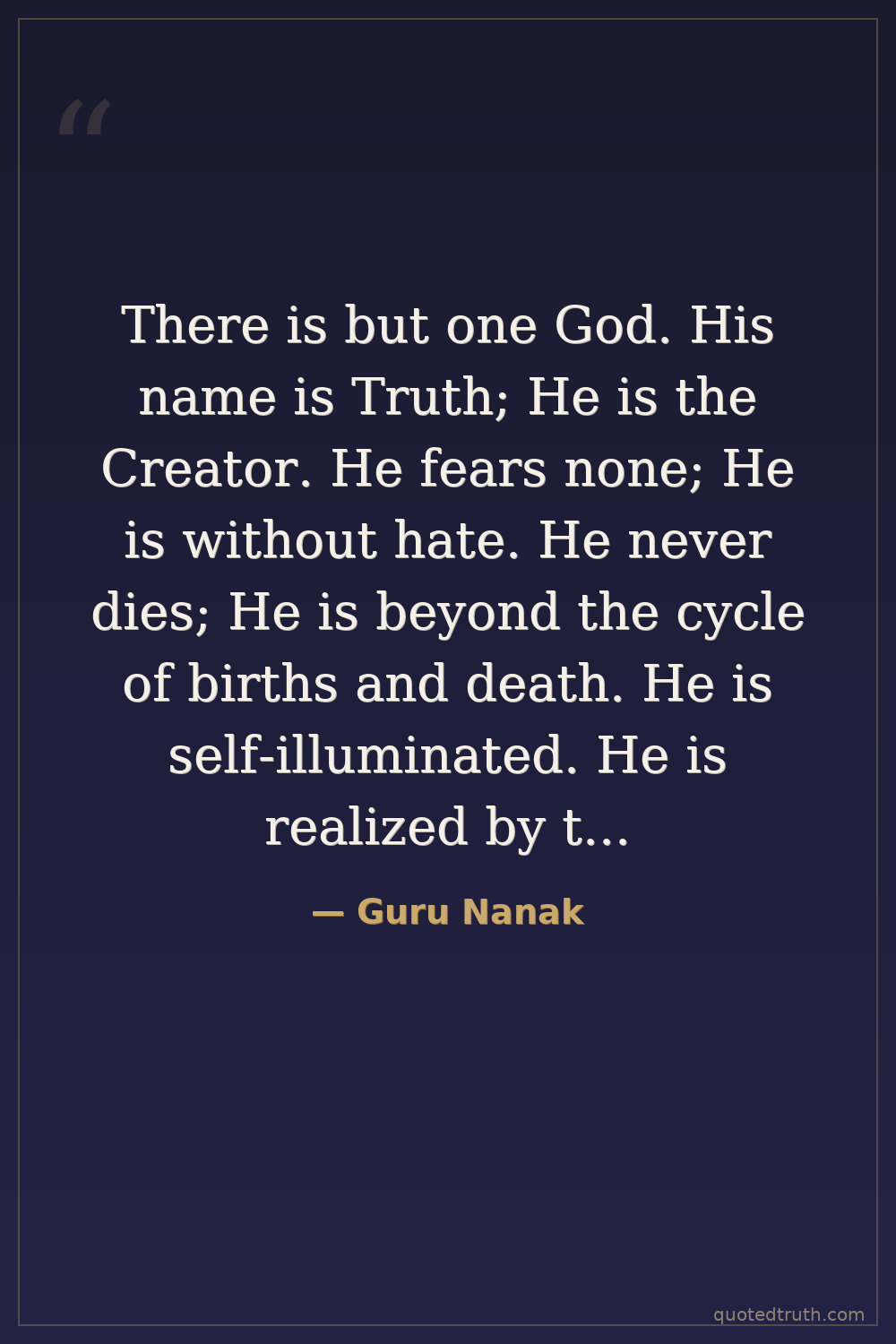
Guru Nanak — "There is but one God. His name is Truth; He is the Creator. He fears none; He is…"

There is but one God. His name is Truth; He is the Creator. He fears none; He is without hate. He never dies; He is beyond the cycle of births and death. He is self-illuminated. He is realized by the kindness of the True Guru.
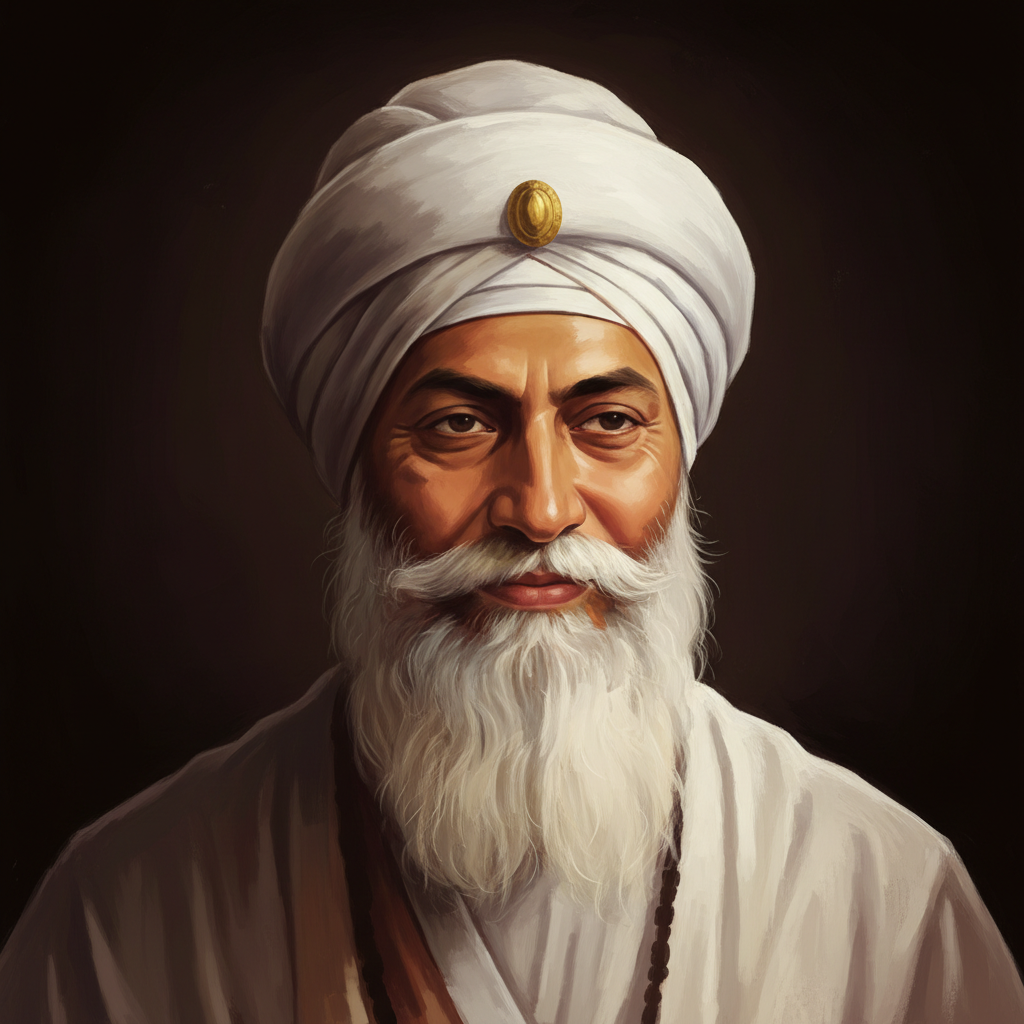
Guru Nanak — Guru Nanak Early Modern · Founder of Sikhism

Get This Quote & Author's Image Illustrated On:

Click any product to generate a realistic preview. Up to 3 at a time.
* Initial load can take up to 90 seconds — revising the preview in another color is nearly instant.

Kitchen

Apparel

Other

About Guru Nanak (1469-1539)

Founder of Sikhism and the first of the Ten Sikh Gurus, whose teachings of one universal God and rejection of caste shaped Punjab. Closely associated with Kabir (mystical poet whose verses appear in the Sikh Guru Granth Sahib). For an intellectual contrast, see Brahmanical orthodoxy, the Hindu caste-and-ritual establishment of his era — Sikhism was founded as a deliberate alternative to both Hindu ritual hierarchy and Islamic exclusivism — Nanak's universalism was a structural rejection of caste and priestly mediation.

Details

Mool Mantra, opening verse of the Guru Granth Sahib

Date: c. 15th-16th century CE

Philosophical

Verification

Unverifiable

Found in 1 providers: gemini

1 source checked

Understanding this quote

What it means

One universal God exists, defined by truth rather than human-made names or forms. This God created everything, holds no fear or hatred toward any being, transcends death and rebirth, and shines by inner light alone. Humans cannot reach this divine presence through ritual or status but only through genuine spiritual guidance and grace.

Relevance to Guru Nanak

Guru Nanak spent his life rejecting caste hierarchy, idol worship, and empty ritual, insisting God belongs to no single religion. He traveled thousands of miles across Asia to spread this message of one formless Creator accessible to all. This opening verse of the Guru Granth Sahib distills his entire mission into a few precise lines.

The era

In 15th-16th century Punjab, Hinduism and Islam frequently clashed over theology, ritual purity, and political power under the Mughal and Lodi sultanates. Religious identity was tribal and often violent. Nanak's declaration of one borderless God who favors no community directly challenged both Brahmin caste gatekeeping and Islamic exclusivity, making it a radical, unifying act.

AI-generated insights based on extensive research and information for context. Factual errors? Email [email protected].
Your Cart

Your cart is empty