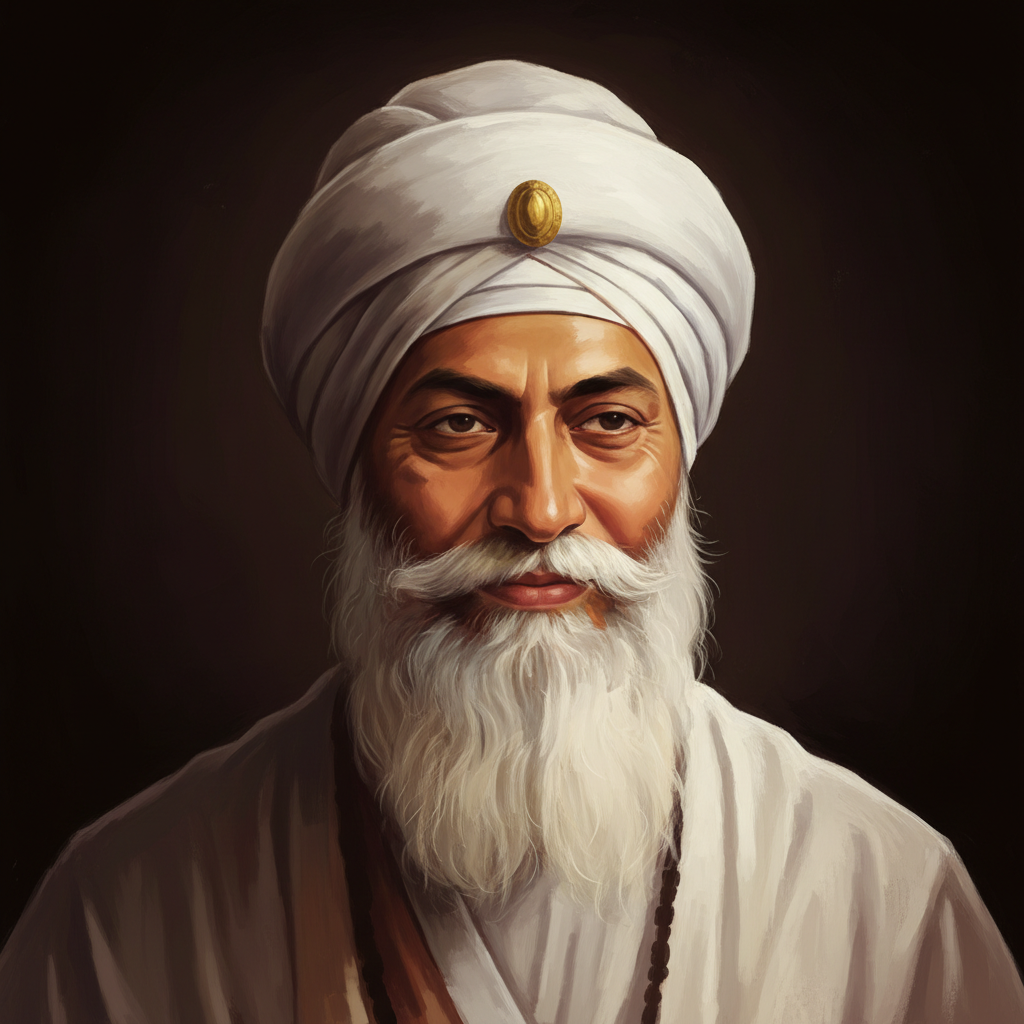
Guru Nanak — "There is no Hindu and no Musalman."
There is no Hindu and no Musalman.
There is no Hindu and no Musalman.
Click any product to generate a realistic preview. Up to 3 at a time.
* Initial load can take up to 90 seconds — revising the preview in another color is nearly instant.
"He who is born, is bound to die. The only thing certain is death. All else is illusion."
"The wise man speaks little and listens much. Especially when someone is explaining how to fix a leaky faucet."
"A true yogi does not wander around, but fixes his mind on God within."
"Without devotion, life is barren, like a tree without fruit."
"I bow at His feet constantly and pray to Him. The Guru, the True Guru, has shown me the Way."
Founder of Sikhism and the first of the Ten Sikh Gurus, whose teachings of one universal God and rejection of caste shaped Punjab. Closely associated with Kabir (mystical poet whose verses appear in the Sikh Guru Granth Sahib). For an intellectual contrast, see Brahmanical orthodoxy, the Hindu caste-and-ritual establishment of his era — Sikhism was founded as a deliberate alternative to both Hindu ritual hierarchy and Islamic exclusivism — Nanak's universalism was a structural rejection of caste and priestly mediation.
Upon emerging from the Vein river, first utterance after enlightenment, Janam Sakhi tradition
Date: 1499 (approximate)
GeneralFound in 1 providers: grok
1 source checked
Religious labels do not define a person's worth or spiritual truth. Hindu and Muslim are just social categories layered onto a shared human reality; God does not recognize those divisions. What matters is direct devotion, honest living, and treating every person as equal in the divine light, not which temple or mosque you attend or which rituals you perform.
Nanak reportedly spoke these words after emerging from a three-day disappearance in the Bein river around 1499, launching his mission. He rejected caste, ritualism, and sectarianism, preached one formless God (Ik Onkar), ate with Muslims and Hindus alike, and traveled with the Muslim musician Mardana. His life embodied this erasure of religious boundaries.
In late-15th and early-16th century Punjab, Hindu and Muslim communities lived under Delhi Sultanate and later Mughal rule amid deep sectarian friction, Brahminical caste hierarchy, forced conversions, and jizya taxation. Bhakti and Sufi movements were already questioning ritualism. Nanak's declaration cut directly into this charged landscape, offering a third path that refused both orthodoxies during a moment of religious polarization and political upheaval.
AI-generated insights based on extensive research and information for context. Factual errors? Email [email protected].
Your cart is empty