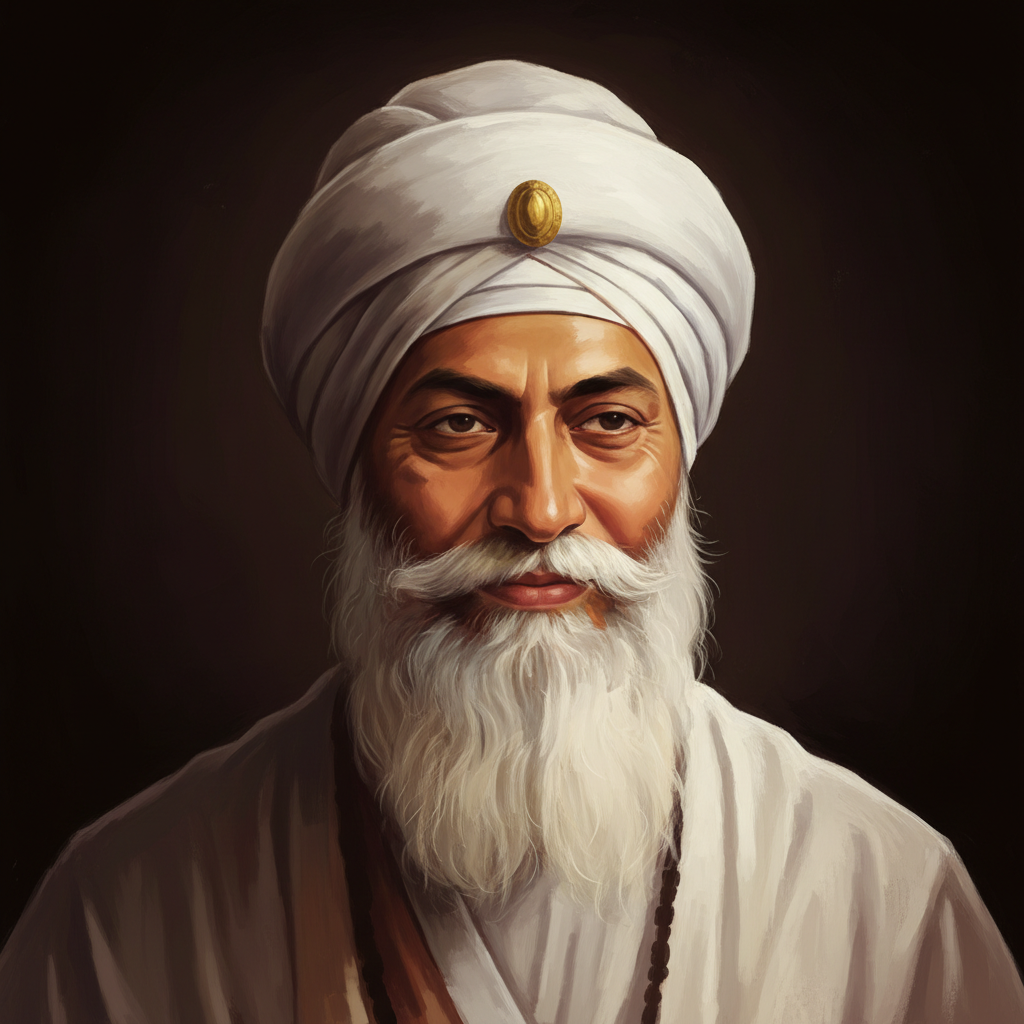
Guru Nanak — "The mouth that praises God is blessed; the eyes that see Him are blessed."
The mouth that praises God is blessed; the eyes that see Him are blessed.
The mouth that praises God is blessed; the eyes that see Him are blessed.
Click any product to generate a realistic preview. Up to 3 at a time.
* Initial load can take up to 90 seconds — revising the preview in another color is nearly instant.
"If you must speak, speak only the Truth."
"Without genuine understanding, observing (Clergy-concocted) fasting, religious rituals and daily Poojaa lead only to the love of duality."
"There is but one God. His name is Truth; He is the Creator. He fears none; He is without hate. He never dies; He is beyond the cycle of births and death. He is self-illuminated. He is realized by the …"
"The greatest joy is to be found in the Lord's Name."
"Guru Nanak taught that depriving others of their rights is a serious moral offense."
Founder of Sikhism and the first of the Ten Sikh Gurus, whose teachings of one universal God and rejection of caste shaped Punjab. Closely associated with Kabir (mystical poet whose verses appear in the Sikh Guru Granth Sahib). For an intellectual contrast, see Brahmanical orthodoxy, the Hindu caste-and-ritual establishment of his era — Sikhism was founded as a deliberate alternative to both Hindu ritual hierarchy and Islamic exclusivism — Nanak's universalism was a structural rejection of caste and priestly mediation.
Found in 1 providers: gemini
1 source checked
Blessings come to those who speak God's praises and to those who perceive the divine directly. The quote elevates speech and sight — two ordinary human faculties — by connecting them to God. Being blessed isn't tied to caste, ritual, or priestly mediation; it flows from sincere devotion. Praising God transforms the mouth from a vessel of idle talk into something sacred, and seeing God reframes all of existence as divine presence.
Guru Nanak made devotional singing (kirtan) the cornerstone of Sikh worship, composing hundreds of hymns praising God — he embodied the blessed mouth. He rejected priestly gatekeepers and insisted God was directly perceptible through sincere devotion, called Naam Simran. During his four great journeys across Asia, he sought God's presence in all communities. His core teaching that the divine is accessible to everyone, not just the high-caste, makes this quote deeply autobiographical.
Guru Nanak lived during India's transition from the Delhi Sultanate to early Mughal rule (1469–1539), a period of sharp religious stratification. Brahminical Hinduism enforced caste-based spiritual access; Islamic orthodoxy emphasized law over inner experience. The Bhakti and Sufi movements were pushing back, asserting that ordinary devotees could reach God directly. This quote aligns with that democratizing impulse — blessing is available to any mouth that praises, any eyes that seek, regardless of birth or creed.
AI-generated insights based on extensive research and information for context. Factual errors? Email [email protected].
Your cart is empty