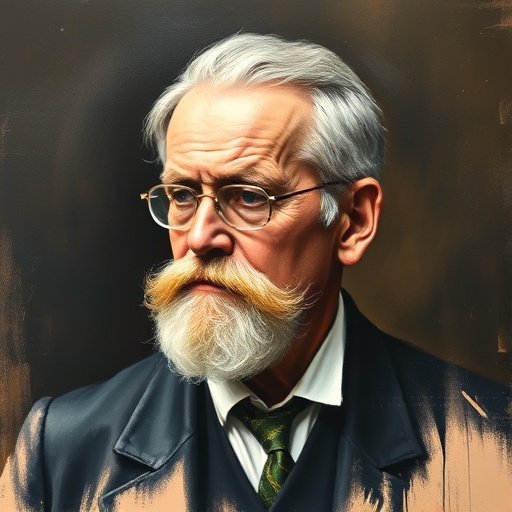
Gregor Mendel — "My scientific work brought me such satisfaction, and I am convinced the entire W…"
My scientific work brought me such satisfaction, and I am convinced the entire World will recognize the results of these studies.
My scientific work brought me such satisfaction, and I am convinced the entire World will recognize the results of these studies.
Click any product to generate a realistic preview. Up to 3 at a time.
* Initial load can take up to 90 seconds — revising the preview in another color is nearly instant.
"The numerical ratios I have observed cannot be dismissed as mere coincidence."
"I have spent more time with peas than with people."
"My experiments with single traits all lead to the same result: that from the seeds of hybrids, plants are obtained half of which in turn carry the hybrid trait (Aa), the other half, however, receive t…"
"It requires a good deal of courage to undertake such extensive experiments."
"I have sown many seeds, but only a few have borne fruit."
A quote attributed to him in his final years, emphasizing personal satisfaction and future recognition.
Date: c. 1883-1884
PhilosophicalFound in 1 providers: gemini
1 source checked
Mendel expresses deep personal fulfillment in his research while showing remarkable confidence that his findings would eventually gain global recognition. Despite working in obscurity, he believed his discoveries about heredity were too important to remain ignored. The statement captures both intellectual satisfaction — the joy of understanding nature — and a quiet but firm conviction that truth, once found, inevitably earns its place in history.
Mendel spent eight years crossbreeding pea plants in a monastery garden in Brno, presenting his results in 1865 to an audience that largely ignored him. He died in 1884 without mainstream recognition. Yet his letters reveal a man unbothered by immediate fame — a patient monk-scientist who trusted the data. This quote reflects that exact temperament: serene certainty rooted in methodological rigor rather than ego or ambition.
The 1860s saw Darwin's evolution theory shaking biology, but the mechanism of inheritance remained a mystery. Science was professionalizing but still dominated by established figures in major institutions — a monastery friar in Moravia had little platform. Mendel's work was rediscovered in 1900, sparking the genetics revolution. His confidence proved prophetic: twentieth-century biology, medicine, and agriculture were built directly on the hereditary laws he discovered alone.
AI-generated insights based on extensive research and information for context. Factual errors? Email [email protected].
Your cart is empty