Alan Turing — "The question, 'Can machines think?' should be replaced by 'Are there imaginable …"
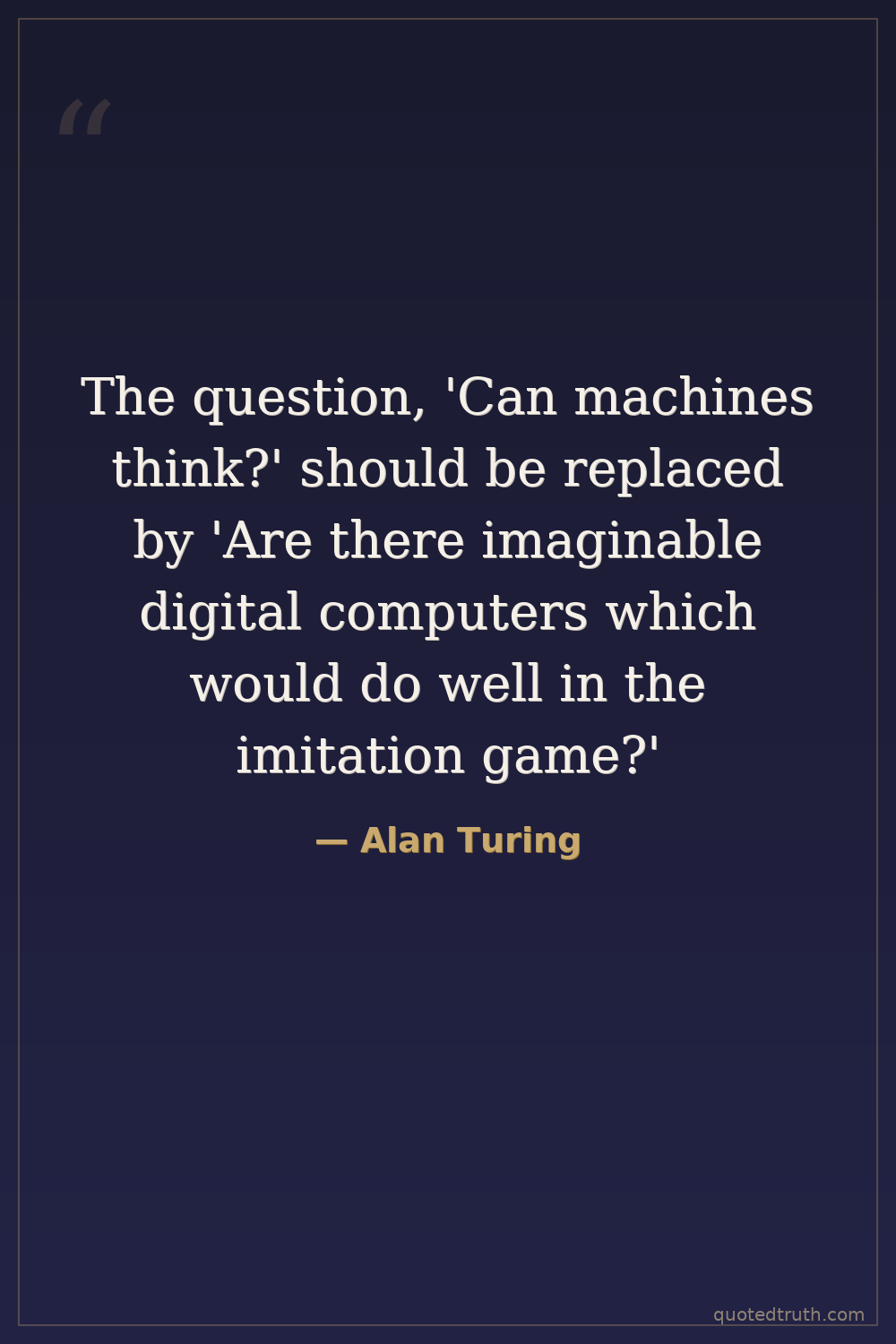
The question, 'Can machines think?' should be replaced by 'Are there imaginable digital computers which would do well in the imitation game?'
The question, 'Can machines think?' should be replaced by 'Are there imaginable digital computers which would do well in the imitation game?'
Click any product to generate a realistic preview. Up to 3 at a time.
* Initial load can take up to 90 seconds — revising the preview in another color is nearly instant.
"Mathematical logic, as a subject, is going to have a great future."
"We are trying to create a machine that can solve problems."
"The human brain is an electrical machine."
"We are not interested in the fact that the machine can do well, but in the fact that it can do badly."
"I expect to lie in the sun, talk French and modern Greek, and make love, though the sex and nationality... has yet to be decided: in fact it is quite possible that this item will be altogether omitted…"
From his paper 'Computing Machinery and Intelligence', published in the journal Mind.
Date: 1950
PhilosophicalFound in 1 providers: gemini
1 source checked
Instead of debating the abstract, philosophical question of whether machines can truly think, we should ask a concrete, testable question: can a machine convincingly imitate human conversation well enough that a person cannot tell the difference? Replace unanswerable metaphysics with a practical, empirical test we can actually run.
Turing proposed this directly in his landmark 1950 paper introducing the Imitation Game, later called the Turing Test. As a mathematician who broke Enigma by building machines that mimicked enemy logic, Turing consistently converted abstract problems into computable procedures. He believed operational definitions beat philosophical debates.
In 1950, computers were room-sized calculating machines; the idea they could simulate thought was radical. Cold War pressures accelerated computing research while philosophers debated consciousness. Turing reframed AI before the field existed, shifting discourse from theology and philosophy toward engineering, anticipating debates that dominate artificial intelligence research seventy-five years later.
AI-generated insights based on extensive research and information for context. Factual errors? Email [email protected].
Your cart is empty