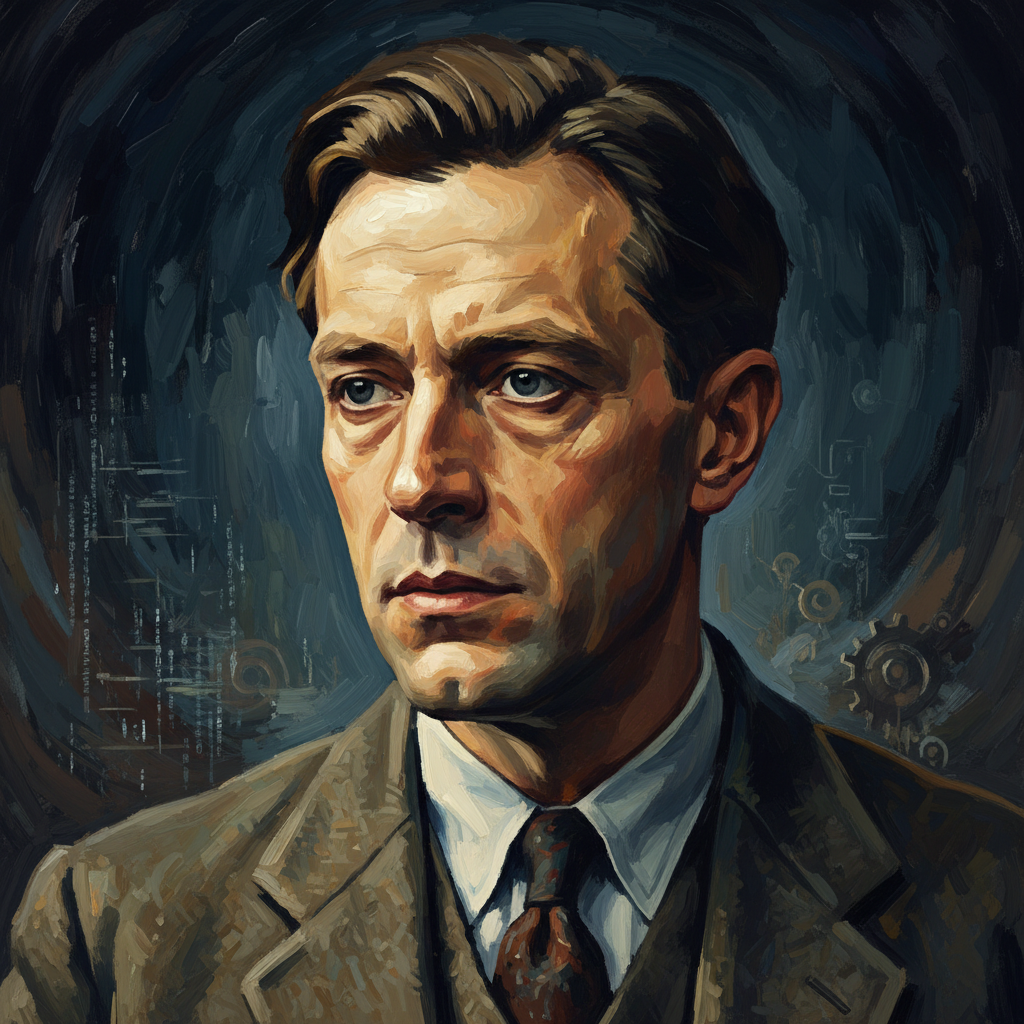
Alan Turing — "The human brain is an electrical machine."
The human brain is an electrical machine.
The human brain is an electrical machine.
Click any product to generate a realistic preview. Up to 3 at a time.
* Initial load can take up to 90 seconds — revising the preview in another color is nearly instant.
"The machine should be able to learn from experience."
"A machine does not have to be conscious to be intelligent."
"It seems probable that once the machine thinking method had started, it would not take long to outstrip our feeble powers… They would be able to converse with each other to sharpen their wits. At some…"
"The problem of artificial intelligence is to create machines that can learn and adapt."
"The digital computers of today are in principle exactly the same as the universal machines I described."
Found in 1 providers: grok
1 source checked
The brain runs on electrical signals — neurons firing across synapses — making it, at its core, a physical information-processing system rather than something mystical or unknowable. This strips away supernatural framing of mind and repositions thought as a mechanical process. The implication is direct: if the brain is a machine, it can be studied, modeled, and potentially replicated by other machines.
Turing's entire career centered on whether machines could think. His 1950 paper introduced the Turing Test to operationalize machine intelligence, and his universal computing model showed one machine could execute any algorithm. Viewing the brain as electrical machinery was foundational — it meant mind was computation, not spirit, and therefore reproducible. His Bletchley codebreaking work proved machines could already solve problems once assumed to require human intuition.
The 1940s–50s birthed modern computing alongside fierce debate about whether machines could replicate human thought. Wiener's cybernetics and Shannon's information theory reframed brains and machines as information systems. Neuroscience was simultaneously discovering neurons fired electrically. Religious and philosophical traditions insisted on human uniqueness; Turing's framing challenged that directly. The Cold War also pushed governments to automate intelligence work, making machine cognition urgently practical and politically charged.
AI-generated insights based on extensive research and information for context. Factual errors? Email [email protected].
Your cart is empty