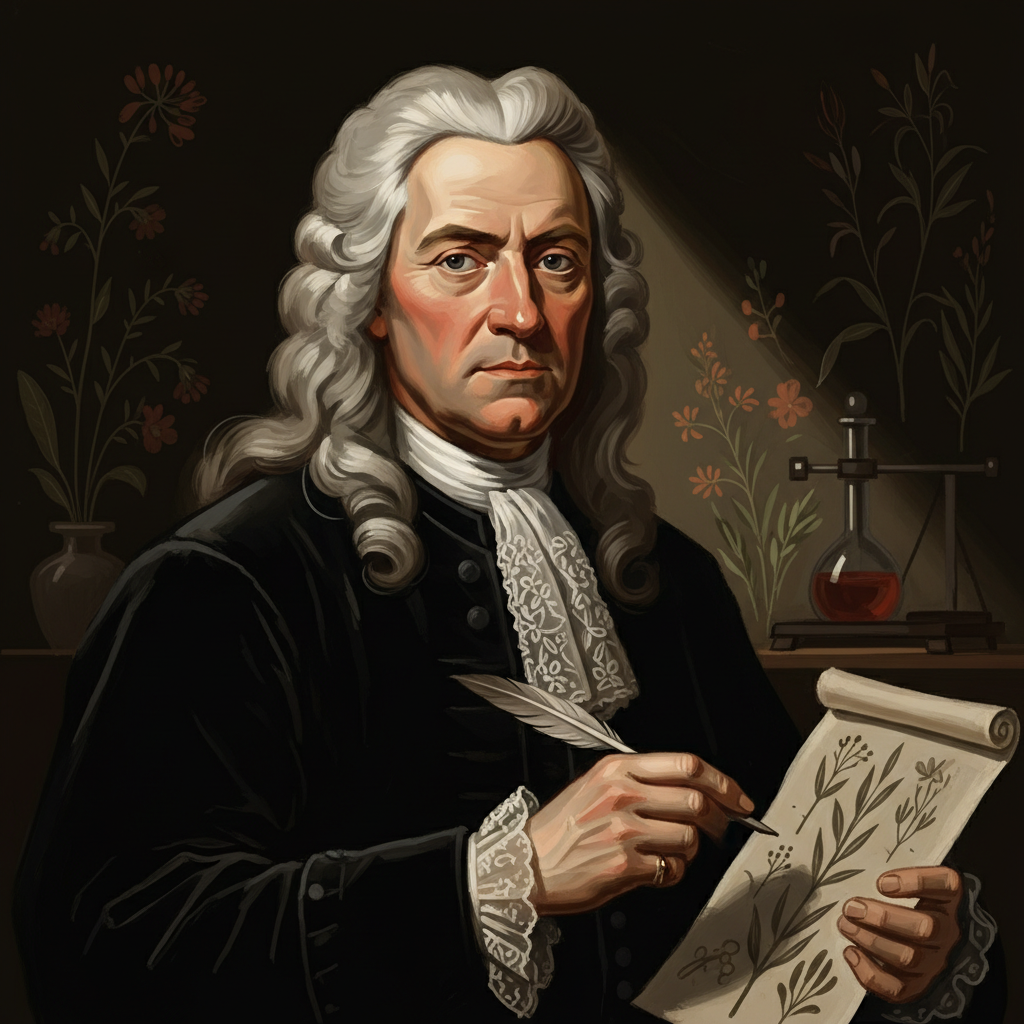
Carl Linnaeus — "Every genus is natural, created as such in the beginning, hence not to be rashly…"
Every genus is natural, created as such in the beginning, hence not to be rashly split up or stuck together by whim or according to anyone's theory.
Every genus is natural, created as such in the beginning, hence not to be rashly split up or stuck together by whim or according to anyone's theory.
Click any product to generate a realistic preview. Up to 3 at a time.
* Initial load can take up to 90 seconds — revising the preview in another color is nearly instant.
"The natural system is the highest goal of botany."
"If you do not know the names of things, the knowledge of them is lost, too."
"I saw the infinite, all-knowing and all-powerful God from behind as he went away, and I grew dizzy. I followed his footsteps over nature's fields and saw everywhere an eternal wisdom and power, an ins…"
"I have explored the whole world of nature."
"Nature has been kind to me, and I have repaid her by being her faithful interpreter."
Swedish botanist and the father of modern taxonomy whose Systema Naturae (1735) introduced binomial nomenclature for naming all species. Closely associated with Joseph Banks (British naturalist who carried Linnaean classification on Cook's voyages). For an intellectual contrast, see Comte de Buffon, French naturalist and Histoire Naturelle author (1749-1788) — Buffon explicitly attacked Linnaean fixed-categories taxonomy as artificial and rejected the binomial system; his gradualist, environment-shaped natural history was the explicit alternative. Anticipates the fixed-species-vs-evolution debate Darwin would later resolve.
From his writings, emphasizing the divine origin and natural integrity of genera.
Date: 18th Century
PhilosophicalFound in 1 providers: gemini
1 source checked
Natural groups of organisms are real, objective categories that exist independent of human invention. They should not be arbitrarily divided or merged to fit someone's personal preference or fashionable theory. Classification must respect the actual boundaries nature provides, not the convenience of any individual scientist or intellectual framework.
Linnaeus built the foundational system of biological classification still used today, naming over 12,000 species. This reflects his core belief that nature has inherent order — his binomial nomenclature and hierarchical taxonomy aimed to reveal God's divine plan, not impose arbitrary human categories. He fiercely defended genera as real, discoverable units.
In 18th-century Europe, natural philosophy was transitioning from speculative systems to empirical science. Competing naturalists proposed contradictory classification schemes based on single traits or personal theories. Linnaeus was asserting scientific discipline against chaos: classification required consensus grounded in observable nature, not philosophical whim, as botany and zoology professionalized during the Enlightenment.
AI-generated insights based on extensive research and information for context. Factual errors? Email [email protected].
Your cart is empty