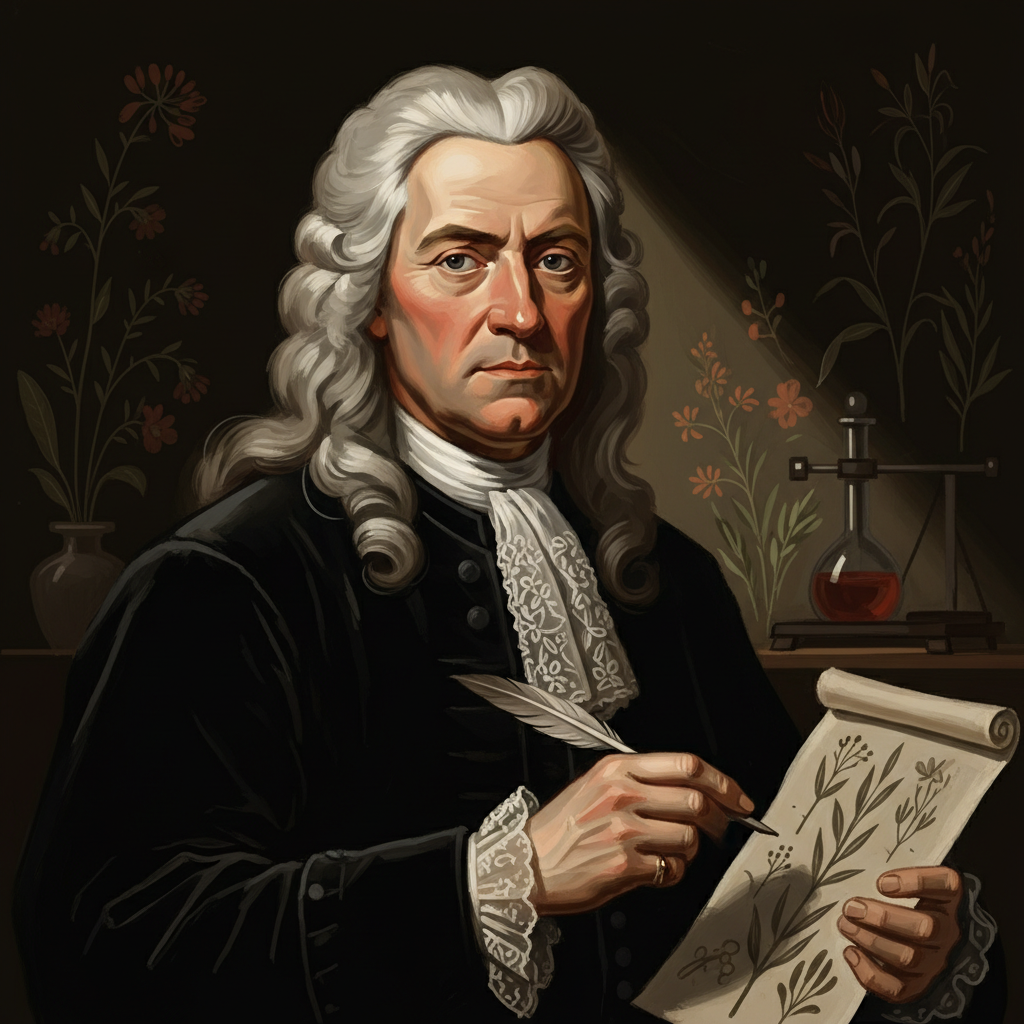
Carl Linnaeus — "The only true knowledge is that which is acquired through the senses."
The only true knowledge is that which is acquired through the senses.
The only true knowledge is that which is acquired through the senses.
Click any product to generate a realistic preview. Up to 3 at a time.
* Initial load can take up to 90 seconds — revising the preview in another color is nearly instant.
"I saw a monster today: a two-headed calf. It lived for only an hour, but I dissected it to see if God had given it two souls."
"Blessed be the Lord for the beauty of summer and spring, for the air, the water, the verdure, and the song of birds."
"Man is the measure of all things, but the Creator is the measure of man."
"The European is inventive, governed by laws, and wears tight clothing."
"The Asiatic is haughty, greedy, and governed by opinions."
Swedish botanist and the father of modern taxonomy whose Systema Naturae (1735) introduced binomial nomenclature for naming all species. Closely associated with Joseph Banks (British naturalist who carried Linnaean classification on Cook's voyages). For an intellectual contrast, see Comte de Buffon, French naturalist and Histoire Naturelle author (1749-1788) — Buffon explicitly attacked Linnaean fixed-categories taxonomy as artificial and rejected the binomial system; his gradualist, environment-shaped natural history was the explicit alternative. Anticipates the fixed-species-vs-evolution debate Darwin would later resolve.
An empiricist philosophical stance on the acquisition of knowledge.
Date: Uncertain (attributed)
EducationalFound in 1 providers: gemini
1 source checked
Genuine knowledge comes only from direct sensory experience — seeing, touching, and examining the world firsthand. It rejects pure speculation, inherited dogma, and armchair reasoning as sources of real understanding. Truth must be grounded in empirical evidence the senses can verify. Observations of actual phenomena, not abstract theorizing or received authority, constitute legitimate knowledge about reality.
Linnaeus built his entire scientific legacy on direct sensory examination. He personally inspected thousands of plant and animal specimens to construct his binomial nomenclature system, published in Systema Naturae. He dispatched students across continents to observe and collect firsthand. His taxonomy demanded hands-on measurement, visual description, and tactile assessment — not inherited classical authority. To Linnaeus, a species misidentified by sight was a species misclassified by science.
The 18th-century Enlightenment positioned empiricism as the antidote to scholastic tradition. Europe's Scientific Revolution had undermined Aristotelian authority, replacing deductive reasoning with observation-based inquiry. Meanwhile, explorers returning from the Americas, Africa, and Asia brought thousands of unknown species, making systematic sensory-based classification urgently necessary. Natural philosophers competed to catalog nature through direct study. Claiming knowledge without observation was increasingly regarded as superstition rather than scholarship.
AI-generated insights based on extensive research and information for context. Factual errors? Email [email protected].
Your cart is empty