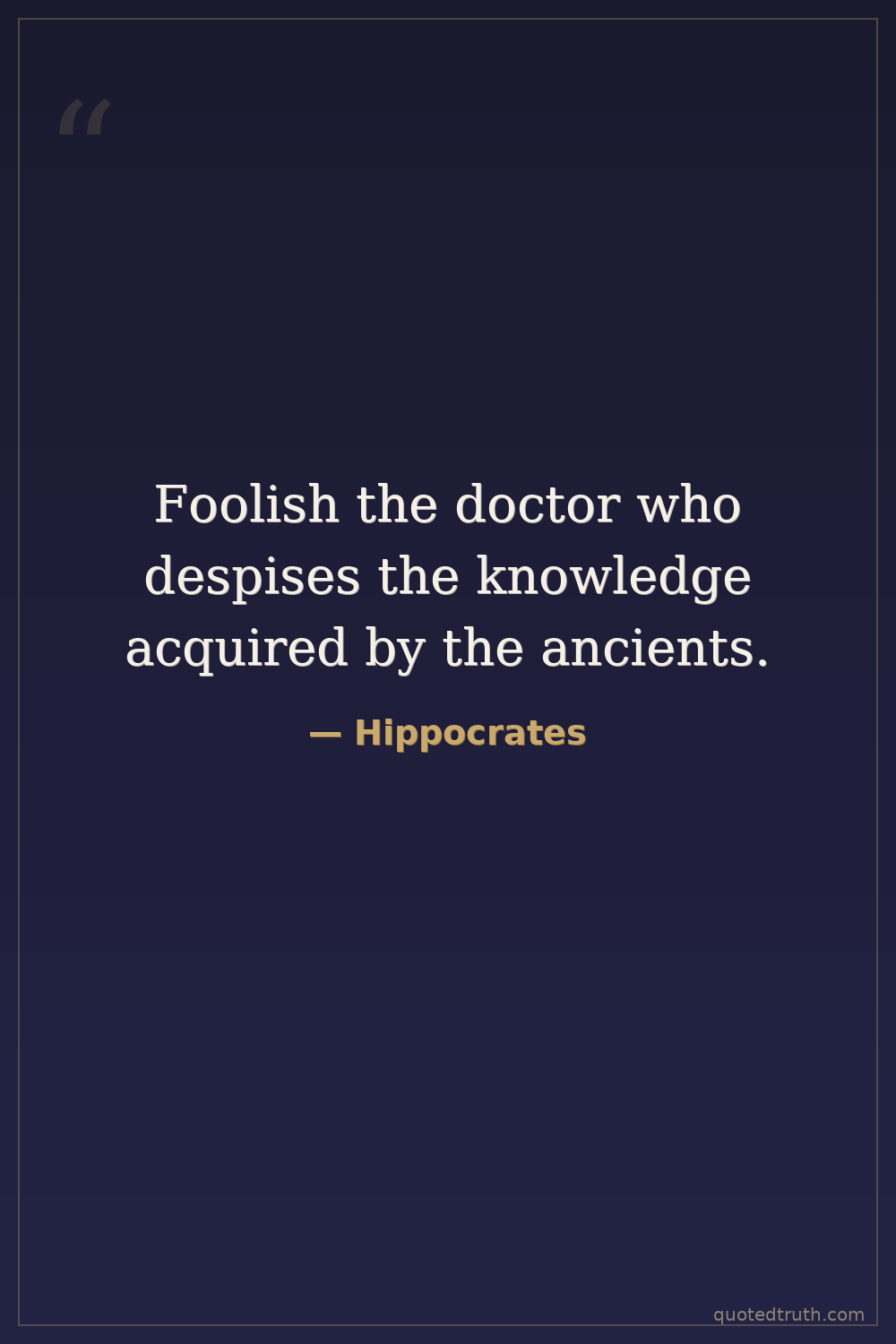
Hippocrates — "Foolish the doctor who despises the knowledge acquired by the ancients."
Foolish the doctor who despises the knowledge acquired by the ancients.
Foolish the doctor who despises the knowledge acquired by the ancients.
Click any product to generate a realistic preview. Up to 3 at a time.
* Initial load can take up to 90 seconds — revising the preview in another color is nearly instant.
"It is well to be up before daybreak, for such habits contribute to health, wealth, and wisdom."
"If you want to live a long life, you must be careful not to eat too much of the same thing."
"Wherever the art of medicine is loved, there is also a love of humanity."
"Cure sometimes, treat often and comfort always."
"Much suffering is caused by the humors."
Advocating for respect and learning from historical medical wisdom.
Date: c. 5th Century BCE
PhilosophicalFound in 1 providers: gemini
1 source checked
Dismissing accumulated wisdom from previous generations is arrogant and self-defeating. Knowledge builds on itself across time, and rejecting older insights simply because they are old leaves you ignorant of hard-won truths. A skilled practitioner respects what came before, building on inherited understanding rather than discarding it out of pride or the mistaken belief that only new discoveries hold value.
Hippocrates himself drew heavily from Egyptian, Babylonian, and earlier Greek medical traditions. He synthesized centuries of empirical observation into systematic practice. His Hippocratic Corpus references prior healers respectfully. As someone who codified inherited knowledge into teachable medicine, he understood firsthand that his own work depended entirely on predecessors who carefully documented what worked and what harmed patients.
In ancient Greece, knowledge transmission was fragile and oral traditions could be lost entirely. Temple healing traditions from Egypt and Mesopotamia held centuries of accumulated observation. Greek physicians competed with religious healers and folk remedies. Preserving and respecting elder knowledge was existentially important since libraries were rare, texts expensive, and institutional memory easily destroyed by war, famine, or the death of a single keeper of knowledge.
AI-generated insights based on extensive research and information for context. Factual errors? Email [email protected].
Your cart is empty