What it means
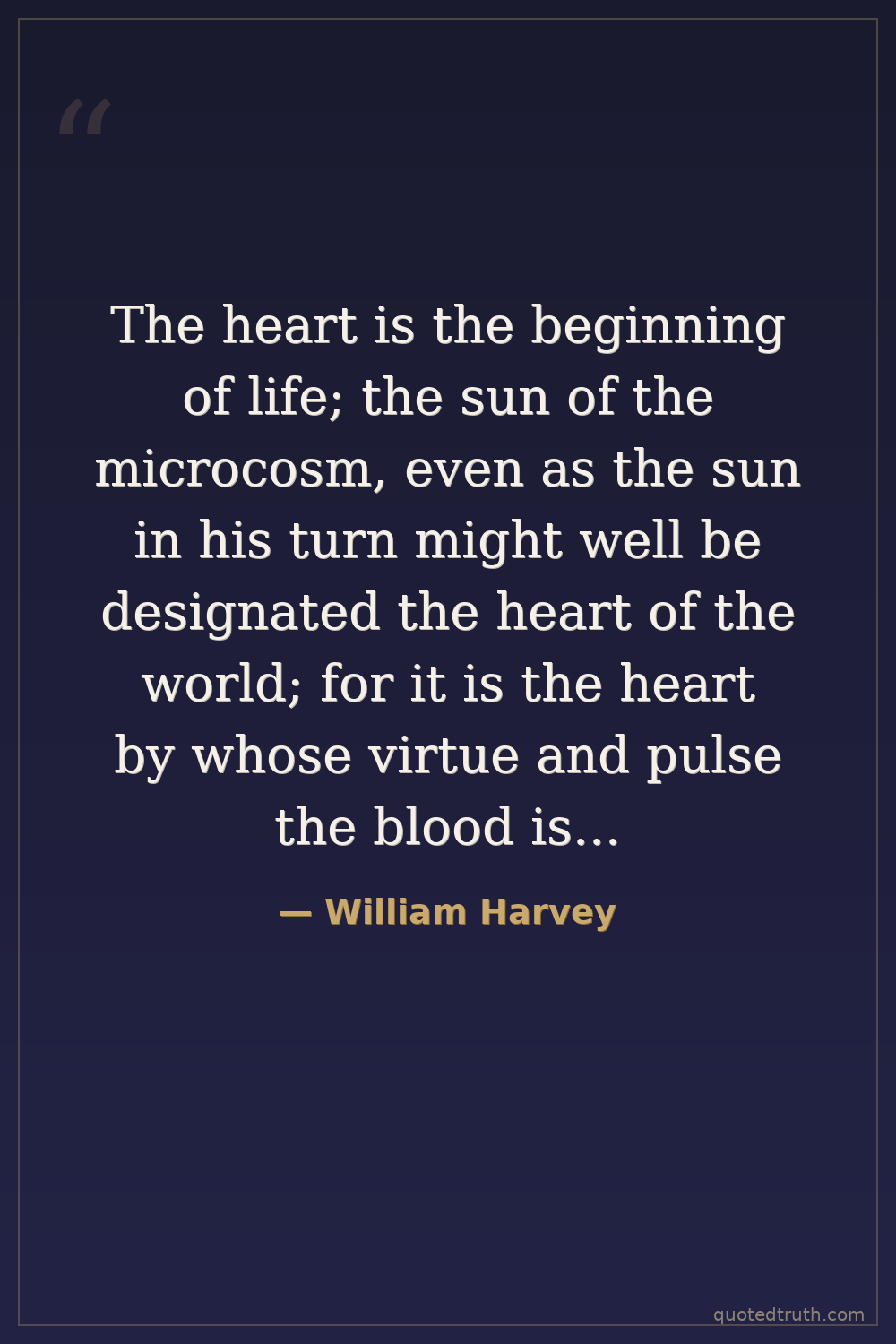
The heart is the engine of life itself—constantly pumping blood through the body, keeping it nourished, warm, and alive. Just as the sun powers everything on Earth, the heart powers every cell and organ. Without its rhythmic work, blood would stagnate and the body would fail. It is not merely a muscle but the fundamental source from which all bodily activity originates.
Relevance to William Harvey
Harvey proved in 1628 through meticulous dissection and experiment that blood circulates continuously, driven by the heart's pumping action—overturning 1,400 years of Galenic medicine. This quote directly mirrors his revolutionary discovery: the heart as active mechanical pump, not passive vessel. His solar metaphor reflects his Neo-Platonic training while grounding it in observable physiology he personally demonstrated.
The era
In the early 17th century, European medicine still followed Galen's ancient model where blood was produced in the liver and consumed by organs. Harvey's 1628 Exercitatio Anatomica de Motu Cordis shattered this consensus. The period's scientific revolution—Galileo, Kepler, Bacon—created space for empirical challenge to ancient authority, making Harvey's mechanistic heart metaphor both scientifically radical and culturally resonant.
AI-generated insights based on extensive research and information for context. Factual errors? Email [email protected].