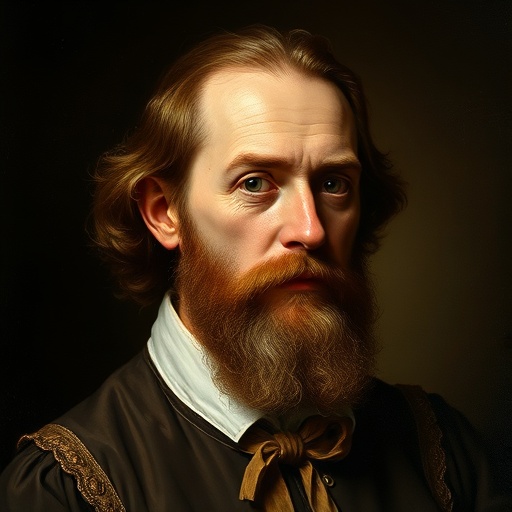
William Harvey — "The physician must be a philosopher, for there is not so great a difference betw…"
The physician must be a philosopher, for there is not so great a difference between them.
The physician must be a philosopher, for there is not so great a difference between them.
Click any product to generate a realistic preview. Up to 3 at a time.
* Initial load can take up to 90 seconds — revising the preview in another color is nearly instant.
"The egg is the common origin of all animals."
"It seems to me that the motion of the blood is like that of water in a mill-stream."
"The heart, like a pump, perpetually propels the blood."
"The circulation of the blood is the greatest discovery ever made in medicine."
"I have often wondered and even laughed at those who fancied that everything had been so consummately and absolutely investigated by an Aristotle or a Galen or some other mighty name, that nothing coul…"
English physician whose On the Motion of the Heart and Blood in Animals (1628) demonstrated blood circulation, overturning 1,400 years of Galenic medicine. Closely associated with Francis Bacon (his contemporary in the new English empiricism). For an intellectual contrast, see Galenic medicine, the 2nd-century Greek medical tradition (humors, blood-as-consumed-fuel) — Harvey calculated that the heart pumps more blood per hour than the body could possibly produce as fuel — a single quantitative observation that demolished the entire Galenic-Aristotelian medical worldview. The cleanest example in medical history of arithmetic disproving 14 centuries of authority.
Emphasizing the intellectual and philosophical depth required for medicine.
Date: Uncertain (attributed)
WisdomFound in 1 providers: gemini
1 source checked
A doctor cannot simply memorize treatments and apply them mechanically — genuine healing requires the same rigorous questioning, observation, and reasoning that philosophy demands. Medicine and philosophy share a common foundation: both seek truth about nature through careful inquiry rather than blind acceptance of inherited dogma. A physician who does not think deeply about cause and effect is merely guessing.
Harvey spent decades systematically challenging Galenic orthodoxy that had dominated medicine for 1,400 years. His discovery of blood circulation came through controlled experiments, logical deduction, and anatomical observation — precisely the methods of natural philosophy. He refused to accept received wisdom without empirical verification, embodying the physician-philosopher ideal by treating the body as a system governed by discoverable natural laws.
Harvey worked during the Scientific Revolution, when figures like Galileo, Bacon, and Descartes were dismantling medieval scholasticism and demanding evidence-based reasoning. Natural philosophy was not yet separated from science; universities still taught medicine through Aristotle and Galen. The boundary between doctor and philosopher was genuinely blurred, making Harvey's synthesis of empirical observation with philosophical method both radical and timely.
AI-generated insights based on extensive research and information for context. Factual errors? Email [email protected].
Your cart is empty