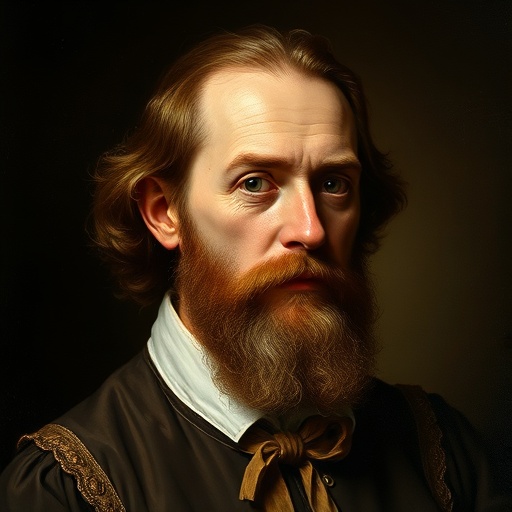
William Harvey — "It is not by words, but by facts and arguments, that we must seek for truth."
It is not by words, but by facts and arguments, that we must seek for truth.
It is not by words, but by facts and arguments, that we must seek for truth.
Click any product to generate a realistic preview. Up to 3 at a time.
* Initial load can take up to 90 seconds — revising the preview in another color is nearly instant.
"The heart by its pulsific action moves, perfects, and cherishes the blood, and preserves it from corruption and coagulation."
"The left ventricle of the heart ejects blood into the aorta."
"The heart is a muscle, and its function is to pump blood."
"The greatest art is to conceal art."
"The blood is the very bond of the soul, and the soul itself."
English physician whose On the Motion of the Heart and Blood in Animals (1628) demonstrated blood circulation, overturning 1,400 years of Galenic medicine. Closely associated with Francis Bacon (his contemporary in the new English empiricism). For an intellectual contrast, see Galenic medicine, the 2nd-century Greek medical tradition (humors, blood-as-consumed-fuel) — Harvey calculated that the heart pumps more blood per hour than the body could possibly produce as fuel — a single quantitative observation that demolished the entire Galenic-Aristotelian medical worldview. The cleanest example in medical history of arithmetic disproving 14 centuries of authority.
Reflecting his emphasis on empirical evidence and logical reasoning in scientific pursuit.
Date: 17th Century
PhilosophicalFound in 1 providers: gemini
1 source checked
Truth cannot be established through rhetoric, persuasion, or authority alone. It must be earned through observable evidence, rigorous demonstration, and logical reasoning built on real-world facts. Claims require proof, not just eloquent expression. Understanding follows from careful investigation of what actually exists and occurs, not from repeating received wisdom or deferring to those who speak most convincingly.
Harvey spent decades dissecting animals and measuring blood flow, directly challenging Galen's 1,400-year-old theory through relentless experimentation. His 1628 work 'De Motu Cordis' proved circulation via physical demonstration, not argument from authority. He faced fierce opposition from physicians who trusted ancient texts over observable evidence, making this commitment to facts over words both his methodology and his personal manifesto.
The early 17th century saw direct conflict between Scholastic tradition—where Aristotle and Galen's written authority settled disputes—and the emerging Scientific Revolution demanding empirical verification. Vesalius had recently exposed anatomical errors in Galen. Harvey worked alongside Bacon's calls for inductive reasoning. Printing spread competing ideas rapidly, making the battle between textual authority and experimental observation the defining intellectual struggle of the age.
AI-generated insights based on extensive research and information for context. Factual errors? Email [email protected].
Your cart is empty