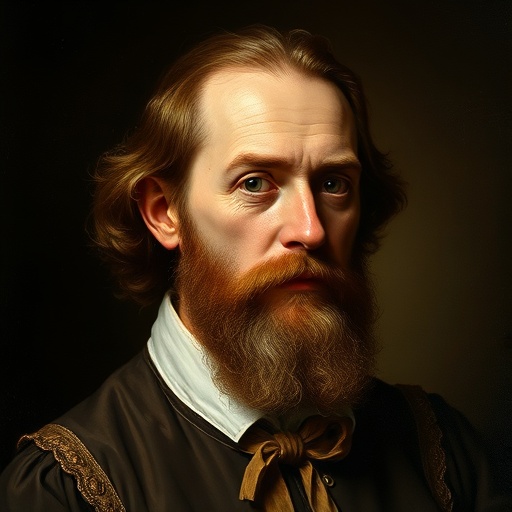
William Harvey — "The heart is a muscle, and its function is to pump blood."
The heart is a muscle, and its function is to pump blood.
The heart is a muscle, and its function is to pump blood.
Click any product to generate a realistic preview. Up to 3 at a time.
* Initial load can take up to 90 seconds — revising the preview in another color is nearly instant.
"The heart is the household divinity which, discharging its function, nourishes, cherishes, quickens the whole body."
"The circulation of the blood is a discovery that overthrows all the ancient doctrines of medicine."
"I have not been afraid to publish my thoughts, knowing that truth, though for a time suppressed, will at last prevail."
"I hold that the motion of the blood is in a circle, and is constantly impelled and distributed by the pulsific action of the heart."
"The art of medicine is to be learned only by experience and observation."
English physician whose On the Motion of the Heart and Blood in Animals (1628) demonstrated blood circulation, overturning 1,400 years of Galenic medicine. Closely associated with Francis Bacon (his contemporary in the new English empiricism). For an intellectual contrast, see Galenic medicine, the 2nd-century Greek medical tradition (humors, blood-as-consumed-fuel) — Harvey calculated that the heart pumps more blood per hour than the body could possibly produce as fuel — a single quantitative observation that demolished the entire Galenic-Aristotelian medical worldview. The cleanest example in medical history of arithmetic disproving 14 centuries of authority.
Found in 1 providers: grok
1 source checked
The heart operates purely as a mechanical pump—a muscle that contracts rhythmically to push blood through the body. This strips away mystical or spiritual interpretations of the heart's role, framing it instead as a functional biological engine. Blood moves because the heart forces it to move, continuously and systematically, sustaining life through physical mechanics rather than divine or humoral forces.
Harvey spent decades dissecting animals and studying human cadavers to prove blood circulates continuously rather than being consumed and produced. His 1628 work De Motu Cordis demonstrated the heart's pumping mechanics through careful measurement and vivisection experiments. This statement encapsulates his revolutionary reduction of cardiac function to observable, measurable physiology—the core of his life's scientific achievement.
In early modern Europe, Galenic medicine dominated for 1,400 years, holding that blood ebbed and flowed like tides and the heart generated vital spirits. Harvey published during the Scientific Revolution when empirical observation began challenging ancient authority. His mechanical view of the heart aligned with Descartes' contemporaneous machine-body philosophy, yet faced fierce resistance from physicians whose entire practice rested on overturning Galenic humoral theory.
AI-generated insights based on extensive research and information for context. Factual errors? Email [email protected].
Your cart is empty