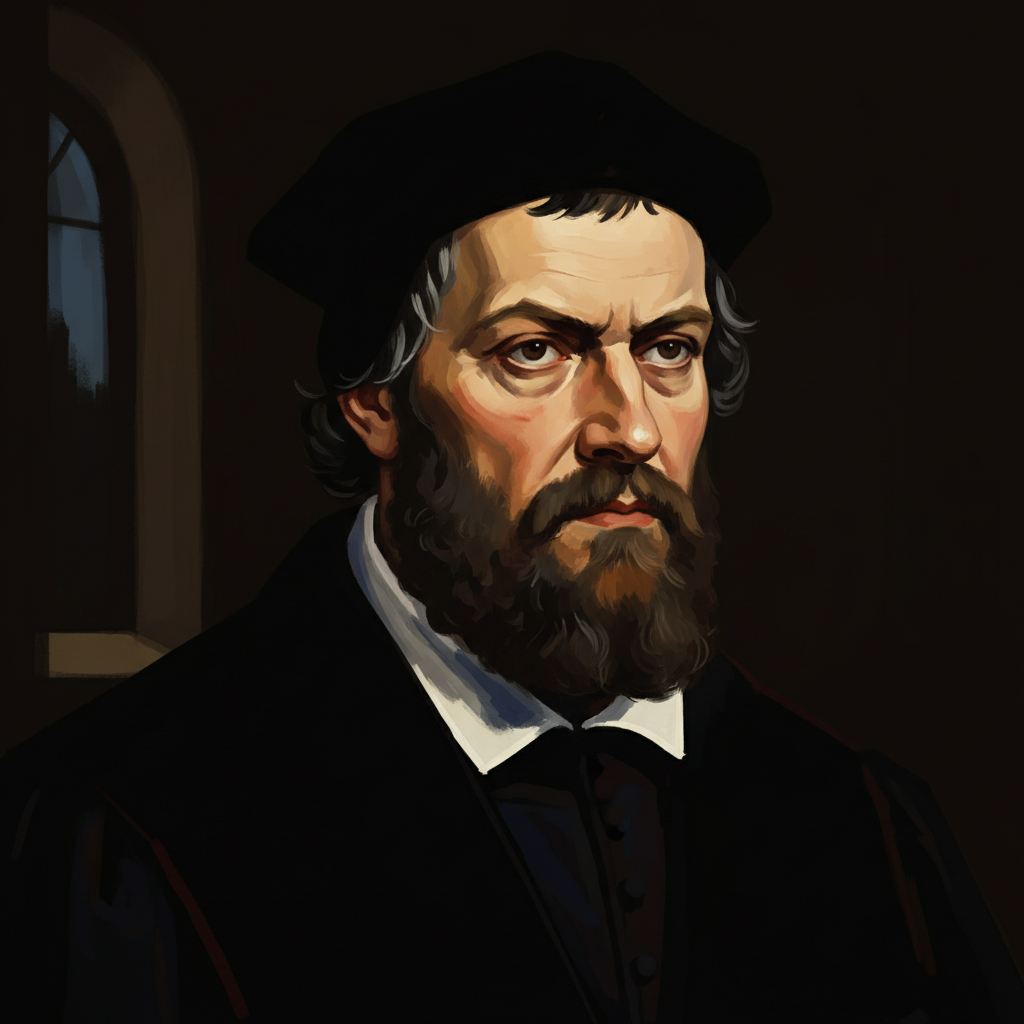
Martin Luther — "A man must have a good mind, and a strong body, and a pure heart, to be a good p…"
A man must have a good mind, and a strong body, and a pure heart, to be a good preacher.
A man must have a good mind, and a strong body, and a pure heart, to be a good preacher.
Click any product to generate a realistic preview. Up to 3 at a time.
* Initial load can take up to 90 seconds — revising the preview in another color is nearly instant.
"I have so much to do today, I'll need to spend another hour on my knees."
"Their rabbis should be forbidden to teach on pain of loss of life and limb."
"I frankly confess that even if it were possible I should not wish to have free choice given to me, or to have anything left in my own hands by which I might strive for salvation."
"A Jewish heart is as hard as a stick, a stone, as iron, as a devil."
"A simple layman armed with Scripture is to be believed above a pope or a cardinal without it."
German theologian whose 95 Theses (1517) launched the Protestant Reformation and broke the Catholic Church's monopoly on Western Christianity. Closely associated with Philipp Melanchthon (Lutheran systematizer) and John Calvin (later Reformer who built on Luther's break). For an intellectual contrast, see Pope Leo X, Renaissance pope (1513-1521) — Leo X's indulgence sales triggered Luther's break and Leo excommunicated him in 1521 — Luther's entire Reformation is structured as a direct answer to the indulgence-funded Vatican Leo represented.
Found in 1 providers: grok
1 source checked
Effective preaching demands three things working together: sharp thinking to grasp and explain difficult ideas, physical stamina to handle the demanding workload, and moral integrity so the message matches the messenger. A preacher missing any one of these falls short. Brains alone produce cold lectures, strength alone produces empty performance, and purity alone without intellect or endurance cannot sustain real ministry over time.
Luther lived this standard. He was a trained theology professor who out-argued Rome's scholars, a relentless worker who preached thousands of sermons, translated the entire Bible into German, and wrote prolifically despite chronic illness. His break with the Catholic Church demanded fierce moral conviction, risking excommunication and death at the Diet of Worms in 1521. He held preachers to high standards because he embodied the punishing combination himself.
In early-modern Europe, preaching was the primary mass medium, shaping public opinion before newspapers existed. Luther's 1517 Ninety-Five Theses ignited the Reformation precisely because pulpits reached everyone. Many Catholic priests were poorly educated, absent, or morally compromised, fueling reform demand. Protestant movements made the sermon central to worship, replacing the Latin Mass with vernacular preaching, so a competent, healthy, upright preacher became essential infrastructure for the entire religious revolution sweeping Germany.
AI-generated insights based on extensive research and information for context. Factual errors? Email [email protected].
Your cart is empty