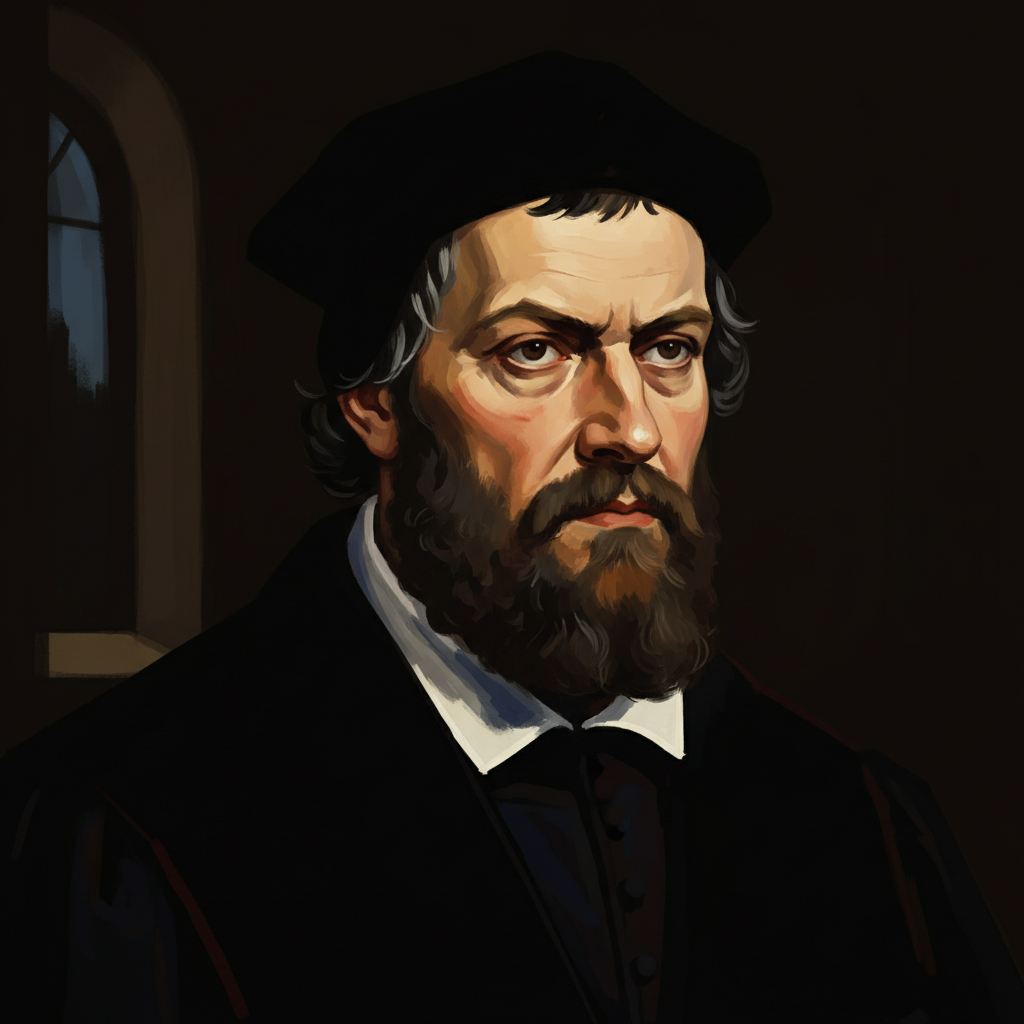
Martin Luther — "A Jewish heart is as hard as a stick, a stone, as iron, as a devil."
A Jewish heart is as hard as a stick, a stone, as iron, as a devil.
A Jewish heart is as hard as a stick, a stone, as iron, as a devil.
Click any product to generate a realistic preview. Up to 3 at a time.
* Initial load can take up to 90 seconds — revising the preview in another color is nearly instant.
"Here I stand; I can do no other. God help me. Amen."
"The Christian's life is not a bed of roses, but a cross."
"A man remains foolish until his 40th year, when he begins to recognize his foolishness; then life is soon over."
"A cow has a more certain faith than a hundred thousand Papists."
"A woman must be a woman and cannot be a man. She, too, is God's creature and her divine station is that she should bear and care for and rear children."
German theologian whose 95 Theses (1517) launched the Protestant Reformation and broke the Catholic Church's monopoly on Western Christianity. Closely associated with Philipp Melanchthon (Lutheran systematizer) and John Calvin (later Reformer who built on Luther's break). For an intellectual contrast, see Pope Leo X, Renaissance pope (1513-1521) — Leo X's indulgence sales triggered Luther's break and Leo excommunicated him in 1521 — Luther's entire Reformation is structured as a direct answer to the indulgence-funded Vatican Leo represented.
Found in 1 providers: gemini
1 source checked
The speaker claims Jewish people have hearts so unyielding they resist persuasion, compassion, or change, comparing their inner disposition to wood, stone, metal, and demonic nature. It is a dehumanizing statement asserting that an entire group is stubbornly closed off to the speaker's religious truth, and therefore beyond ordinary appeals to reason or feeling. In plain modern terms, it is a slur dressed as theological observation.
Luther wrote this in his 1543 treatise On the Jews and Their Lies, late in life after decades of failed attempts to convert Jews to his reformed Christianity. Initially sympathetic in 1523, he turned venomous when conversions did not follow. The line reflects his polemical style, his conviction that Scripture alone revealed truth, and a bitterness that later shaped centuries of Protestant antisemitism, infamously cited by Nazi propagandists.
Early sixteenth-century Europe treated Jews as theological outsiders, confined to ghettos, barred from guilds, and periodically expelled from Spain, Portugal, and German cities. The Reformation intensified scriptural disputes, and Luther initially hoped a purified gospel would win Jewish converts. When it did not, reformers and Catholics alike escalated rhetoric. Printing presses spread such pamphlets rapidly, hardening popular attitudes during an era already marked by plague blame, blood libels, and forced conversions.
AI-generated insights based on extensive research and information for context. Factual errors? Email [email protected].
Your cart is empty