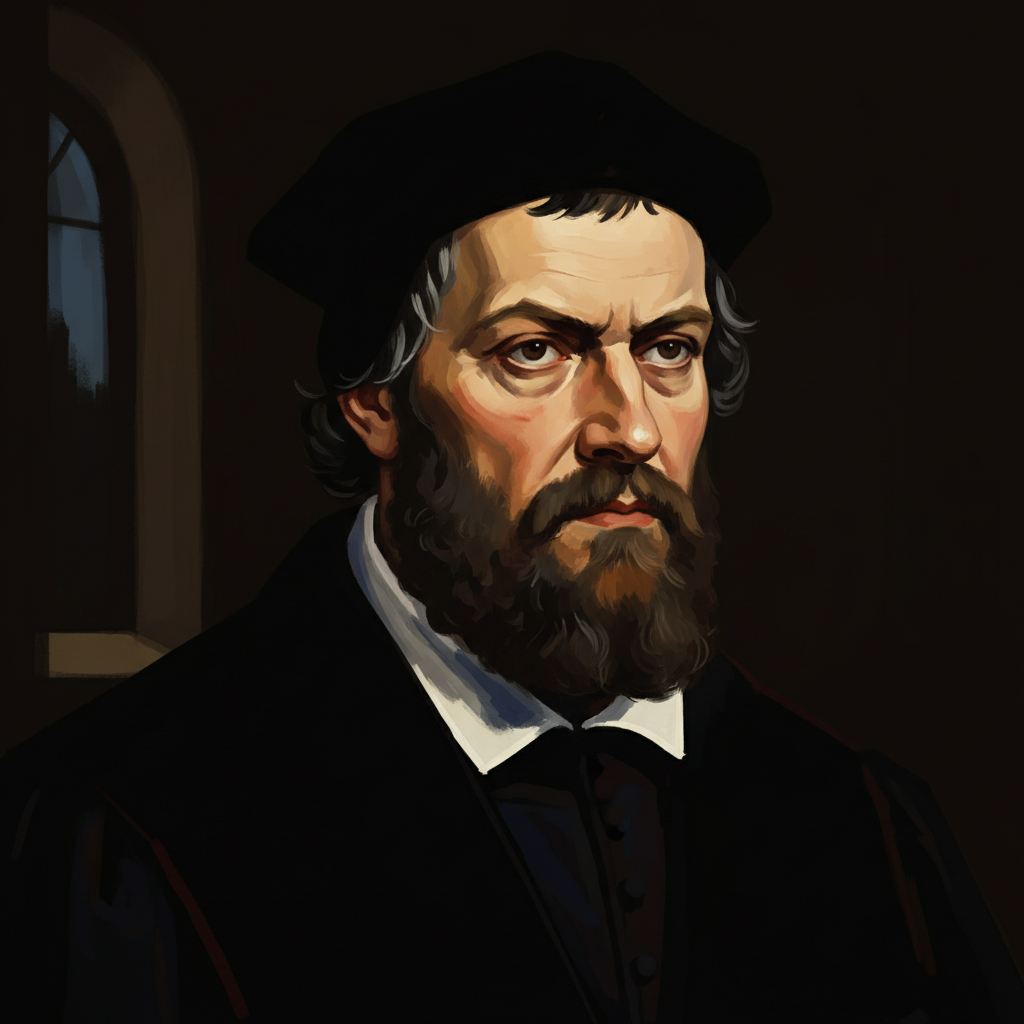
Martin Luther — "A man who has no wife is only half a man."
A man who has no wife is only half a man.
A man who has no wife is only half a man.
Click any product to generate a realistic preview. Up to 3 at a time.
* Initial load can take up to 90 seconds — revising the preview in another color is nearly instant.
"The book of Esther I toss into the Elbe. I am such an enemy to the book of Esther that I wish it did not exist, for it Judaizes too much and has in it a great deal of heathenish foolishness."
"If they can bear to live among us Christians and Jews, then they should be forced to work like women in childbirth."
"You have as much laughter as you have faith."
"If I am to be executed, I would rather be executed by the Pope than by my own people."
"To gather with God's people in united adoration of the Father is as necessary to the Christian life as prayer."
German theologian whose 95 Theses (1517) launched the Protestant Reformation and broke the Catholic Church's monopoly on Western Christianity. Closely associated with Philipp Melanchthon (Lutheran systematizer) and John Calvin (later Reformer who built on Luther's break). For an intellectual contrast, see Pope Leo X, Renaissance pope (1513-1521) — Leo X's indulgence sales triggered Luther's break and Leo excommunicated him in 1521 — Luther's entire Reformation is structured as a direct answer to the indulgence-funded Vatican Leo represented.
Found in 1 providers: deepseek
1 source checked
Marriage completes a man's identity and purpose. Without a spouse, he lacks a crucial part of what it means to be fully human, missing the companionship, partnership, and shared life that make a person whole. The statement treats singleness as incompleteness, suggesting that a wife supplies something essential that a man cannot provide for himself, whether emotional, practical, spiritual, or social wholeness.
Luther famously rejected clerical celibacy, which he viewed as an unnatural Catholic imposition. In 1525 he married Katharina von Bora, a former nun, and their household became a model Protestant parsonage. He praised marriage as a divine estate and wrote warmly of Katie's partnership. This quote reflects his conviction that marriage, not monastic vows, was God's ordinary calling for men and essential to a full Christian life.
In early modern Europe, the Reformation shattered centuries of mandatory priestly celibacy. Catholic tradition elevated virginity above marriage, but Luther's 1520s reforms reframed marriage as honorable, even for clergy. Monasteries emptied as monks and nuns married. This reframing intersected with patriarchal household structures where men headed 'whole houses' of wife, children, and servants. A bachelor was socially anomalous, lacking the economic and moral unit that defined respectable male adulthood.
AI-generated insights based on extensive research and information for context. Factual errors? Email [email protected].
Your cart is empty