What it means
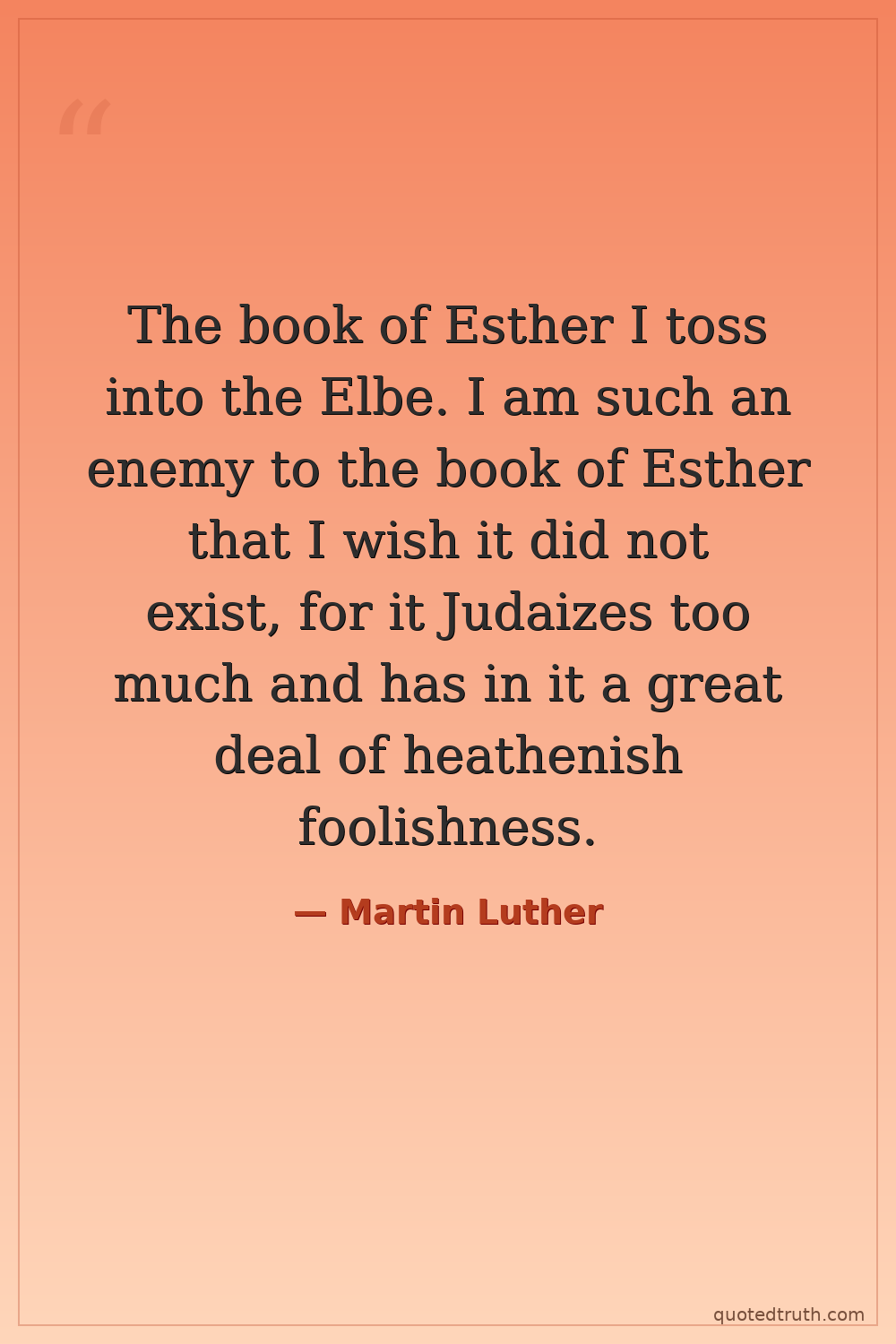
Luther bluntly rejects the biblical Book of Esther, saying he would throw it into the Elbe river and wishes it had never been included in scripture. He claims the book is too Jewish in character and contains pagan nonsense. He is dismissing a canonical text as unworthy, both because of its Jewish themes and what he considers superstitious or worldly content unbefitting holy scripture.
Relevance to Martin Luther
Luther built his theology on sola scriptura, yet he freely ranked biblical books by their usefulness, elevating Romans and John while dismissing James as an epistle of straw. His hostility toward Esther fits his broader anti-Jewish turn, culminating in the 1543 tract On the Jews and Their Lies. As a biblical translator producing the German Bible, his judgments carried weight in shaping Protestant canon attitudes.
The era
In early-modern sixteenth-century Germany, the Reformation was shattering the Catholic Church's monopoly on scripture and canon. Reformers debated which books belonged in the Bible, and Luther's 1534 German translation redefined the canon for Protestants by separating apocrypha. Antisemitism was widespread, with Jews expelled from many territories. Printing presses amplified such remarks, and theological insults like tossing books into rivers were part of the blunt polemical culture of the era.
AI-generated insights based on extensive research and information for context. Factual errors? Email [email protected].