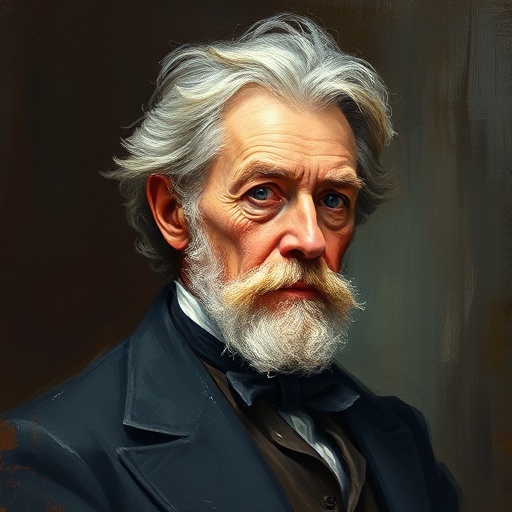
Michael Faraday — "A man who is certain he is right is almost sure to be wrong."
A man who is certain he is right is almost sure to be wrong.
A man who is certain he is right is almost sure to be wrong.
Click any product to generate a realistic preview. Up to 3 at a time.
* Initial load can take up to 90 seconds — revising the preview in another color is nearly instant.
"I am no poet, but if you think for a moment of the energy that is in a single drop of water, you will see a poetry in it."
"Magnetic curves are lines of force; they are not only lines of force but lines of action."
"I have far more confidence in the one man who works mentally and bodily at a matter than in the six who merely talk about it."
"The true scientist is a man who is always learning, and never assumes that he knows everything."
"The important thing is to know how to take a hint, to seize upon the suggestion, however small, and to extract its full value."
Similar to the above, a witty and self-aware statement.
Date: 19th century (approximate)
GeneralFound in 2 providers: gemini,deepseek
2 sources checked
Being absolutely convinced you're correct is itself a warning sign. Total certainty closes off the questioning, doubt, and willingness to test your assumptions that lead to accurate understanding. People who refuse to consider they might be mistaken usually are mistaken, because they've stopped checking. Real reliability comes from holding your views provisionally, inviting challenge, and updating when evidence pushes back. Confidence without humility tends to harden into error.
Faraday built his discoveries, including electromagnetic induction in 1831, through patient experimentation rather than theoretical certainty. A self-taught bookbinder's apprentice who became one of history's greatest experimentalists, he kept meticulous lab notebooks, repeated tests, and revised conclusions when results surprised him. A devout Sandemanian Christian, he prized humility and distrusted intellectual pride. He famously declined a knighthood and the presidency of the Royal Society, embodying the cautious, self-skeptical mindset this quote describes.
Faraday worked during the early-to-mid 1800s, when science was professionalizing and competing dogmas, from Naturphilosophie to rigid Newtonian mechanics, clashed over how nature worked. The Royal Institution where he lectured was a battleground of confident theorists. Industrial Britain rewarded bold claims, yet many celebrated certainties, like the luminiferous ether or caloric theory of heat, were quietly collapsing under new evidence, validating Faraday's preference for experimental humility over pronouncement.
AI-generated insights based on extensive research and information for context. Factual errors? Email [email protected].
Your cart is empty