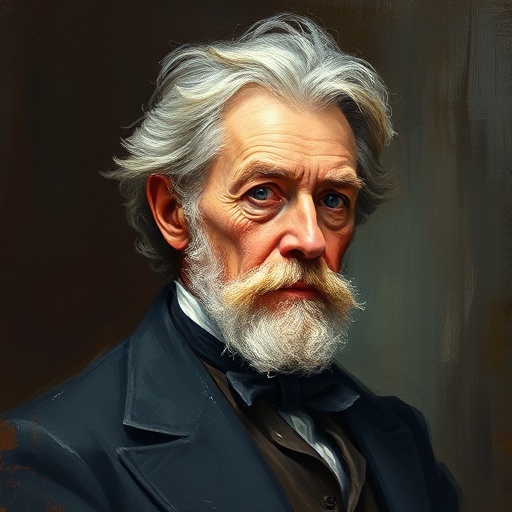
Michael Faraday — "I am no poet, but if you think for a moment of the energy that is in a single dr…"
I am no poet, but if you think for a moment of the energy that is in a single drop of water, you will see a poetry in it.
I am no poet, but if you think for a moment of the energy that is in a single drop of water, you will see a poetry in it.
Click any product to generate a realistic preview. Up to 3 at a time.
* Initial load can take up to 90 seconds — revising the preview in another color is nearly instant.
"The book of nature is written in the language of mathematics."
"The more I study, the more I am convinced of the existence of God."
"The very best way to learn is to do."
"The lecturer should endeavor to rouse the minds of his auditors, and to fix their attention."
"The greatest pleasure in life is to discover something new."
Attributed, demonstrating his imaginative appreciation for nature.
Date: Mid 19th Century (approx.)
Art & CreativityFound in 1 providers: grok
1 source checked
A single drop of water holds enormous hidden energy, whether in the molecular bonds, the electricity it can conduct, or the force it carries when moving. Recognizing this invisible power in something so ordinary is itself a kind of poetry. You do not need rhymes or metaphors to find wonder, because reality, examined closely, already contains more beauty and drama than any verse could invent.
Faraday spent his career revealing invisible forces inside ordinary matter, discovering electromagnetic induction, electrolysis, and the laws tying electricity to chemistry. A devout Sandemanian with little formal schooling, he saw nature as a unified creation worth reverent attention. His famous Christmas Lectures, especially The Chemical History of a Candle, used humble objects to unfold deep physics, exactly mirroring this claim that a single drop of water contains more poetry than he could write.
Faraday worked in early to mid nineteenth century Britain, when Romantic poets like Wordsworth and Coleridge celebrated nature while industrial science was rapidly decoding it. Steam engines, telegraphy, and gas lighting were transforming daily life, and the public flocked to Royal Institution lectures for scientific spectacle. Educated readers debated whether mechanistic science drained wonder from the world. Faraday's remark pushes back, insisting that experimental physics does not kill poetry but uncovers a deeper one hidden in matter.
AI-generated insights based on extensive research and information for context. Factual errors? Email [email protected].
Your cart is empty