Euclid — "To cut off from the greater of two given unequal straight lines a straight line …"
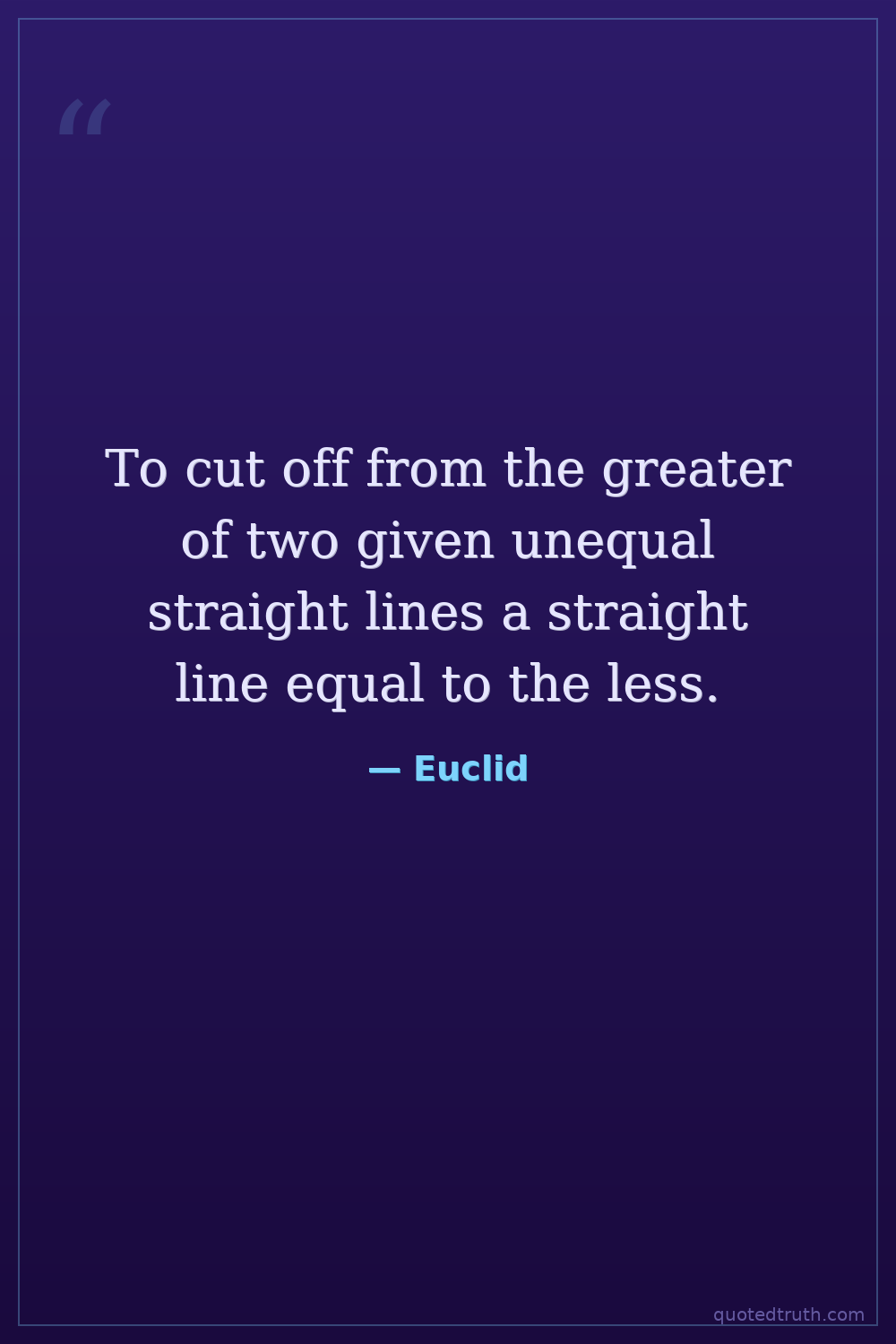
To cut off from the greater of two given unequal straight lines a straight line equal to the less.
To cut off from the greater of two given unequal straight lines a straight line equal to the less.
Click any product to generate a realistic preview. Up to 3 at a time.
* Initial load can take up to 90 seconds — revising the preview in another color is nearly instant.
"To apply a given parallelogram to a given straight line in a given rectilinear angle."
"A surface is that which has length and breadth only."
"If two triangles have two sides equal to two sides respectively, and have the angles contained by the equal straight lines equal, they will also have the base equal to the base, the triangle will be e…"
"Magnitudes which can be made to coincide are equal."
"If equals be subtracted from equals, the remainders are equal."
Found in 1 providers: grok
1 source checked
This describes a basic geometric construction task: given two line segments of different lengths, find a way to mark off a portion of the longer one that exactly equals the shorter one. In practical terms, it is like measuring and marking a precise length using only a compass and straightedge—the classical tools of geometry. The statement is precise and operational, defining a constructive problem rather than asserting a theorem.
This is the statement of Proposition 3 from Euclid's Elements, written around 300 BCE in Alexandria. Euclid's genius lay in building all of mathematics from undeniable axioms upward, step by logical step. This proposition reflects his belief that geometry must be constructive—every claim demonstrable with compass and straightedge alone. His 13-book Elements systematized centuries of scattered Greek geometry, and this small, precise problem-statement captures his voice: methodical, rigorous, devoid of hand-waving.
Around 300 BCE, Alexandria under Ptolemy I had become the ancient world's intellectual capital. Greek mathematics was shifting from practical measurement to abstract, proof-based reasoning. Earlier thinkers like Pythagoras and Eudoxus had made advances, but no unified system existed. Euclid's Elements filled that gap. Without algebra, geometric construction was the primary language for expressing mathematical relationships—so precisely stating what must be constructed was itself a rigorous, foundational mathematical act.
AI-generated insights based on extensive research and information for context. Factual errors? Email [email protected].
Your cart is empty