What it means
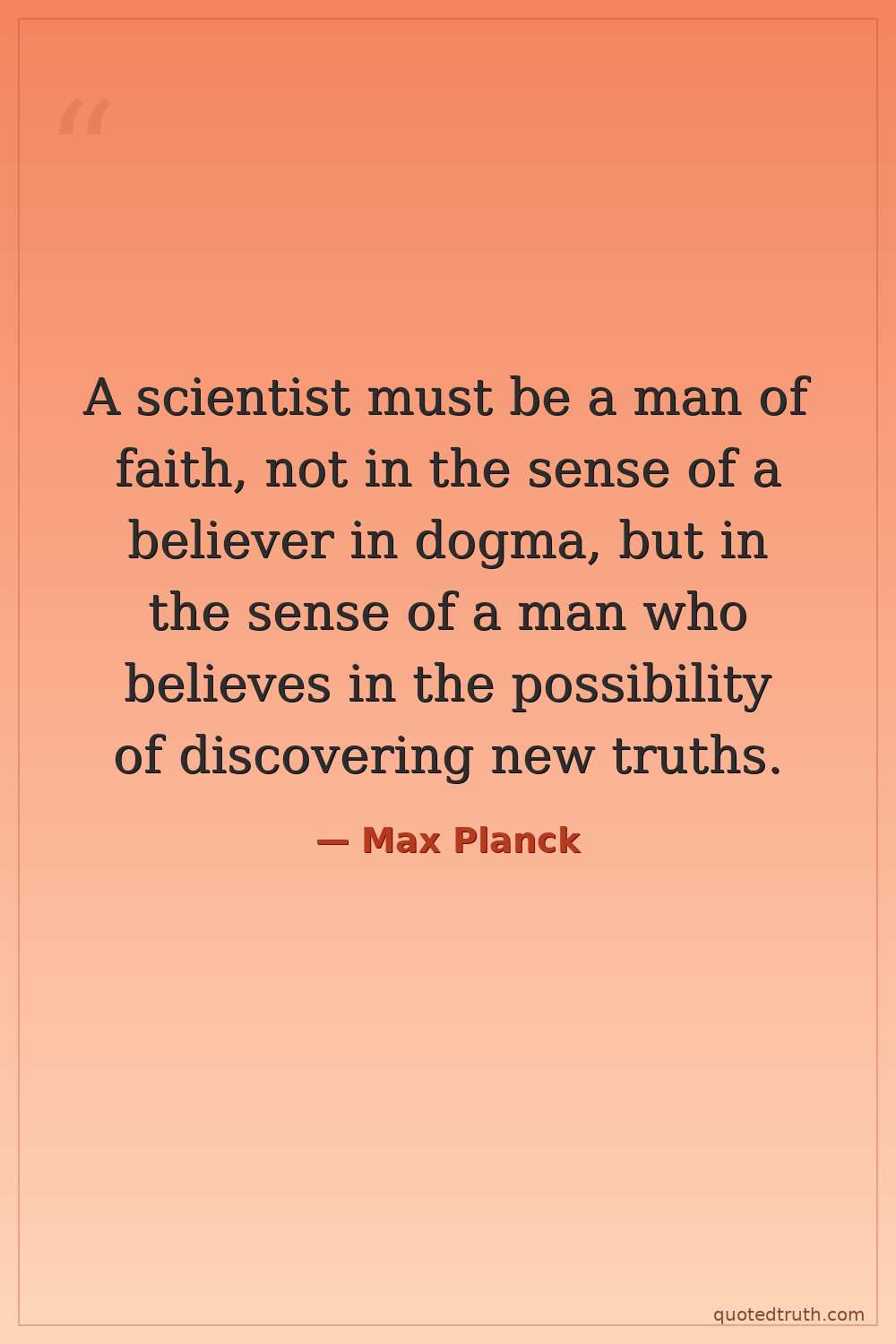
A researcher needs a kind of faith, but not religious dogma. It's the conviction that undiscovered truths exist and can be found through persistent inquiry. Without this underlying belief that the unknown is knowable, scientists would lack the motivation to pursue experiments whose outcomes are uncertain. It frames science as a hopeful enterprise rather than a purely cold, mechanical one, driven by trust in the rational intelligibility of nature.
Relevance to Max Planck
Planck spent years pursuing thermodynamics and blackbody radiation before introducing the quantum concept in 1900, a leap that overturned classical physics. He was also a devout Lutheran who openly reconciled science and religion. This quote captures his personal philosophy: rigorous empiricism paired with deep conviction that nature's laws are discoverable. His persistence through decades of incremental work embodied the faith in hidden truths he describes.
The era
Planck worked through a revolutionary era (1900-1947) when physics was collapsing and rebuilding. Classical mechanics failed to explain atomic phenomena, and scientists faced unprecedented uncertainty. Meanwhile, two World Wars, Nazi interference in German science, and the loss of his son to the Gestapo tested every conviction. In this climate of intellectual upheaval and personal tragedy, faith that truth remained discoverable was not abstract philosophy but a working scientist's necessary stance.
AI-generated insights based on extensive research and information for context. Factual errors? Email [email protected].