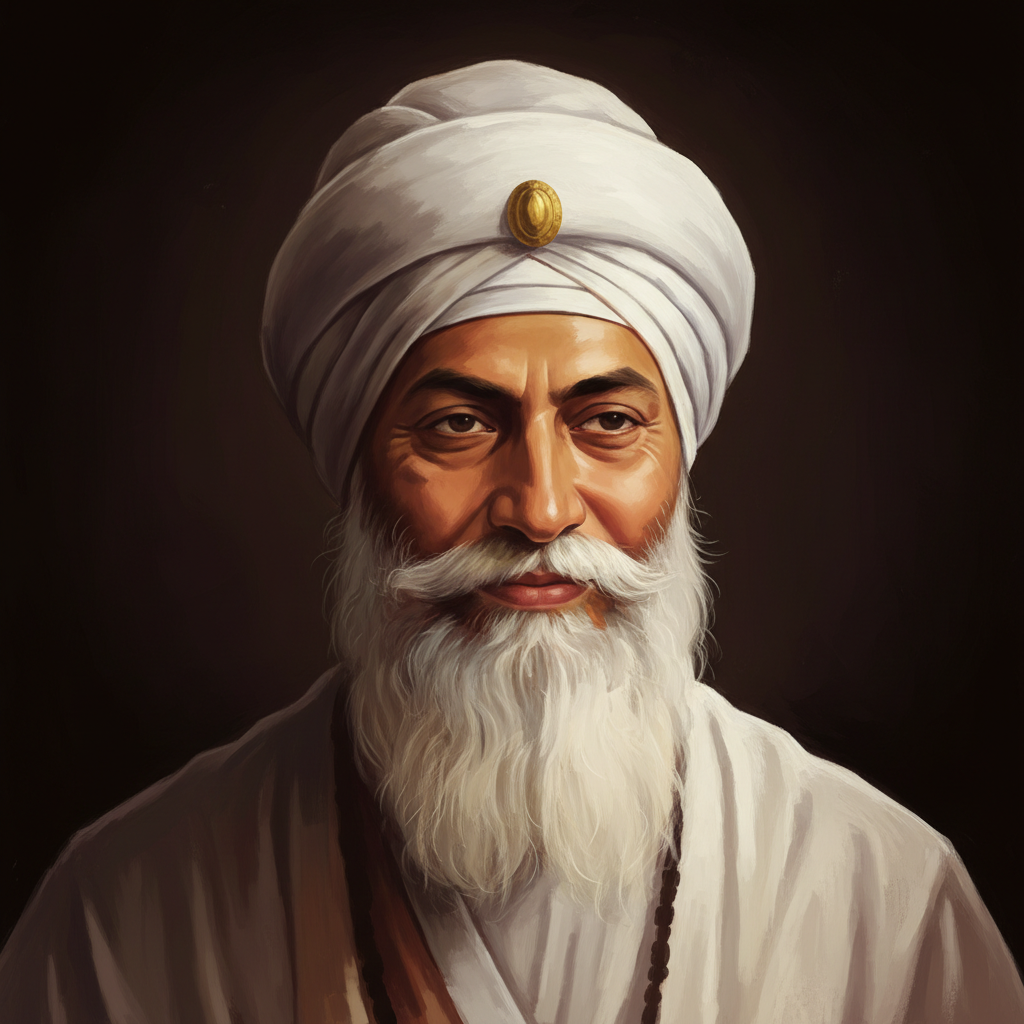
Guru Nanak — "A true yogi does not wander around, but fixes his mind on God within."
A true yogi does not wander around, but fixes his mind on God within.
A true yogi does not wander around, but fixes his mind on God within.
Click any product to generate a realistic preview. Up to 3 at a time.
* Initial load can take up to 90 seconds — revising the preview in another color is nearly instant.
"The world is a garden, and we are its gardeners; we must sow the seeds of truth and righteousness."
"Even if you have a hundred thousand friends, you are alone if you don't have a good cup of tea."
"The one who serves others, serves God."
"Whatever you do, do it with love. And a good soundtrack."
"One cannot comprehend Him through the intellect, even if one were to try a hundred thousand times."
Founder of Sikhism and the first of the Ten Sikh Gurus, whose teachings of one universal God and rejection of caste shaped Punjab. Closely associated with Kabir (mystical poet whose verses appear in the Sikh Guru Granth Sahib). For an intellectual contrast, see Brahmanical orthodoxy, the Hindu caste-and-ritual establishment of his era — Sikhism was founded as a deliberate alternative to both Hindu ritual hierarchy and Islamic exclusivism — Nanak's universalism was a structural rejection of caste and priestly mediation.
Japji Sahib, Pauri 28, Guru Granth Sahib (interpretation)
Date: c. 15th-16th century CE
BiblicalFound in 1 providers: gemini
1 source checked
Real spiritual practice is not about physical travel, ascetic wandering, or outward displays of holiness. Instead, genuine discipline means turning attention inward and keeping the mind steadily focused on the divine presence that already exists within a person. Someone can live an ordinary life among family and work and still be deeply devoted, while another who roams from shrine to shrine may be spiritually empty. Location, costume, and reputation do not determine authenticity; inner awareness does.
Guru Nanak founded Sikhism by rejecting the renunciate path common to Hindu yogis and Muslim Sufis of his region. Though he traveled widely on his udasis to debate ascetics at places like Mount Sumeru and Mecca, he taught householder spirituality: honest work, sharing earnings, and constant remembrance of one God. This saying captures his direct challenge to the Nath yogis, whom he encountered repeatedly, insisting that matted hair and cave-dwelling counted for nothing without inward devotion.
In late-fifteenth and early-sixteenth century Punjab, the Mughal conquest was reshaping North India while Hindu yogic orders, Muslim pirs, and wandering sadhus competed for religious authority. Ritualism, caste restrictions, pilgrimage economies, and ascetic showmanship dominated popular piety. The Bhakti and Sant movements were pushing back with vernacular devotion accessible to ordinary people. Nanak's teaching emerged inside this ferment, offering a middle path that bypassed both Brahminical orthodoxy and ascetic withdrawal, which made his critique of performative yoga especially pointed.
AI-generated insights based on extensive research and information for context. Factual errors? Email [email protected].
Your cart is empty