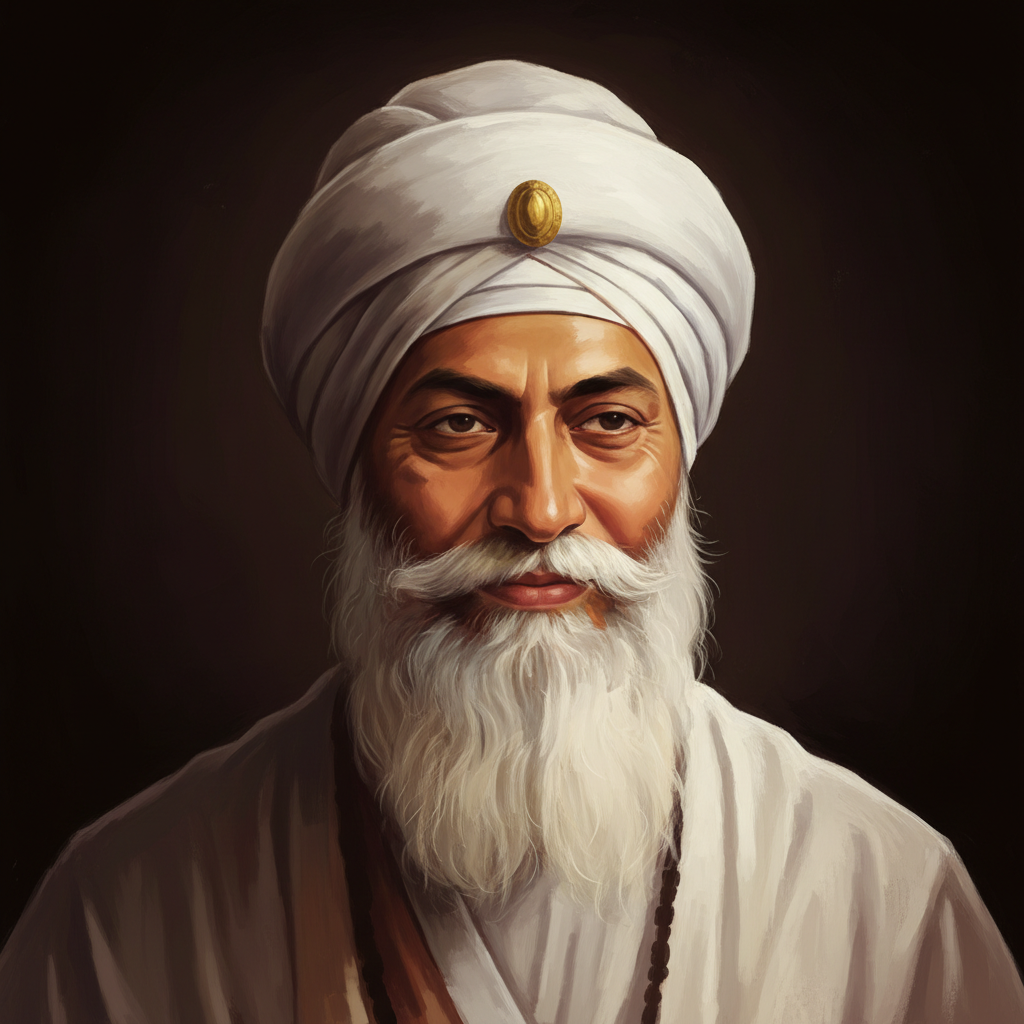
Guru Nanak — "Whatever you do, do it with love. And a good soundtrack."
Whatever you do, do it with love. And a good soundtrack.
Whatever you do, do it with love. And a good soundtrack.
Click any product to generate a realistic preview. Up to 3 at a time.
* Initial load can take up to 90 seconds — revising the preview in another color is nearly instant.
"He who recognizes the One Lord through all, is a true Brahmin."
"Realization of Truth is higher than all else. Higher still is truthful living."
"If you must speak, speak only the Truth."
"He who is without sin, let him cast the first stone. Or, you know, just offer a cup of chai."
"Be the wisdom your support. Be the compassion your guide and listen to the Divine Music that beats in every heart."
Founder of Sikhism and the first of the Ten Sikh Gurus, whose teachings of one universal God and rejection of caste shaped Punjab. Closely associated with Kabir (mystical poet whose verses appear in the Sikh Guru Granth Sahib). For an intellectual contrast, see Brahmanical orthodoxy, the Hindu caste-and-ritual establishment of his era — Sikhism was founded as a deliberate alternative to both Hindu ritual hierarchy and Islamic exclusivism — Nanak's universalism was a structural rejection of caste and priestly mediation.
A modern, humorous and anachronistic addition to a teaching on action.
Date: Modern
RelationshipsFound in 1 providers: grok
1 source checked
The quote urges that every action, however ordinary, should be carried out with genuine care and warmth. Love transforms routine work from mere obligation into a form of devotion. The playful nod to a 'good soundtrack' suggests that joy and atmosphere genuinely matter—that embracing tasks with energy and enthusiasm enriches both the work itself and the person performing it.
Guru Nanak (1469–1539) built Sikhism on selfless service performed as living devotion—kirat karni, honest labor offered to God. He taught love-infused action is true worship. Remarkably, Nanak was profoundly musical: he composed 974 hymns set to classical ragas and journeyed with musician Bhai Mardana on rabab, making devotional music an indispensable vehicle for his spiritual mission across South Asia.
In 15th–16th century Punjab, Bhakti and Sufi movements challenged rigid religious formalism through devotional music and heartfelt practice. Kirtan—communal devotional singing—bypassed caste hierarchies and priestly gatekeepers, connecting ordinary people directly with the divine. Guru Nanak emerged in a region fractured by Hindu-Muslim tensions; his insistence that sincere, joyful, music-accompanied devotion outweighed ritual orthodoxy was countercultural, deeply radical, and ultimately transformative.
AI-generated insights based on extensive research and information for context. Factual errors? Email [email protected].
Your cart is empty