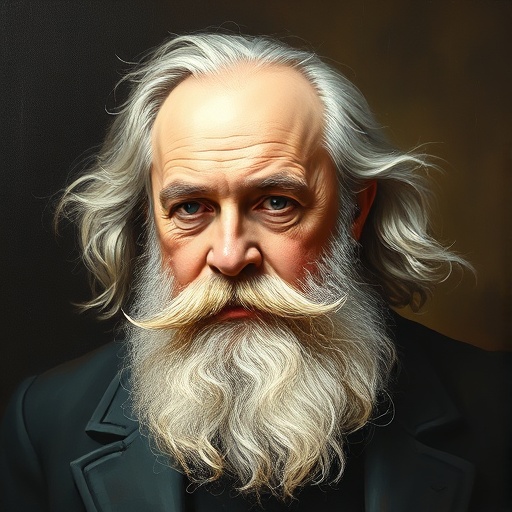
Dmitri Mendeleev — "A well-made theory is like a good overcoat; Eloquent words are like a beautiful …"
A well-made theory is like a good overcoat; Eloquent words are like a beautiful tie.
A well-made theory is like a good overcoat; Eloquent words are like a beautiful tie.
Click any product to generate a realistic preview. Up to 3 at a time.
* Initial load can take up to 90 seconds — revising the preview in another color is nearly instant.
"he reproached the modern scientific thought because it “got entangled in ions and electrons”."
"Science which deals with the infinite is itself without bounds."
"My table will serve as an instrument for discovering new facts and for correcting old ones."
"Atomic weight belongs not to coal or diamond but carbon."
"I saw in a dream a table where all the elements fell into place as required. Awakening, I immediately wrote it down on a piece of paper, only in one place did a correction later seem necessary."
Found in 1 providers: deepseek
1 source checked
A solid theory functions like a reliable overcoat: it protects you, keeps its shape under pressure, and serves its purpose across conditions. Fancy rhetoric, by contrast, is mere decoration, like a tie chosen for looks. The quote argues that substance and structural integrity matter far more than surface polish. Useful frameworks endure because they work; clever phrasing impresses briefly but cannot shelter you when the weather turns against your ideas.
Mendeleev spent years wrestling element properties into the periodic table, a framework so well-constructed it predicted undiscovered elements like gallium and germanium. He valued rigorous classification over speculative flourish and was known for blunt, unadorned speech. As a chemist who distrusted showmanship, he judged ideas by whether they held together and made accurate predictions, not by how elegantly they were presented. The overcoat metaphor fits his practical, utility-first worldview perfectly.
Mendeleev worked in late-19th-century Russia, an era when chemistry was shifting from descriptive cataloging to predictive science. European laboratories competed to isolate new elements, and scientific societies prized eloquent lecturers. Meanwhile, Russia was modernizing industrially under Alexander II, demanding useful knowledge over philosophical ornament. Mendeleev, advising on oil, agriculture, and metrology, embodied that pragmatic turn: theories had to earn their keep through accurate prediction and industrial application, not through the polished oratory fashionable in academic circles.
AI-generated insights based on extensive research and information for context. Factual errors? Email [email protected].
Your cart is empty