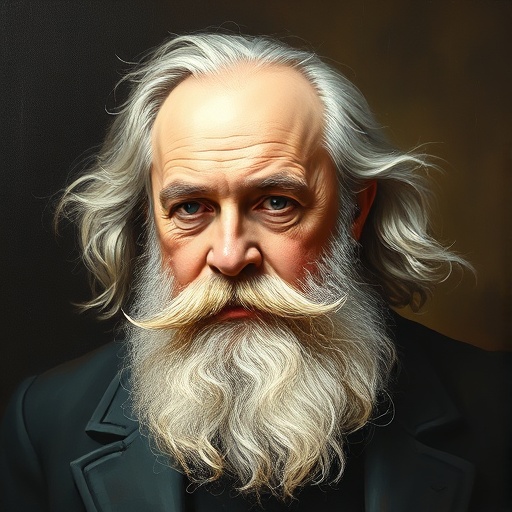
Dmitri Mendeleev — "My table will serve as an instrument for discovering new facts and for correctin…"
My table will serve as an instrument for discovering new facts and for correcting old ones.
My table will serve as an instrument for discovering new facts and for correcting old ones.
Click any product to generate a realistic preview. Up to 3 at a time.
* Initial load can take up to 90 seconds — revising the preview in another color is nearly instant.
"By gradually studying matter, people finally take command of it."
"The chemical elements are the children of the sun."
"Why do they [Americans] quarrel, why do they hate Negroes, Indians, even Germans, why do they not have science and poetry commensurate with themselves, why are there so many frauds and so much nonsens…"
"Why do they [Americans] quarrel, why do they hate Negroes, Indians, even Germans, why do they not have science and poetry commensurate with themselves, why are there so many frauds and so much nonsens…"
"There is nothing in this world that I fear to say."
Found in 1 providers: grok
1 source checked
Mendeleev is saying his periodic table is not just a catalog of known elements but an active research tool. By organizing elements according to their properties, the arrangement itself will reveal gaps where undiscovered elements must exist and expose errors in previously measured atomic weights or assumed behaviors. The framework predicts and corrects, turning a static chart into a working engine for ongoing scientific discovery rather than a finished summary of what chemists already knew.
This captures Mendeleev's defining achievement. When he published his table in 1869, he deliberately left empty spaces and predicted the properties of eka-aluminum, eka-boron, and eka-silicon, later confirmed as gallium, scandium, and germanium. He also corrected atomic weights for beryllium, uranium, and indium based on where they fit. A rigorous St. Petersburg chemist who valued systematic order, Mendeleev saw classification as prediction, not bookkeeping, and staked his reputation on the table's forecasting power.
Mendeleev worked in late-1800s Russia during a transformative period for chemistry. About 60 elements were known, atomic weights were often inaccurate, and chemists debated whether elements had any underlying order. Dalton's atomic theory was maturing, spectroscopy was revealing new elements, and the Karlsruhe Congress of 1860 had just standardized atomic weights. Russia was industrializing under Alexander II, and Mendeleev, teaching at St. Petersburg University, embodied a national push to modernize science and compete with Western European research institutions.
AI-generated insights based on extensive research and information for context. Factual errors? Email [email protected].
Your cart is empty