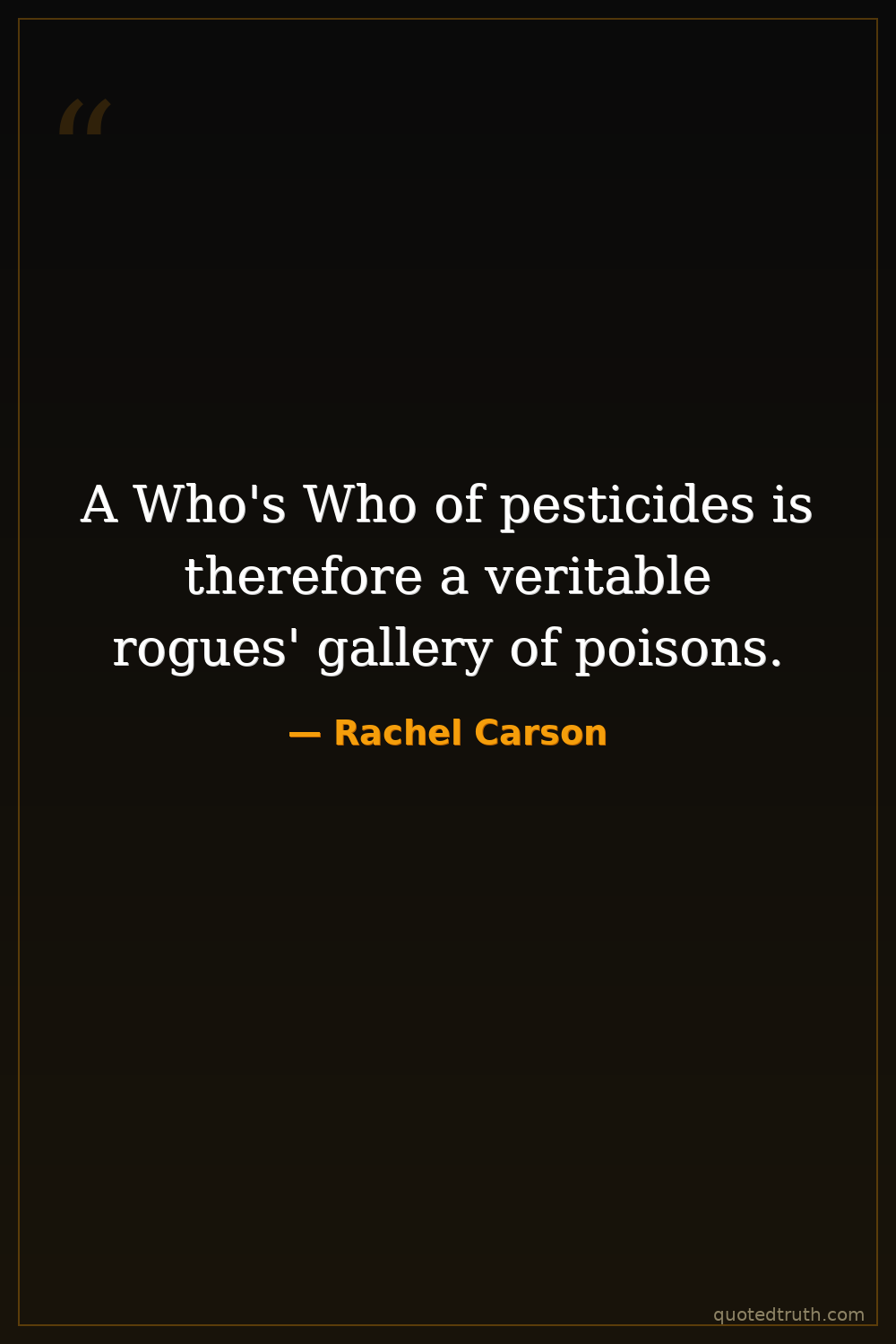
Rachel Carson — "A Who's Who of pesticides is therefore a veritable rogues' gallery of poisons."
A Who's Who of pesticides is therefore a veritable rogues' gallery of poisons.
A Who's Who of pesticides is therefore a veritable rogues' gallery of poisons.
Click any product to generate a realistic preview. Up to 3 at a time.
* Initial load can take up to 90 seconds — revising the preview in another color is nearly instant.
"The beauty of the living world I was trying to save has always been uppermost in my mind—that, and anger at the heedless and needless destruction of that beauty."
"To stand at the edge of the sea, to sense the ebb and flow of the tides, to feel the breath of a coastal breeze—this is to know the pulse of life."
"The more we learn about the complexities of life, the more we realize how little we know."
"We need to re-establish our connection with the natural world. It is essential for our well-being."
"I am haunted by the thought of what we are doing to the earth."
Found in 1 providers: grok
1 source checked
Drawing on two familiar reference points—a Who's Who directory of celebrated figures and a rogues' gallery of criminals—Carson equates the pesticide industry's proudest products with known toxins. Every chemical promoted as an agricultural solution is simultaneously a poison with documented capacity to harm birds, fish, soil organisms, and people. The framing inverts the industry's celebratory narrative, treating notoriety as evidence of danger rather than achievement.
Carson was a marine biologist and science writer who spent years documenting how synthetic pesticides—especially DDT—traveled through food chains, devastating bird populations and contaminating water. Silent Spring (1962) was her direct challenge to the chemical industry and compliant regulators. Her signature method was converting dense toxicology into vivid, morally urgent prose; calling pesticides a rogues' gallery was precisely that—scientific fact delivered with the rhetorical force of a prosecutor's opening statement.
Carson wrote Silent Spring amid a postwar chemical boom. DDT had been celebrated since World War II as a near-miraculous insecticide, and by the late 1950s synthetic pesticides were federally promoted and aerially sprayed across millions of acres. Corporate lobbying kept regulatory scrutiny minimal. Her book ignited a national reckoning that led directly to DDT's U.S. ban in 1972 and the establishment of the Environmental Protection Agency in 1970.
AI-generated insights based on extensive research and information for context. Factual errors? Email [email protected].
Your cart is empty