What it means
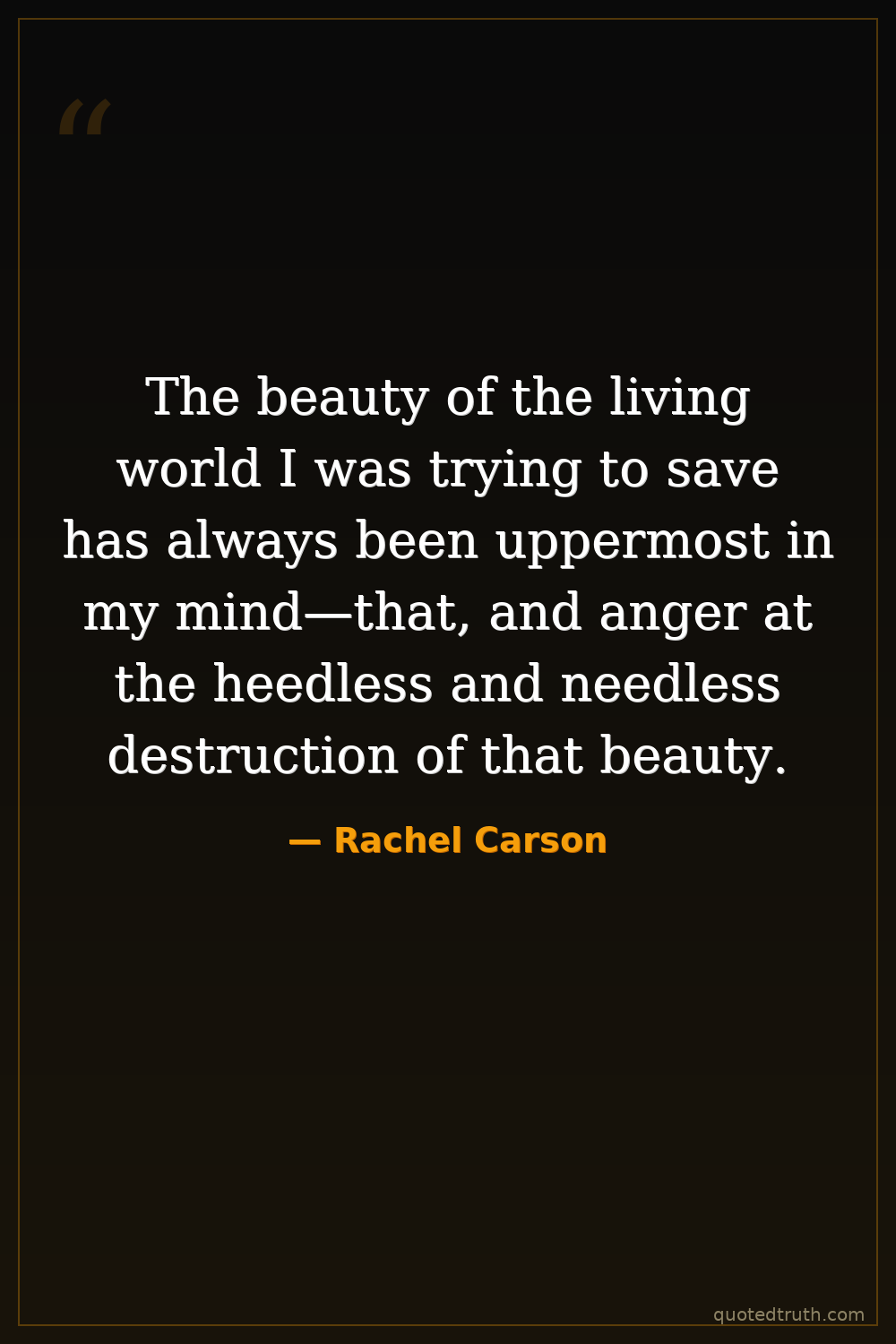
Carson is saying her core motivations were always two things: profound love for the natural world's beauty, and fury at its pointless destruction. She wasn't driven primarily by data or policy—she was emotionally anchored to living things. The phrase "heedless and needless" carries real weight: the damage wasn't inevitable collateral from progress, but careless and avoidable. Love and anger together, not one without the other, powered her work.
Relevance to Rachel Carson
Carson spent decades as a marine biologist and nature writer before Silent Spring, publishing The Sea Around Us and The Edge of the Sea—books born of genuine wonder at ocean life. When she documented DDT's devastation of bird populations while battling breast cancer, the quote reflects her reality: she was simultaneously grieving the world's destruction and fighting to stop it, even as her own body failed her.
The era
Silent Spring appeared in 1962, when industrial pesticide use—especially DDT—had exploded after World War II with almost no regulatory oversight. Chemical companies marketed pesticides as miracles of modern progress. Carson wrote during Cold War optimism about technology solving all problems. Her book fractured that consensus, prompting the first Earth Day in 1970, the EPA's founding, and eventually DDT's US ban in 1972—a direct consequence of her documented anger.
AI-generated insights based on extensive research and information for context. Factual errors? Email [email protected].