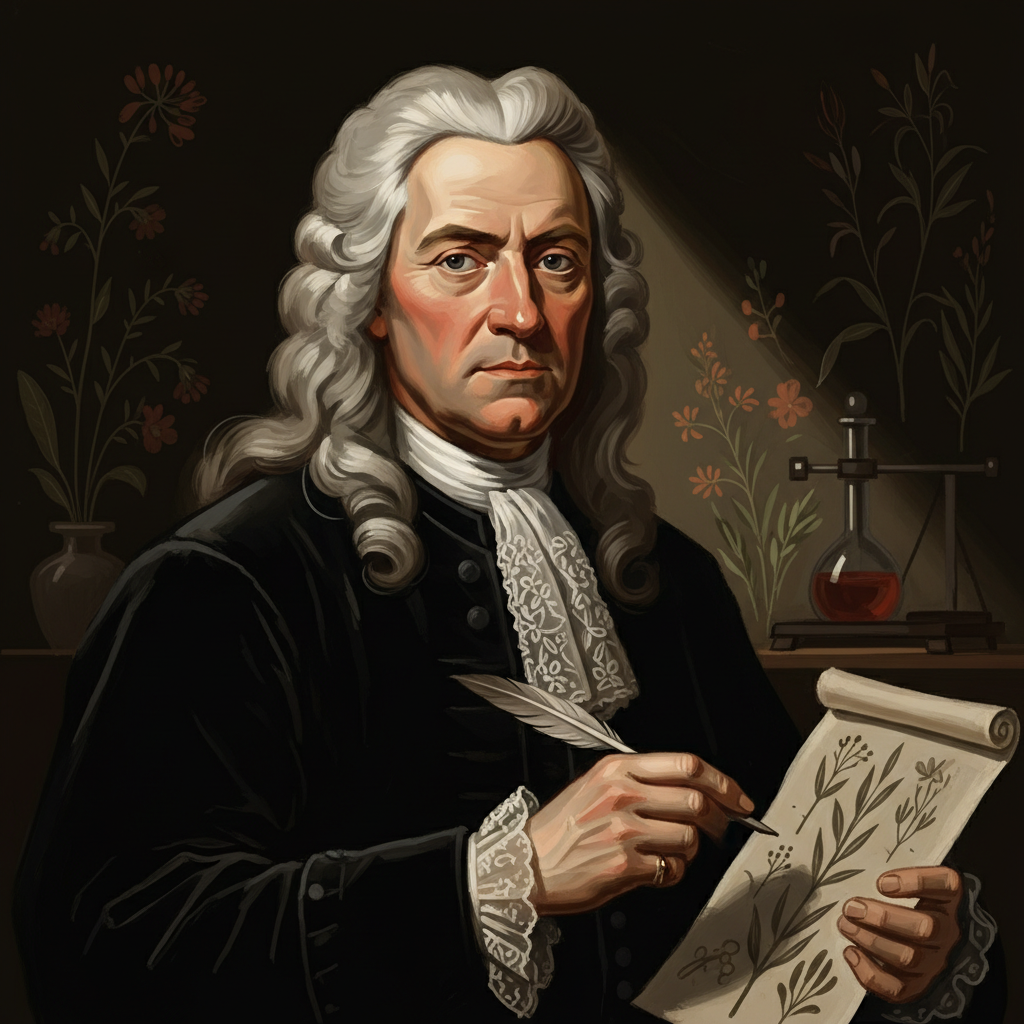
Carl Linnaeus — "A world without names is a world without knowledge."
A world without names is a world without knowledge.
A world without names is a world without knowledge.
Click any product to generate a realistic preview. Up to 3 at a time.
* Initial load can take up to 90 seconds — revising the preview in another color is nearly instant.
"The distinctions of sex are evident in plants, as in animals."
"It is not wealth or ancestry, but rather the spirit of the age, which has raised me to the highest pinnacle of fame."
"The calyx is the marriage bed, the corolla the bed-curtains, the filaments the spermatic vessels, the anthers the testes, the pollen the semen, the pistil the vagina, the ovary the uterus, the ovules …"
"It is not the business of a botanist to know all the plants, but to know how to find out what they are."
"Man is the masterpiece of creation."
Swedish botanist and the father of modern taxonomy whose Systema Naturae (1735) introduced binomial nomenclature for naming all species. Closely associated with Joseph Banks (British naturalist who carried Linnaean classification on Cook's voyages). For an intellectual contrast, see Comte de Buffon, French naturalist and Histoire Naturelle author (1749-1788) — Buffon explicitly attacked Linnaean fixed-categories taxonomy as artificial and rejected the binomial system; his gradualist, environment-shaped natural history was the explicit alternative. Anticipates the fixed-species-vs-evolution debate Darwin would later resolve.
Found in 1 providers: grok
1 source checked
Naming things is the foundation of understanding them. Without shared labels, we cannot organize observations, communicate discoveries, or build on each other's knowledge. A name transforms raw perception into a concept others can reference, debate, and refine. This applies to science, language, and thought broadly — categories give structure to what would otherwise be an undifferentiated flood of experience with no way to reason about it.
Linnaeus spent his life doing exactly this — his 1735 Systema Naturae introduced binomial nomenclature, giving every known organism a standardized two-part Latin name. Before his system, naturalists across Europe used wildly inconsistent terms for the same species, making communication nearly impossible. He personally named roughly 12,000 species and believed rigorous classification was the only path to genuine natural knowledge. His career was a direct embodiment of this conviction.
The 18th-century Age of Exploration was flooding European naturalists with thousands of undescribed plants and animals from the Americas, Africa, and Asia. No universal naming standard existed — the same organism could carry a dozen names across countries. The Enlightenment demanded rational order over inherited confusion, making systematic classification urgent. Linnaeus's binomial system arrived precisely when science needed a common language to process its rapidly expanding knowledge of the natural world.
AI-generated insights based on extensive research and information for context. Factual errors? Email [email protected].
Your cart is empty