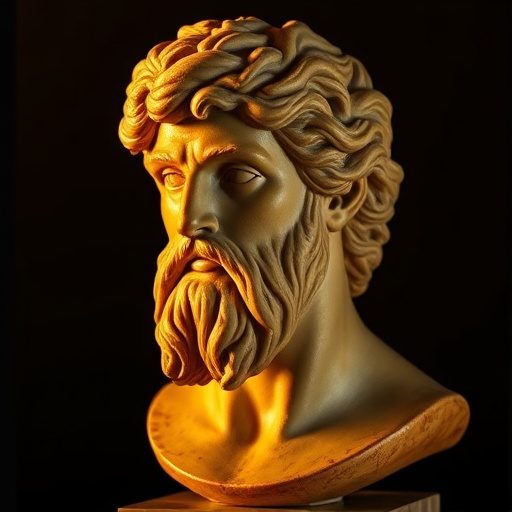
Pythagoras — "Accustom yourself to a way of living that is neat and decent without luxury."
Accustom yourself to a way of living that is neat and decent without luxury.
Accustom yourself to a way of living that is neat and decent without luxury.
Click any product to generate a realistic preview. Up to 3 at a time.
* Initial load can take up to 90 seconds — revising the preview in another color is nearly instant.
"Don't sit on a bushel."
"Rest satisfied with doing well, and leave others to talk of you as they please."
"You should make great things, not promising great things."
"All is number."
"Choose always the way that seems the best, however rough it may be; custom will soon render it easy and agreeable."
Greek philosopher and mathematician whose school in Croton combined geometry (the Pythagorean theorem), number-mysticism, and a religious-vegetarian way of life. Closely associated with Thales of Miletus (earlier pre-Socratic and the first philosopher). For an intellectual contrast, see Heraclitus, pre-Socratic Greek philosopher of flux — Heraclitus called Pythagoras 'the chief of swindlers' — among the founding insults of the philosophical-rivalry tradition. Their 'all is flux' vs 'all is number' poles still organize the philosophy of mathematics today (Platonist vs anti-realist).
Advice on living a simple and moderate life from the 'Golden Verses'.
Date: c. 570-495 BCE
WisdomFound in 1 providers: gemini
1 source checked
Live simply and with order — keep your life tidy and respectable, but don't chase wealth, excess, or comfort beyond what you need. Make this simplicity a habit, not just an occasional choice. The point isn't deprivation but deliberate moderation: a life clean in its structure and honest in its needs, free from the distraction and corruption that luxury brings.
Pythagoras founded a secretive philosophical brotherhood in Croton with strict communal rules — shared property, dietary restrictions, and ascetic discipline. He taught that the soul achieves purification through reason and mathematics, not earthly comfort. His followers literally lived this principle. For Pythagoras, a clean, ordered life was prerequisite to clear thought and spiritual advancement — mathematics demanded a mind unclouded by desire or material excess.
In sixth-century BCE Greece, expanding trade wealth created sharp disparities between luxurious aristocrats and common citizens. Philosophers were actively debating what constituted the virtuous life amid growing materialism in city-states like Corinth and Athens. Pythagoras's emphasis on disciplined simplicity echoed broader counter-cultural movements challenging excess, while his communal experiment in Croton stood as a direct protest against luxury's perceived corruption of character and civic virtue.
AI-generated insights based on extensive research and information for context. Factual errors? Email [email protected].
Your cart is empty