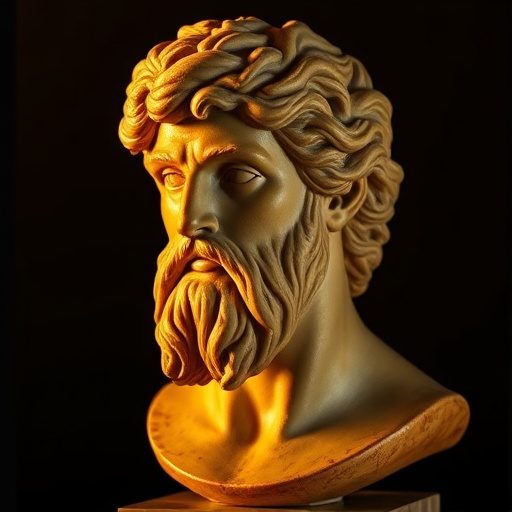
Pythagoras — "All is number."
All is number.
All is number.
Click any product to generate a realistic preview. Up to 3 at a time.
* Initial load can take up to 90 seconds — revising the preview in another color is nearly instant.
"Do not go to bed until you have gone over the day three times in your mind. What did I do wrong? What did I do right? What did I leave undone?"
"The universe is a living creature, endowed with soul and reason."
"The stars in the heavens sing a music if only we had ears to hear."
"The most difficult thing in life is to know yourself."
"The earth is a sphere."
Greek philosopher and mathematician whose school in Croton combined geometry (the Pythagorean theorem), number-mysticism, and a religious-vegetarian way of life. Closely associated with Thales of Miletus (earlier pre-Socratic and the first philosopher). For an intellectual contrast, see Heraclitus, pre-Socratic Greek philosopher of flux — Heraclitus called Pythagoras 'the chief of swindlers' — among the founding insults of the philosophical-rivalry tradition. Their 'all is flux' vs 'all is number' poles still organize the philosophy of mathematics today (Platonist vs anti-realist).
A concise summary of the Pythagorean cosmological view that numbers are the essence of reality.
Date: c. 5th Century BCE
PhilosophicalFound in 1 providers: gemini
1 source checked
Reality at its deepest level is mathematical. Every pattern in music, nature, motion, and form can be described by numerical ratios and relationships. Numbers are not just tools for counting but the underlying structure that gives the universe its order. If you understand the numbers behind something, you understand the thing itself, because quantity, proportion, and ratio are what make existence coherent rather than chaotic.
Pythagoras founded a school that treated mathematics as sacred. He discovered that musical harmony follows whole-number ratios on a vibrating string, which convinced him numerical law governs everything. His theorem on right triangles, his work on proportions, and his belief in the transmigration of souls all rested on the idea that hidden numerical patterns rule matter, sound, and spirit alike, making this line the core thesis of his life's work.
In 6th-century BCE Greece, most thinkers explained the cosmos through myth, gods, or a single physical substance like water or air. Pythagoras lived during the early pre-Socratic shift toward rational inquiry, founding his brotherhood in Croton in southern Italy. Claiming that abstract numbers, not elements or deities, were the true foundation of reality was radical. It helped launch Western mathematics, influenced Plato profoundly, and moved philosophy from storytelling toward proof.
AI-generated insights based on extensive research and information for context. Factual errors? Email [email protected].
Your cart is empty