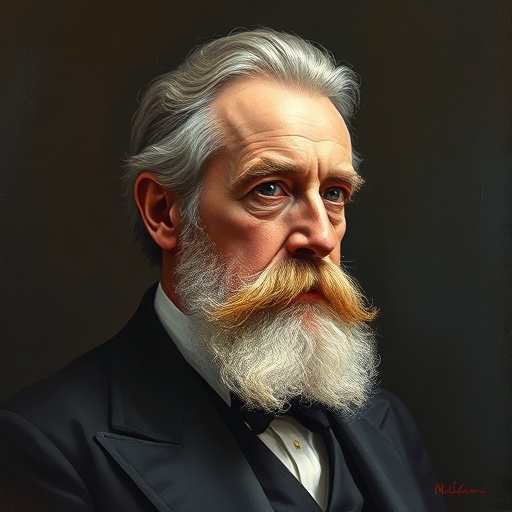
Alexander Graham Bell — "All really big discoveries are the results of thought."
All really big discoveries are the results of thought.
All really big discoveries are the results of thought.
Click any product to generate a realistic preview. Up to 3 at a time.
* Initial load can take up to 90 seconds — revising the preview in another color is nearly instant.
"The invention of the telephone was the result of long and patient investigation."
"Any one, if he will only observe, can find some little thing he does not understand as a starter for an investigation."
"The most important thing is to keep on trying, to never give up."
"The telephone may be used for the transmission of speech, music, and other sounds, but its principal use will be for communication between individuals."
"Man is the result of slow growth; that is why he occupies the position he does in animal life. What does a pup amount to that has gained its growth in a few days or weeks, beside a man who only attain…"
From an address to the graduating class of the Friends' School, Washington D.C.
Date: 1914
PhilosophicalFound in 1 providers: gemini
1 source checked
Major breakthroughs don't happen by accident or pure luck — they require concentrated, sustained mental effort. The insight behind a discovery is the payoff of rigorous thinking done beforehand. This pushes back against the idea that innovation is purely hands-on tinkering. Before you can build something transformative, you must first understand the problem deeply enough in your mind to see the solution clearly.
Bell spent years studying acoustics and speech before inventing the telephone in 1876. Trained in his father's phonetics research and motivated by his deaf mother and wife, he approached invention intellectually — understanding sound-wave transmission theoretically before building hardware. His notebooks show systematic reasoning, not trial-and-error. He held over 18 patents across aviation, hydrofoils, and optical telecommunications, each rooted in deep theoretical inquiry rather than stumbled-upon discovery.
Bell's era — the Second Industrial Revolution of the 1860s–1900s — featured competing visions of invention: Edison's famous trial-and-error model versus rigorous scientific-theoretical approaches. Darwin had recently transformed biology through systematic reasoning. Universities were establishing formal research programs. Society debated whether genius was instinct or intellect. Bell's quote champions disciplined thought at a moment when the romantic myth of the lone tinkerer was clashing with the rise of structured scientific inquiry.
AI-generated insights based on extensive research and information for context. Factual errors? Email [email protected].
Your cart is empty