What it means
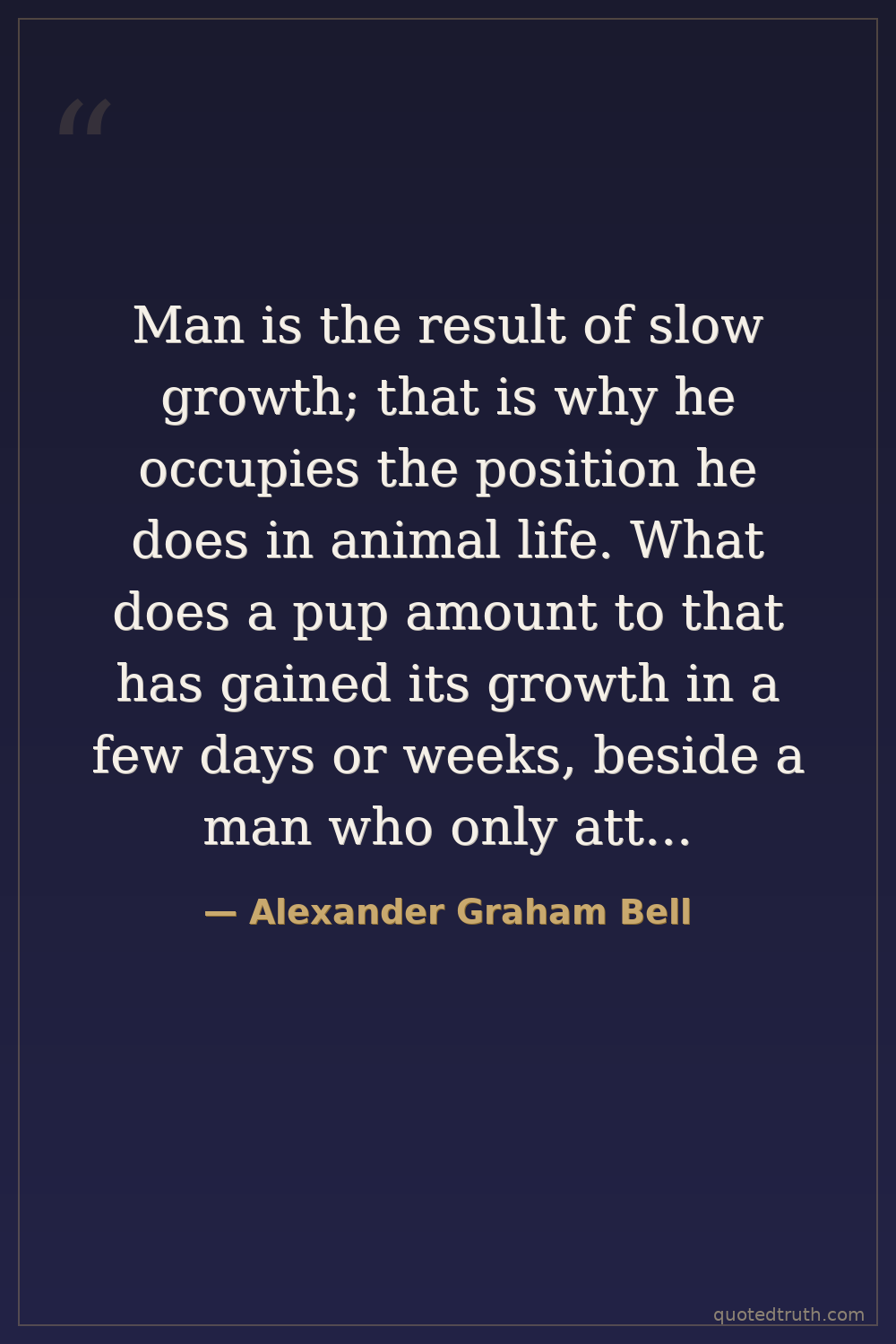
Humans dominate the animal kingdom precisely because they develop so slowly. A puppy reaches full size in weeks, yet amounts to little compared to a human who spends years maturing. That long developmental period — physical, mental, and social — builds the depth and capability that elevates humans above other creatures. Slow growth is not a weakness; it is the mechanism behind human complexity and superiority.
Relevance to Alexander Graham Bell
Bell embodied patient, cumulative development. He spent years studying sound and working with deaf students — his mother and wife were both deaf — before the telephone patent in 1876. No breakthrough came quickly. His later decades were consumed by eugenics research and heredity studies, reflecting a sustained fascination with biological development and what makes humans exceptional. His entire career was a proof-of-concept for slow, iterative growth yielding extraordinary results.
The era
Bell's era was electrified by Darwin's theory of evolution, published in 1859, which repositioned humans within the animal kingdom and sparked fierce debate about what truly distinguished them. Victorian science was obsessed with hierarchy in nature and the mechanisms of human progress. Bell's quote engages directly with that discourse, reframing the slow human maturation period — once seen as vulnerability — as the evolutionary advantage that explains human dominance.
AI-generated insights based on extensive research and information for context. Factual errors? Email [email protected].