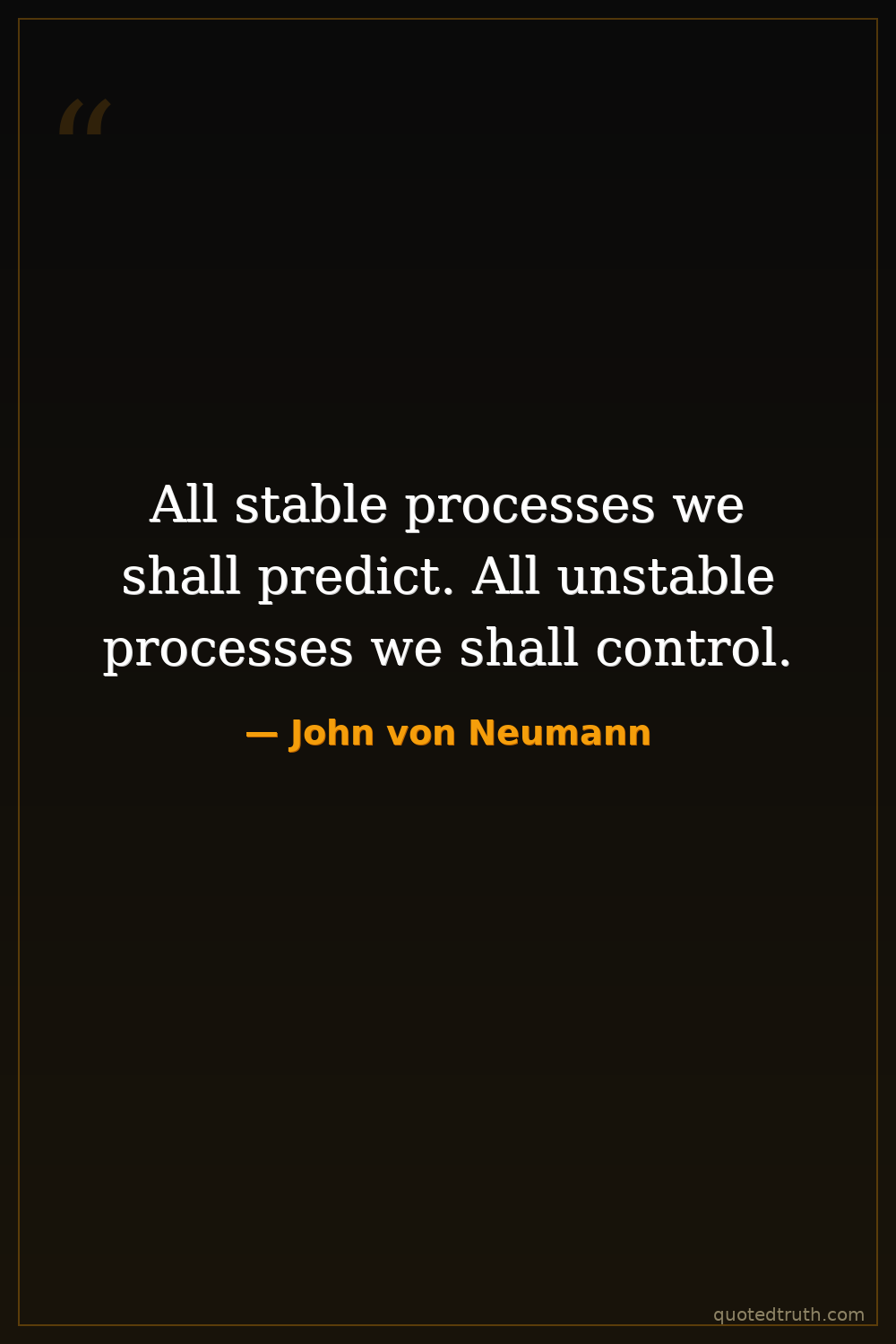
John von Neumann — "All stable processes we shall predict. All unstable processes we shall control."
All stable processes we shall predict. All unstable processes we shall control.
All stable processes we shall predict. All unstable processes we shall control.
Click any product to generate a realistic preview. Up to 3 at a time.
* Initial load can take up to 90 seconds — revising the preview in another color is nearly instant.
"My own feeling is that the most important advances in the future will come from the interaction of mathematics with other sciences."
"In the beginning was the word, and the word was 'bit'."
"The world is not as simple as we would like it to be."
"Anyone who considers arithmetical methods of producing random digits is, of course, in a state of sin."
"The world is governed by statistics, not by laws."
A bold and ambitious statement reflecting a belief in the ultimate power of science and technology to understand and manipulate the world.
Date: Mid-20th century
ShockingFound in 1 providers: gemini
1 source checked
A declaration of total rational mastery over all processes. Systems that behave predictably can be mathematically modeled and forecast with precision. Systems that are chaotic or unstable are not abandoned to chance—they become targets for deliberate intervention and control. The two statements together assert that nothing in nature or human affairs lies beyond the reach of rigorous analysis: the knowable gets predicted, the unruly gets engineered into submission.
Von Neumann's entire career enacted this philosophy. He designed the stored-program computer architecture enabling large-scale prediction. His game theory formalized rational control over strategic, uncertain outcomes. He contributed to the Manhattan Project—literally harnessing unstable nuclear reactions. He pioneered early weather modeling and cellular automata research. His work on the ENIAC and hydrogen bomb both reflected this conviction: that sufficiently sophisticated mathematics could bend any process, however violent or unpredictable, to human will.
Von Neumann worked from the 1930s through the mid-1950s, an era of extraordinary scientific confidence. The Manhattan Project proved humanity could engineer nuclear reactions. Early digital computers promised total predictive power. The Cold War poured massive funding into ballistics, weather modeling, and cryptography. Cybernetics and operations research emerged as disciplines devoted to controlling complex systems. The idea that mathematics could master any process—stable or chaotic—was the defining technological conviction of the postwar scientific elite.
AI-generated insights based on extensive research and information for context. Factual errors? Email [email protected].
Your cart is empty