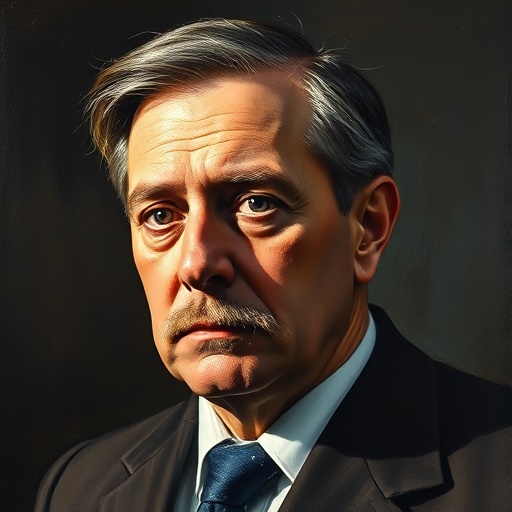
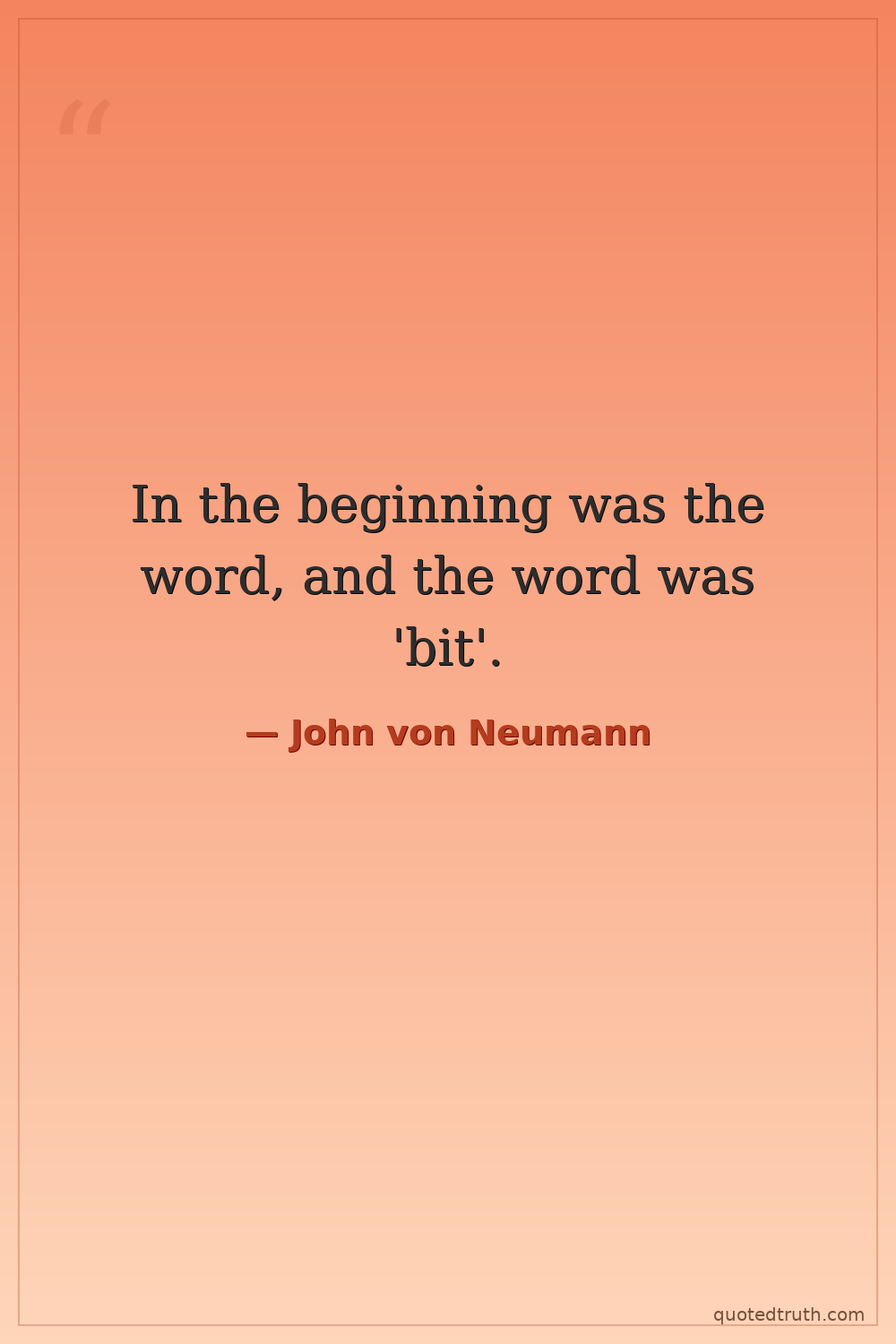
John von Neumann — "In the beginning was the word, and the word was 'bit'."
In the beginning was the word, and the word was 'bit'.
In the beginning was the word, and the word was 'bit'.
Click any product to generate a realistic preview. Up to 3 at a time.
* Initial load can take up to 90 seconds — revising the preview in another color is nearly instant.
"The human brain is an amazing thing. It works from the day you're born until you fall in love."
"I am not a great mathematician; I am merely a good one."
"As far as I'm concerned, the two most important things in life are mathematics and sex."
"My own feeling is that the most important advances in the future will come from the interaction of mathematics with other sciences."
"I'm told that the only difference between a mathematician and a physicist is that a mathematician thinks about mathematics and a physicist thinks about physics. And a physicist is always trying to get…"
A clever play on the biblical quote, often attributed to him in the context of information theory.
Date: 1940s-1950s
GeneralFound in 1 providers: grok
1 source checked
The quote riffs on the biblical 'In the beginning was the Word' (John 1:1), replacing divine Logos with the binary digit—the 'bit.' It proposes that all computation, and by extension modern digital reality, reduces to this single unit: 0 or 1. Everything a computer processes, stores, or communicates ultimately traces back to this indivisible quantum of information. The bit is to computing what the atom is to matter.
Von Neumann architected the stored-program computer—the foundation of virtually every modern machine. He grasped binary logic as the bedrock of digital systems, working alongside Shannon and others formalizing information theory. His EDVAC design established how data and instructions coexist as binary patterns in memory. The wit of a biblical allusion reflects his legendary breadth: a mathematician who moved fluently between quantum physics, economics, weapons design, and the deepest questions of logic.
The mid-20th century witnessed the birth of digital computing. Shannon's 1948 paper formally defined the 'bit' as information's irreducible unit. Von Neumann worked on ENIAC and EDVAC as the first general-purpose electronic computers came online. Cold War pressures—nuclear calculations, cryptography, logistics—accelerated funding. Replacing analog, continuous thinking with discrete binary logic was a philosophical revolution: it meant nature's complexity could, in principle, be encoded, simulated, and manipulated as strings of zeros and ones.
AI-generated insights based on extensive research and information for context. Factual errors? Email [email protected].
Your cart is empty